Collaboration & Productivity Platform+2 more

Elicit
best deal
Try Elicit's free Basic plan with unlimited paper search across 138 million papers, 2 Automated Research Reports per month, and 2 columns per data extraction table.
redeem now
Elicit
best deal
Try Elicit's free Basic plan with unlimited paper search across 138 million papers, 2 Automated Research Reports per month, and 2 columns per data extraction table.
redeem nowWe start with direct ratings from our readers, then look at what real users are saying in practitioner forums and community spaces. We pair that with search demand data and profession-level persona analysis.
Editorial note: this was originally published in june of 2024
quick take
based on real user feedback, community sentiment, pricing value, and fit for target audience. see our full methodology
used Elicit? we'd love to know your thoughts
reader ratings shape our score
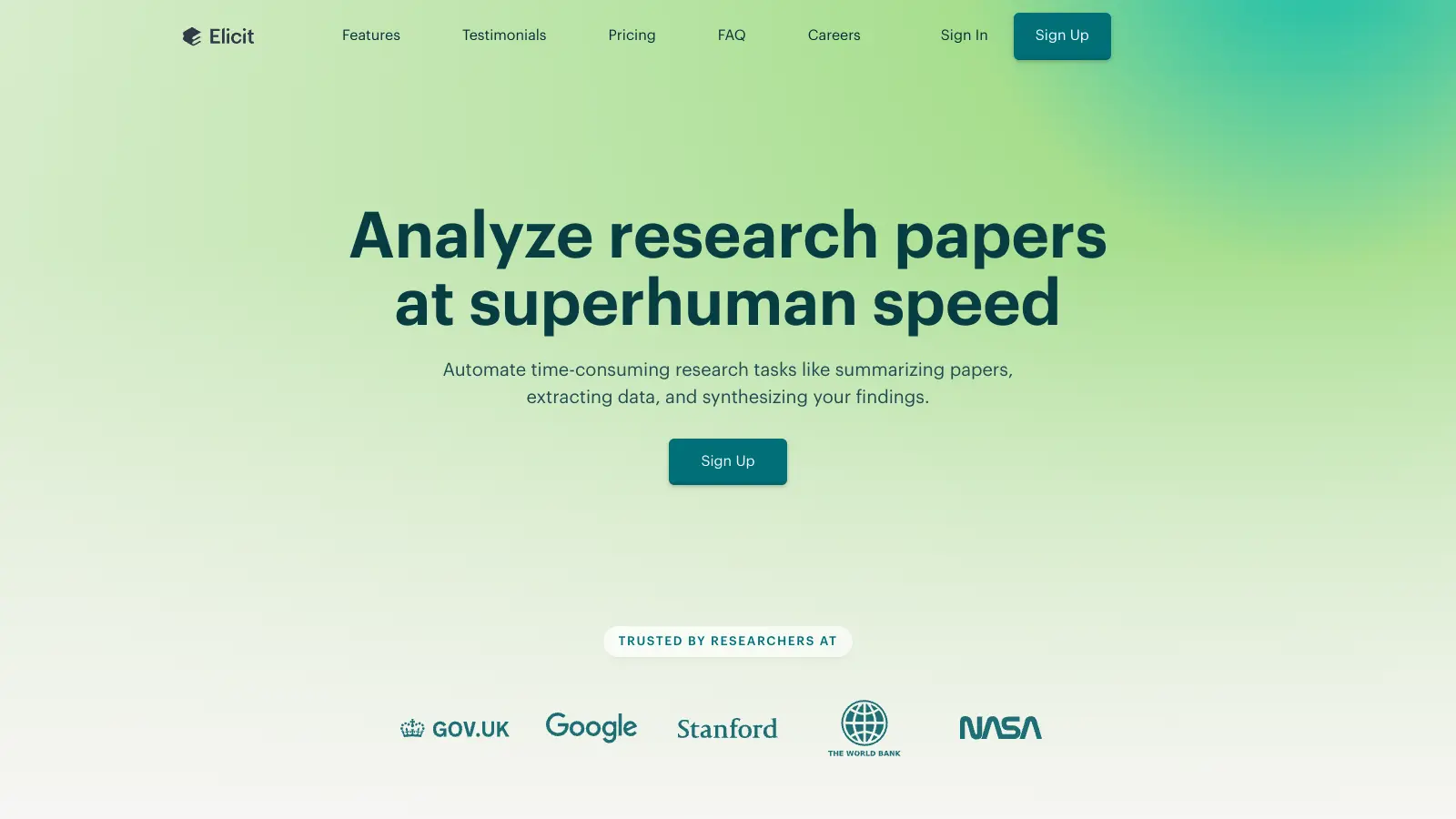
Elicit is an AI-powered research assistant that helps users streamline their academic research process. It finds relevant papers, pulls out important information, and helps make sense of complex data.
The platform uses language processing to understand research queries. It can search through 138 million academic papers from Semantic Scholar and other sources, using semantic similarity matching to identify relevant papers even without exact keyword matches. It creates summaries of key findings and can even help with systematic reviews. For organizing your work, it connects with reference management tools like Zotero.
Elicit handles literature reviews, data extraction from PDFs, and detailed research summaries. The Research Agent feature on Pro and higher plans can search beyond academic publications to include clinical trial data, regulatory documents, and press releases. The tool also offers team features for collaborative research projects.
The service comes with several pricing options. While there's a free basic plan for casual users, paid plans start at $12 per month for independent researchers. More comprehensive plans are available for professional researchers and teams who need advanced features and collaborative tools.
monthly search interest
90.5k/mo now
Elicit's search volume has been broadly stable for three years, oscillating between 50,000 and 110,000 monthly searches without a clear upward or downward trend. The pattern suggests a tool that has found its core audience among researchers and graduate students but hasn't crossed into mainstream adoption. That's not a warning sign: it means you're getting a product built for a specific community rather than one chasing viral growth, and the user base is stable enough that the tool isn't going anywhere.
Elicit works very differently depending on whether you're doing occasional literature searches or running a full systematic review. Find your role below to see whether it's worth the cost for your situation.
overall sentiment
select your role to see what people like you are saying
Academic Researcher
positiveIf you're doing regular literature reviews in a specialized field, Elicit's semantic search is genuinely better than keyword-based tools for surfacing relevant papers you'd otherwise miss. The automated summarization saves real time. At $84/year for Plus, it's reasonable if you're using it weekly, but you'll want to verify results against other databases rather than treating Elicit as exhaustive.
strengths
concerns
Graduate Student
mixedElicit helps with the hardest part of dissertation research: finding relevant papers in a niche area fast. The free tier is too restricted to build a real workflow around, though, and the PDF upload feature being paywalled means you can't analyze papers you already have without upgrading. Unless your institution covers the cost, you'll hit the pay wall before you've got enough value to justify it.
strengths
concerns
Systematic Reviewer
positiveThis is where Elicit earns its keep. The automated screening, structured data extraction across up to 5,000 papers, and custom extraction columns address the most time-consuming bottlenecks in evidence synthesis. You still need to run complementary database searches for methodological rigor, since search accuracy isn't reliable enough to stand alone, but as a workflow accelerator for the screening and extraction phases, Pro at $348/year is defensible.
strengths
concerns
Independent Scholar
mixedWithout institutional database access, Elicit's search across 138 million papers is genuinely useful and the semantic matching beats Google Scholar for niche topics. The Plus plan at $84/year is the realistic minimum for meaningful use. The main catch: you're paying out of pocket with no institutional IT support, so when something breaks or a methodological question comes up, you're on your own with async-only customer service.
strengths
concerns
“The free tier is too restricted to give you a real sense of the tool's value, which means you're being asked to pay before you've had a fair trial.”
Community discussion about Elicit on Reddit sits in a productive but cautious middle ground. In r/MachineLearning, researchers are still wrestling with whether dedicated literature review tools actually beat the old workflow of Google Scholar plus ChatGPT, which suggests Elicit hasn't yet become the obvious default even among technically sophisticated users. In r/PhdProductivity, the recurring theme is tool overwhelm: too many AI research assistants launching with bold claims, and not enough clarity on which ones are actually worth paying for. Elicit comes up in these threads as a genuine option, but the free tier's tight limits push users toward the paid plan faster than many expect, and that creates friction for the exact audience most likely to try it. The pricing has also shifted: the Plus plan sits at $84/year (billed annually), and Pro at $348/year, which is a meaningful jump for anyone without an institutional budget covering the cost.
It depends on which tier and how often you use it. The free Basic plan gives you 2 automated reports per month, which isn't enough to build a real workflow around. The Plus plan at $84/year (billed annually) makes sense if you're doing regular literature work and need more than 4 reports per month and proper export options. Pro at $348/year is only worth it if you're running systematic reviews with large paper sets, where the 5,000-paper screening workflow and 20-column extraction tables justify the cost. Casual or occasional researchers will hit a wall on the free tier quickly.
Systematic reviewers and academic researchers doing large-scale evidence synthesis get the most out of it. The automated screening and extraction tools directly address the most time-consuming parts of their work. Graduate students doing dissertation research benefit from the semantic search, but the paywalled PDF upload and tight free tier limits mean it's a harder sell unless their institution covers the cost.
Two stand out. First, search accuracy isn't reliable enough to use without verification: it occasionally misses relevant papers and returns false positives, which is a serious problem if you're doing a systematic review that needs to be defensible. Second, very recent papers and preprints aren't reliably indexed, so if your field moves fast, you'll still need supplementary searches elsewhere. Customer support is limited to async channels, which creates problems when you hit a methodological question mid-review.
Consensus is better for quick yes/no questions about the state of evidence on a topic, with a cleaner interface for non-expert users. Elicit is better when you need to do actual structured work: data extraction tables, systematic screening, custom columns, and batch processing of hundreds of papers. If you're writing a dissertation or systematic review and need to extract structured data across many papers, use Elicit. If you want a fast answer to a research question without building a full review, Consensus is quicker.
Not as your only search source. Systematic reviewers using Elicit should treat it as one layer in a multi-database search strategy, not a replacement for PubMed, EMBASE, or Cochrane. The search accuracy inconsistencies are enough of a concern that any published review using Elicit alone would face legitimate methodological criticism. Use it to speed up screening and extraction once you've run your primary searches, not to replace them.
toolsforhumans editorial team
Reader ratings and community feedback shape every score. Since 2022, ToolsForHumans has helped 600,000+ people find software that holds up after launch. how we research →

ChatGPT is an AI chatbot by OpenAI that uses language models to hold conversations, generate content, and complete tasks. It includes web browsing, image generation and analysis, voice interaction, autonomous task automation, and custom GPT creation. Available in multiple pricing tiers from free to enterprise, ChatGPT handles creative writing, data analysis, coding, and real-world automation.
best deal
Try ChatGPT Free: Basic AI conversations with GPT-5.2 Instant access (around 10 messages every 5 hours) at no cost.

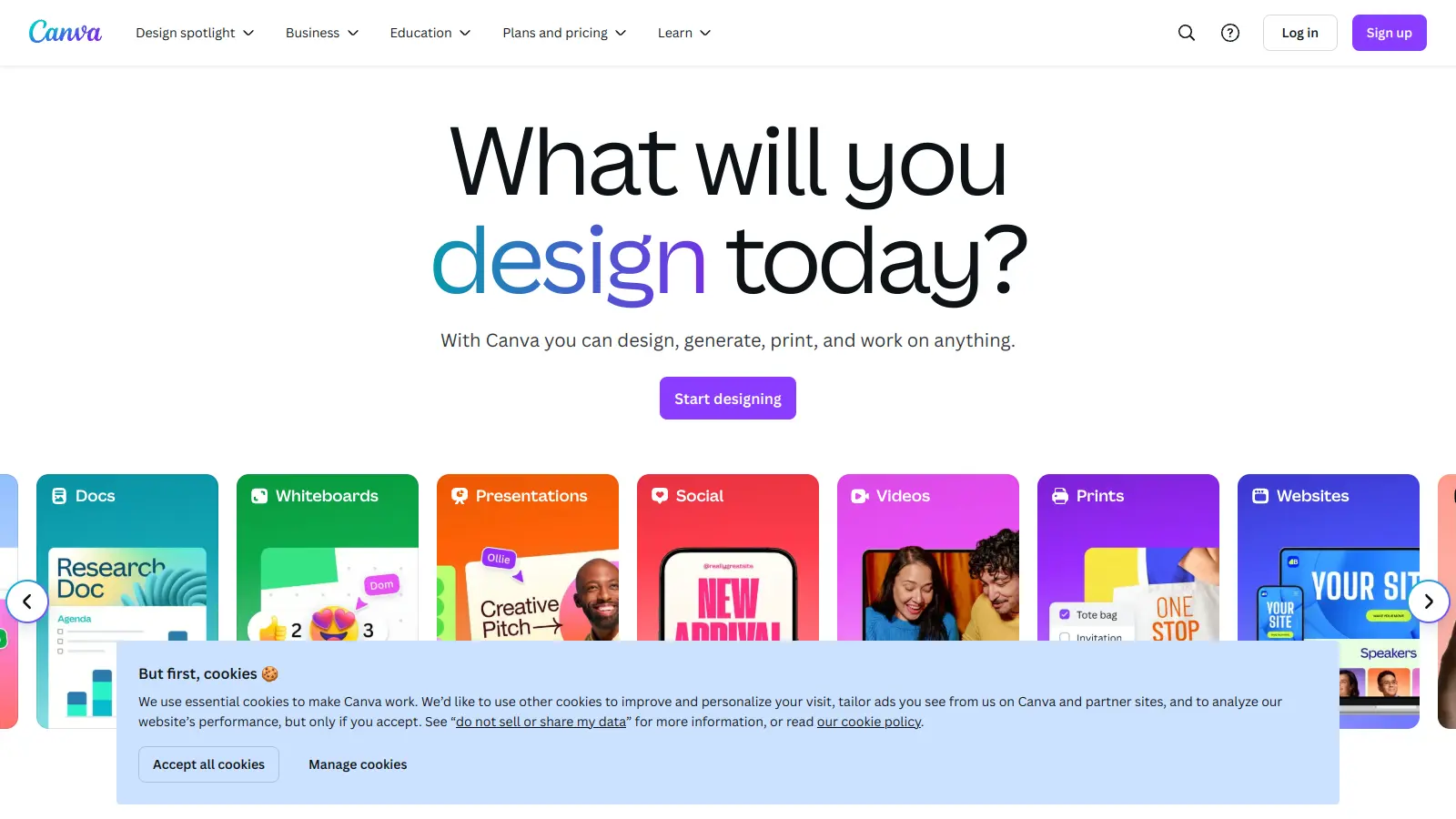
Canva is a graphic design platform that lets individuals and professionals create designs without advanced design skills. It offers hundreds of thousands of templates, design tools, collaboration features, and photo/video editing capabilities. With both free and pro versions, Canva provides access to millions of design elements for creating social media graphics, presentations, posters, and more through its drag-and-drop interface.
best deal
Get 50% off Canva Pro or Business plans for new customers, or try Canva free with 250,000+ templates and 5GB storage

Gemini is an advanced AI assistant by Google that processes text, code, images, audio, and video across Google's ecosystem. It offers content creation, coding assistance, research capabilities, and workflow automation through the Gemini app, web interface, and integrations with Google Workspace, Pixel phones, and Chrome.
best deal
Google AI Plus: Get 50% off at $3.99/month for the first 2 months (new subscribers); Google AI Pro: Try free for one month.

Microsoft 365 Copilot is an AI-powered productivity tool that integrates seamlessly with Microsoft 365 apps like Word, Excel, PowerPoint, and Outlook. It uses advanced language models and Microsoft Graph to provide intelligent, context-aware suggestions, automate tasks, and enhance collaboration by generating content, analyzing data, and offering real-time insights across various work processes.
best deal
Try Copilot Free: Experience basic AI assistance without Office integration

Claude is an AI assistant developed by Anthropic that handles coding, writing, and analysis tasks. It uses Constitutional AI for safety-focused interactions, supports multiple languages, and offers models like Sonnet and Opus with different capabilities. Claude prioritizes user privacy and context-aware responses.
best deal
Try Claude Free - 30-100 daily messages with code generation, image analysis, web search, and access to Claude's latest models

Grammarly is an AI-powered writing assistant that provides real-time grammar, spelling, and punctuation checks, tone adjustments, and generative AI features for composing, rewriting, and proofreading text. It integrates with platforms like Google Docs, Gmail, Microsoft Word, Slack, and web browsers, offering both free and paid versions with features ranging from basic corrections to plagiarism detection and AI writing tools.
best deal
Try Grammarly's Free Version Today - Get Basic Grammar Checks & 100 AI Prompts Per Month Across Your Favorite Apps