Best AI Tools for Video Editing: Top Picks for Creators (2026)
7 tools reviewedlast reviewed 20 march 2026
Editorial note:this was originally published in september of 2023
AI video editing tools have moved well past auto-captions and silence removal. The better ones now handle rough cuts, transcript-based editing, clip extraction, and branded video workflows — cutting hours off production time without requiring a professional editor.
This list covers tools for different stages of the video workflow: editing long-form footage, repurposing content for social, and building polished output from scratch. Each pick is chosen based on pricing clarity, specific feature value, and how well it fits real production tasks.
Whether you're a solo creator managing a YouTube channel or a marketing team producing weekly video content, there's a specific tool here for your situation.
We collect first-hand reviews from people who use these tools every day — what works, what doesn't, whether it's worth paying for. We research pricing, features, and comparisons so that feedback has real context behind it. For this page, tools were selected based on speed, output quality, and whether they reduce manual editing time for common video tasks. Read our full research methodology.
help us improve this guide
tell us what you're looking for, what you're using now, and what caught your eye — takes 30 seconds.
What are AI video editing tools?
AI video editing tools are software applications that use machine learning to automate or assist with tasks in the video post-production process. This includes transcript-based editing, automatic clip selection, caption generation, background noise removal, and content repurposing for different platforms.
They're used by content creators, marketers, journalists, and video producers who need to produce video faster without a full editing team. The core problem they solve is time: manual editing of long-form footage is slow, and AI can handle the repetitive and structural parts of that work.
These tools range from lightweight browser-based editors to desktop apps capable of handling multi-camera interview footage. The best ones fit into an existing workflow rather than replacing it entirely.
Turns blog posts and scripts into short branded video clips.
Content teams repurposing written content into video
PaidFrom $25/mo
our top pick
1
Descript
Edit video by editing its transcript, not a timeline.
Freemium
Best for · Podcast editors and interview-based content creatorsPricing · Free plan available; paid from $24/mo
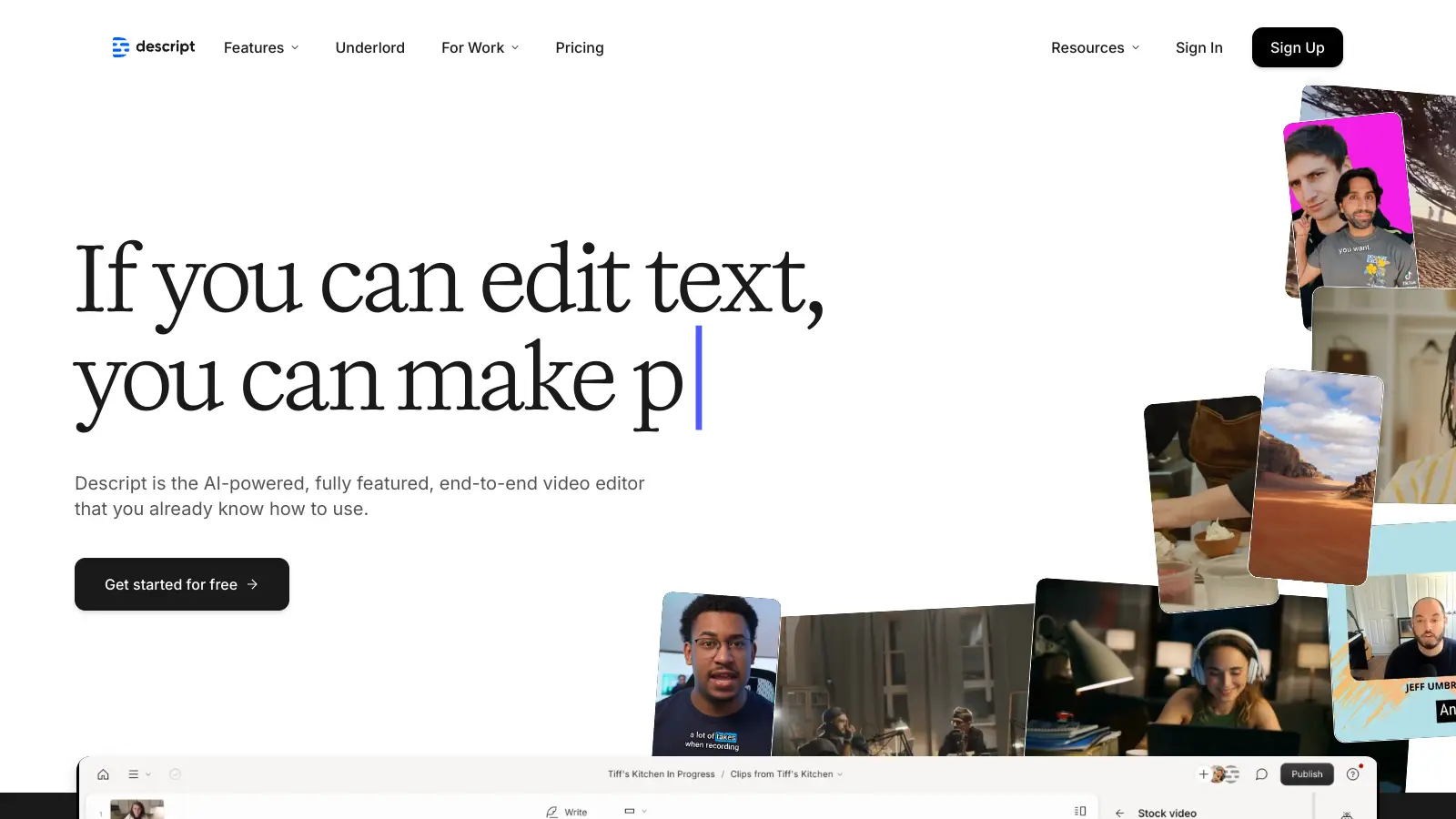
Descript transcribes your footage and lets you cut video by deleting text, making it accessible to anyone who finds traditional timelines confusing. It also handles filler-word removal, background noise cleanup, and screen recording. Overdub lets you generate new voiceover in your own voice to correct mistakes without a re-record session.
Pros
✓Transcript editing removes need to scrub timelines
Extracts short clips from long videos, ranked by virality score.
Freemium
Best for · Creators repurposing long-form content for socialPricing · Free plan available; paid from $19/mo
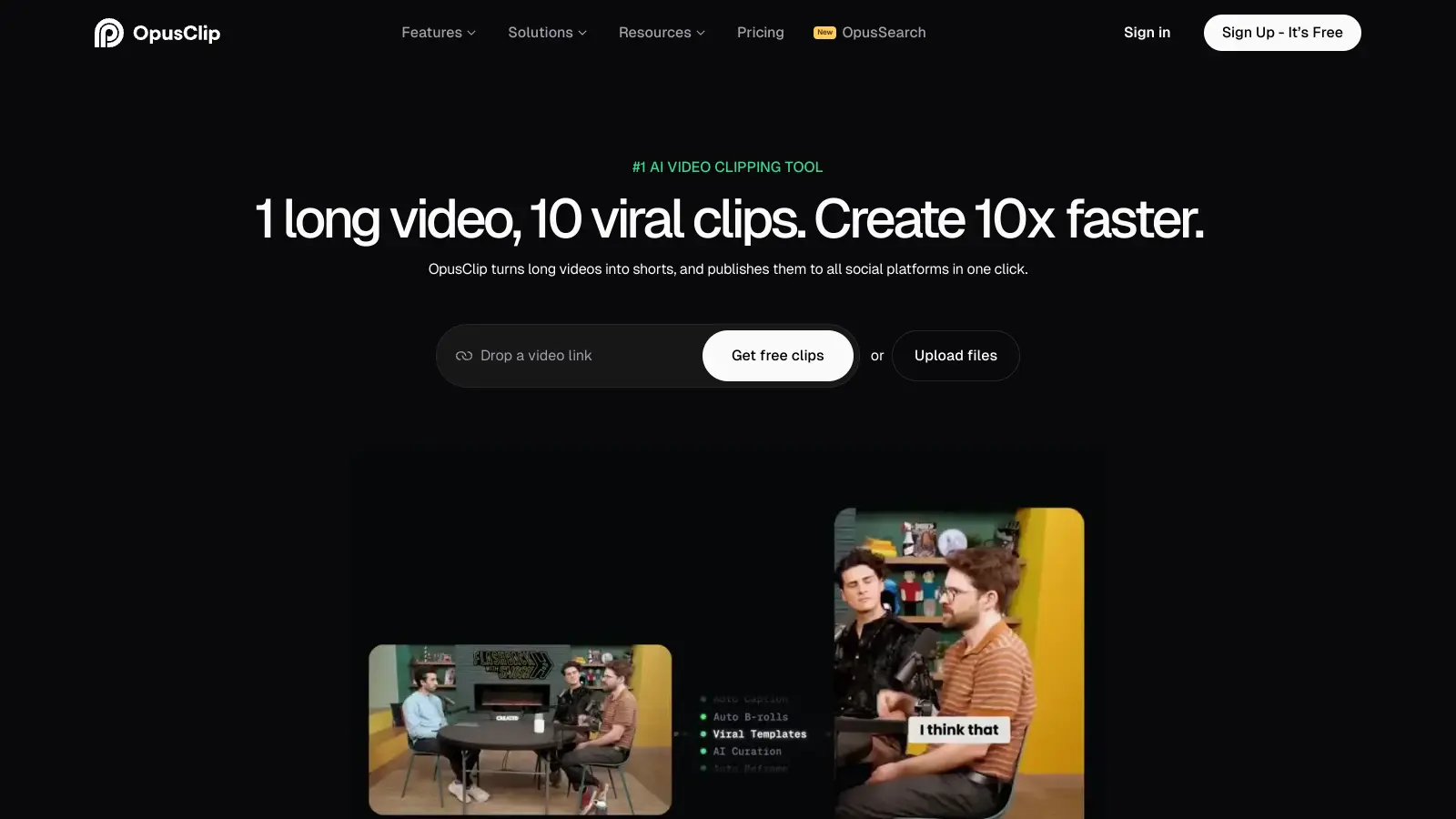
OpusClip takes a long video (or a YouTube URL) and automatically identifies and extracts the most engaging short segments for social media. Each clip gets a virality score, auto-generated captions, and can be reformatted for vertical or square aspect ratios. It's purpose-built for repurposing, not general editing.
Pros
✓Accepts YouTube URLs, no upload needed
✓Virality scoring helps prioritise which clips to use
A browser-based editor with strong AI caption and cleanup tools.
Freemium
Best for · Marketing teams and solo creators working in-browserPricing · Free plan available; paid from $25/mo
VEED is a web-based video editor with a clean interface and a solid set of AI features including auto-subtitles, noise removal, eye contact correction, and a text-to-video tool. It's well-suited for marketing teams and solo creators who want a capable editor without installing software. The subtitle accuracy is consistently strong across accents.
Pros
✓Auto-subtitles accurate across multiple accents
✓Eye contact correction is genuinely useful for talking heads
✓No software installation required
Cons
✗Free plan adds a watermark to exports
✗Timeline editing is basic compared to desktop editors
An AI assistant editor that builds rough cuts from interview footage.
Freemium
Best for · Documentary and long-form interview editorsPricing · Free trial available; pricing on request for full plans
Eddie AI ingests long interview or documentary footage, transcribes it, and builds a structured rough cut using a four-part story framework. It's a desktop app for Mac and Windows, and it handles multi-camera interview footage reasonably well. The rough cuts need editorial review, but they save significant time at the logging and assembly stage.
Pros
✓Handles multi-camera interview footage
✓Story framework structures the rough cut automatically
Text-prompt video creation with editable scripts and voiceovers.
Freemium
Best for · Marketers creating video content from written briefsPricing · Free plan available; paid from $25/mo
InVideo AI generates complete videos from text prompts, with a script, media, voiceover, and music included. You can then edit any element by typing a command in the Magic Box, which adjusts scenes, swaps clips, or changes the voiceover without a timeline. It has a wide range of styles and a library of 50-plus workflow templates.
Pros
✓Text-command editing removes need for timeline skills
✓Realistic voiceovers across many accents and languages
✓50+ style workflows cover most marketing formats
Cons
✗Output quality depends heavily on prompt clarity
✗Less suited to editing footage you've already filmed
A traditional video editor with AI tools layered on top.
Freemium
Best for · Creators who want a full editor with AI assistancePricing · Free plan available; paid from $49.99/yr
Filmora is a full-featured video editor with AI additions including motion tracking, noise removal, smart cutout, and an AI text-to-video feature. It sits between consumer and professional territory — more capable than browser-based tools, less complex than Premiere Pro. The AI features are genuinely integrated rather than bolted on.
Pros
✓Full timeline editor with multi-track support
✓AI motion tracking and smart cutout work well
✓Annual plan is competitively priced
Cons
✗Free version adds a watermark to exports
✗AI text-to-video feature is weaker than dedicated tools
Turns blog posts and scripts into short branded video clips.
Paid
Best for · Content teams repurposing written content into videoPricing · From $25/mo
Pictory is built for content repurposing: paste in a blog post, article, or script, and it generates a video with matching stock footage, captions, and voiceover. It's particularly useful for teams that produce a lot of written content and want a video version without a separate production step. Auto-highlight extraction from long videos is also included.
Pros
✓Blog-to-video conversion is fast and functional
✓Large stock footage library included
✓Auto-highlight extraction works on long recordings
Some tools are built for long-form interview and documentary content, while others are optimised for repurposing existing videos into short social clips. Match the tool to your source material — a talking-head interview workflow is very different from extracting highlights from a webinar.
Do you need browser-based or desktop access?
Browser-based tools like VEED and InVideo are accessible anywhere and require no installation, but desktop apps like Descript and Eddie AI typically handle larger files and more complex timelines better. If you're regularly working with hour-long recordings, desktop usually wins.
How much control do you need over the final cut?
AI-generated rough cuts save time but always need review. Check whether the tool gives you a proper editing interface after the AI pass, or whether it only exports a finished file you can't meaningfully adjust.
What's the output format and quality ceiling?
Most tools export to 1080p; some go to 4K. Check whether the free or entry tier restricts resolution or adds watermarks, since these limits affect what you can actually publish without upgrading.
Does it handle audio as well as video?
Good video editing almost always involves audio cleanup. Tools that include noise removal, filler-word deletion, and voice enhancement in the same package save you from juggling multiple apps. Descript and VEED both handle audio within the same editor.
frequently asked questions
An AI video editor works with footage you already have, helping you cut, caption, repurpose, or clean it up. An AI video generator creates video from text prompts or images without any source footage. Some tools, like InVideo, do both. If you have existing footage to work with, you want an editor. If you need to create video from scratch, you want a generator.
Free tiers exist for most tools, but they usually come with watermarks, resolution caps, or export limits. Paid plans typically start between $12 and $30 per month for individual creators, with team plans ranging from $50 to $150 per month. Tools aimed at professional workflows like Eddie AI use consumption-based or project-based pricing.
Most of the tools on this list are designed for non-editors. Descript in particular treats video editing like text editing, so anyone comfortable with a word processor can use it. That said, tools that generate rough cuts automatically still require review — the AI won't catch every bad take or pacing issue.
Choosing based on the AI feature list rather than the editing interface. A lot of tools have impressive AI features but a clunky editing experience once the AI pass is done. Always check how much control you have over the output after the automated step.
Most accept standard video formats (MP4, MOV, MKV) and work with footage from any source. Some tools like OpusClip also accept YouTube or podcast URLs directly, skipping the upload step. Check file size limits on free tiers — many cap uploads at 1-2GB, which won't cover long 4K recordings.
tools for humans
toolsforhumans editorial team
Reader ratings and community feedback shape every score. Since 2022, ToolsForHumans has helped 600,000+ people find software that holds up after launch. The picks here come from that.