No Code Development Platform+2 more

Codeium
best deal
Start with the Free Version - Unlimited AI Code Completion, 70+ Languages, No Credit Card Needed
redeem now
Codeium
best deal
Start with the Free Version - Unlimited AI Code Completion, 70+ Languages, No Credit Card Needed
redeem nowWe start with direct ratings from our readers, then look at what real users are saying in practitioner forums and community spaces. We pair that with search demand data and profession-level persona analysis.
Editorial note: this was originally published in january of 2023
quick take
based on real user feedback, community sentiment, pricing value, and fit for target audience. see our full methodology
used Codeium? we'd love to know your thoughts
reader ratings shape our score
Codeium is an AI coding assistant that helps developers write and manage code more efficiently. It works alongside popular development environments like Visual Studio Code, IntelliJ, and PyCharm to provide real-time coding support.
At its core, the tool offers intelligent code completion that understands context and can suggest both single-line and multi-line code snippets. Developers can chat with the AI directly in their editor to solve problems, refactor code, or generate documentation. It also includes smart search capabilities to help navigate through large codebases quickly.
Security remains a priority, with no training occurring on private code. The platform supports more than 70 programming languages, including Python, JavaScript, Java, and C++. While the free version provides access to core features, paid plans starting at $15 per month unlock advanced capabilities like expanded context awareness and priority access to larger AI models.
The tool fits naturally into existing development workflows, whether you're working solo or as part of a team. It helps reduce repetitive tasks and catches potential errors early, letting developers focus on solving complex problems rather than getting caught up in routine coding tasks.
monthly search interest
5.4k/mo now
Codeium grew steadily from late 2022 through mid-2024, then spiked sharply in August 2024 when it launched the Windsurf editor, pulling in a much wider audience. Since that peak it has dropped roughly 80%, settling back toward pre-spike levels. That kind of pattern usually means the core product is solid but the viral moment has passed: you're now looking at the real user base, not the hype wave, which is actually a reasonable time to evaluate it.
Whether Codeium is worth it depends heavily on where you are in your career and how you're planning to use it. Pick your role below to see the honest breakdown.
overall sentiment
select your role to see what people like you are saying
Senior Software Engineer
positiveCodeium's autocomplete is genuinely strong at this level, with repository context awareness that surfaces relevant suggestions more reliably than GitHub Copilot at a fraction of the cost. The free tier is hard to argue with if you're mainly after fast, intelligent completions. The main frustration is model diversity: when you need architectural-level reasoning or want to swap in a specific model, you're stuck with what Codeium offers.
strengths
concerns
Junior Developer
positiveIf you're learning to code, Codeium's free tier removes every financial barrier while giving you real-time suggestions across 70+ languages. That's genuinely useful when you're bouncing between Python, JavaScript, and whatever the tutorial demands. The downside is the documentation gaps: when the extension misbehaves, it can be hard to tell whether the problem is the tool or your own setup.
strengths
concerns
Team Lead / Engineering Manager
mixedThe cost savings are real at scale, and the multi-language support means one tool covers most of your team's stack. But the VS Code extension bugs and thin documentation will land back on your desk as support tickets, and that overhead can eat the savings quickly. Hold off on org-wide rollout until the extension stability improves, or budget time for a proper onboarding process.
strengths
concerns
Open Source Contributor
positiveFor open source work where you're jumping across unfamiliar codebases, Codeium's repository context awareness is a genuine asset, and the free tier means there's no cost barrier for side projects. The limited model options and occasional extension instability are minor friction at this level of use, not dealbreakers.
strengths
concerns
“AI-assisted IDEs fail in 73% of enterprise deployments above 15,000 lines, and Codeium's missing security certifications and architectural-level dependency tracking are exactly why you should not roll this out to a large team without doing the homework first.”
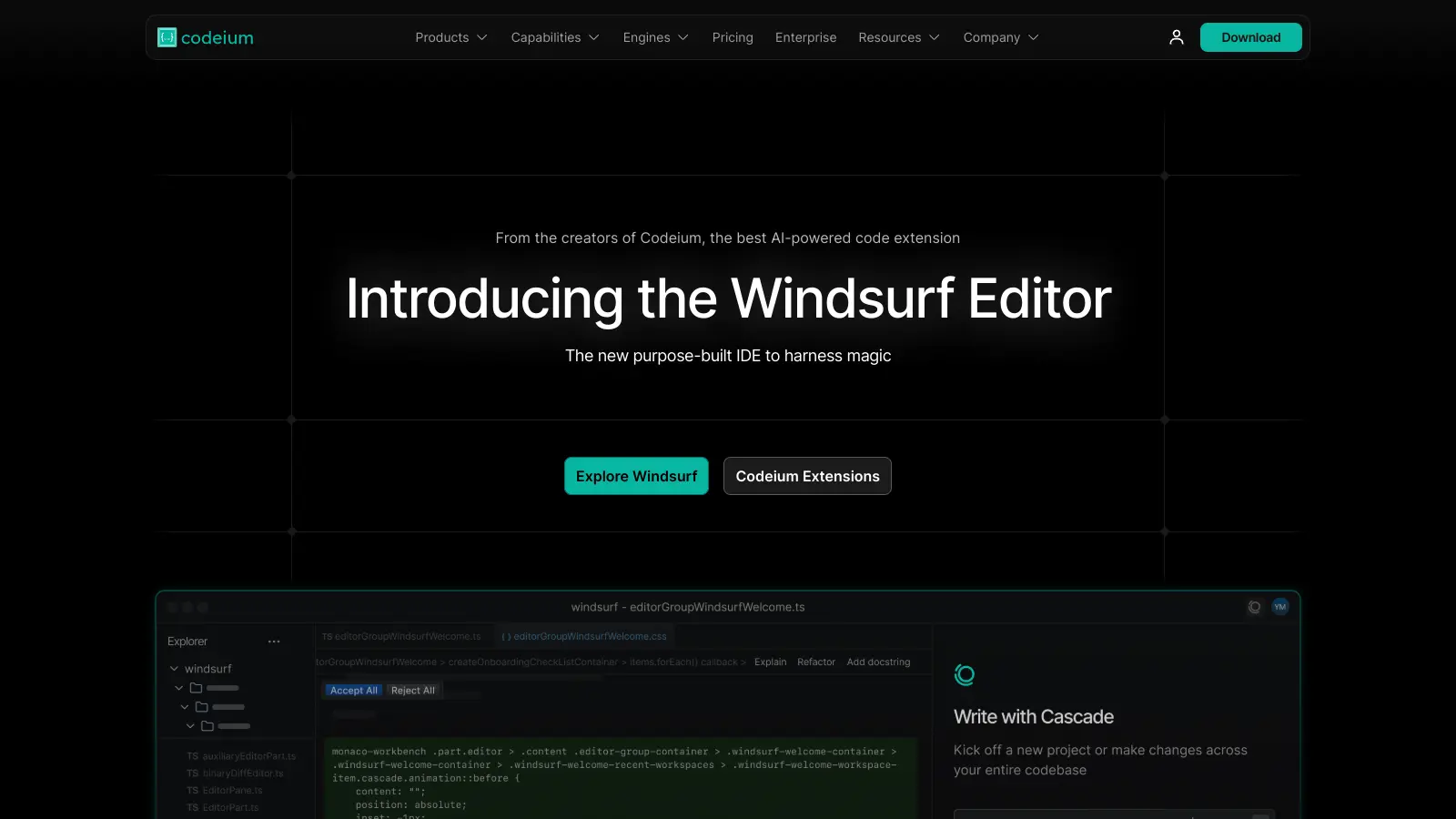
Community discussion around Codeium has shifted significantly since the product rebranded its editor as Windsurf in late 2024. Comparative guides from independent sources consistently position it as the strongest free-tier option in the AI coding assistant space, with autocomplete quality frequently cited as matching or beating GitHub Copilot at no cost. The main criticism that surfaces across discussions is around VS Code extension instability and documentation gaps that leave developers troubleshooting without much support. One detailed guide notes that AI-assisted IDEs fail in 73% of enterprise deployments above 15,000 lines due to missing security certifications and architectural-level dependency tracking, which is a real concern for anyone evaluating Codeium at scale. The rebrand to Windsurf has also created some confusion, with developers unsure whether they're evaluating the standalone plugin, the Windsurf editor, or a combination of both.
The free tier is worth it unconditionally for individual developers. You get unlimited autocomplete across 70+ languages with no credit cap, which is more than most paid alternatives offered two years ago. The Pro plan at $15/month is only worth it if you're regularly hitting context length limits or need faster response times during heavy sessions. Most developers won't need it. The Pro Ultimate at $60/month is hard to justify unless you're doing serious agentic workflows through Windsurf.
Junior developers get the most value here: the free access removes financial barriers, and the real-time suggestions act as a learning scaffold across multiple languages. Senior software engineers who want Copilot-level autocomplete without the subscription cost are the other strong fit. Team leads considering org-wide rollout should approach with caution given the extension stability issues and documentation gaps.
The VS Code extension has recurring stability bugs that require workarounds, which is frustrating for experienced developers and actively confusing for beginners. Documentation is incomplete, so when something breaks or behaves unexpectedly, you're largely on your own. AI model diversity is limited, meaning you can't swap in a different model for complex architectural decisions the way you can with some competitors. Enterprise deployments at scale face real security certification and dependency tracking gaps.
If cost is a constraint or you're working solo, choose Codeium. The free tier is unmatched and the autocomplete quality is comparable. If you're working on a larger codebase, need reliable extension stability, or are rolling out to a team, Cursor is the better call. Cursor's documentation and IDE experience are more polished, and at $20/month the per-seat cost is justifiable if extension bugs would cost you more in lost time.
Honestly, they might. The extension issues are consistent enough to appear across multiple independent reviews, not just isolated reports. For a senior developer, a quick reinstall or config tweak is a minor annoyance. For a junior developer learning the tools, an unexpected extension failure can be hard to distinguish from a mistake in your own code, which is a real problem. If you rely on VS Code heavily, test it for a week before committing to it as your primary assistant.
toolsforhumans editorial team
Reader ratings and community feedback shape every score. Since 2022, ToolsForHumans has helped 600,000+ people find software that holds up after launch. how we research →

Shopify is an e-commerce platform that enables businesses of all sizes to create, manage, and grow online stores. It offers tools for store creation, product management, payment processing, and multichannel sales, supporting both online and in-person transactions. With customizable themes, extensive app integrations, and flexible pricing plans, Shopify caters to entrepreneurs, small businesses, and global brands.
best deal
Get Shopify Basic for $29/month when billed annually (regularly $39/month)

Wix is a website builder that lets individuals and businesses create professional websites without coding. It offers drag-and-drop editing, AI-powered design tools, templates, and features for e-commerce, SEO, and marketing. Pricing ranges from free to enterprise-level, covering everything from personal portfolios to online stores.
best deal
Get 50% off Wix annual plans, with Light Plan starting at $17/month

Jotform is an AI-powered form builder that enables individuals and businesses to create, customize, and manage digital forms, apps, and workflows without coding skills. It offers a drag-and-drop interface, 10,000+ templates, payment integrations, AI agents for customer support, and connects with over 1,000 apps. The platform provides conditional logic, form analytics, and robust security, making data collection and workflow automation simple across industries.
best deal
Try the Starter plan for free with 5 forms, 100 monthly submissions, and all standard features. Nonprofits and educational institutions get 50% off paid plans.

Replit is an AI-powered cloud-based integrated development environment (IDE) that supports over 50 programming languages, offering real-time collaboration, AI assistance through Replit Agent that can build complete applications from natural language prompts, and direct application deployment. It provides a platform for developers of all levels, enabling coding, project sharing, and hosting directly from a web browser with pricing tiers from free to enterprise-level plans.
best deal
Teams users automatically upgraded to Pro at no additional cost for remainder of term; yearly Teams subscribers get $100 monthly credits free until term ends

Dora is a no-code AI platform that enables users to create dynamic, 3D animated websites without coding knowledge. It offers AI-driven design assistance, seamless 3D integration, and a user-friendly interface similar to Figma. The tool allows for easy customization, responsive design, and incorporates advanced features like automated design tasks and 3D model incorporation, making web design more accessible to beginners and professionals alike.
best deal
Try Dora AI Free - Unlimited projects with AI website building, 3D animation, and responsive design.

Zapier is a no-code automation platform that connects over 8,000 apps, enabling users to create automated workflows called "Zaps" without coding. It integrates different services, automating repetitive tasks through customizable triggers, multi-step processes, and real-time data transfer. Pricing ranges from free to enterprise tiers.
best deal
Start automating with unlimited Zaps and 100 monthly tasks free – no credit card needed