Best 3PL Warehouse Management Software for Logistics Teams (2026)
7 tools reviewedlast reviewed 20 march 2026
Editorial note:this was originally published in august of 2024
Running a 3PL warehouse means managing inventory, billing, and compliance for multiple clients simultaneously, each with different SLAs, labeling rules, and order workflows. Generic warehouse software breaks under that load. This list covers tools built specifically for that environment, or enterprise platforms with enough configurability to handle it.
The seven tools here were selected across a range of operational scales, from growing mid-market 3PLs onboarding their first major retail client to large fulfillment networks managing dozens of accounts across multiple sites. Pricing, client portal quality, billing automation, and integration depth were the primary criteria.
If you're replacing a legacy ERP-based setup or evaluating purpose-built 3PL WMS for the first time, the breakdowns below will tell you what each system actually does well and where it falls short.
We collect first-hand reviews from people who use these tools every day — what works, what doesn't, whether it's worth paying for. We research pricing, features, and comparisons so that feedback has real context behind it. For this page, prioritisation was given to software offering real-time inventory tracking, multi-location management, and API integrations with order management systems. Read our full research methodology.
help us improve this guide
tell us what you're looking for, what you're using now, and what caught your eye — takes 30 seconds.
What is 3PL warehouse management software?
A 3PL warehouse management system (WMS) is software built for third-party logistics providers who store and fulfill orders on behalf of multiple client companies. Unlike standard WMS tools designed for a single brand, 3PL WMS handles multi-tenant inventory segregation, per-client billing rules, and customer-facing portals that give each client visibility into their own stock and orders.
The core problems it solves include inventory inaccuracies across client accounts, missed billing charges, slow client onboarding, and the complexity of managing different labeling or compliance requirements per customer. Without purpose-built software, most of this work falls to spreadsheets and manual reconciliation, which breaks down quickly as client count grows.
3PL WMS tools are used by fulfillment centers, contract logistics providers, and ecommerce-focused 3PLs. They range from cloud-native platforms targeting high-velocity DTC fulfillment to modular enterprise systems that connect into ERP and transportation management layers.
ERP-native WMS for 3PLs already running on the NetSuite platform.
3PLs already on the NetSuite ERP platform
CustomPricing on request
our top pick
1
Extensiv 3PL Warehouse Manager
Purpose-built cloud WMS for multi-client 3PL operations.
Custom
Best for · Established mid-market 3PLsPricing · Pricing on request
Extensiv 3PL Warehouse Manager is designed from the ground up for third-party logistics providers, with per-client billing configuration, customer portals, and EDI connectivity built into the core product. It handles inventory segregation across unlimited clients and automates charge capture for storage, picks, and value-added services. The platform is widely used by mid-market fulfillment centers and has a large ecosystem of ecommerce integrations through the Extensiv network.
Pros
✓Multi-client billing with automated charge capture
Unified WMS and OMS for high-growth 3PL and fulfillment operations.
Custom
Best for · Growth-stage 3PLs expanding to multiple sitesPricing · Pricing on request
Deposco combines warehouse management with order orchestration, which matters for 3PLs managing multi-location fulfillment across client accounts. Its 'Bright Socket' integration layer includes 150+ pre-built connectors and is designed to reduce implementation time compared to custom integration builds. The platform handles multi-client billing, compliance labeling, and inventory routing in a single system rather than relying on bolt-on modules.
Pros
✓150+ pre-built integrations via Bright Socket layer
✓Multi-location order routing built into the core platform
✓Automated 3PL billing with per-client charge configuration
Cons
✗No published pricing; scoped contracts can be expensive
✗Best suited for 3PLs with dedicated IT or implementation support
Cloud-native WMS built for high-volume DTC and ecommerce fulfillment.
Custom
Best for · eCommerce-focused 3PLs handling DTC ordersPricing · Pricing on request
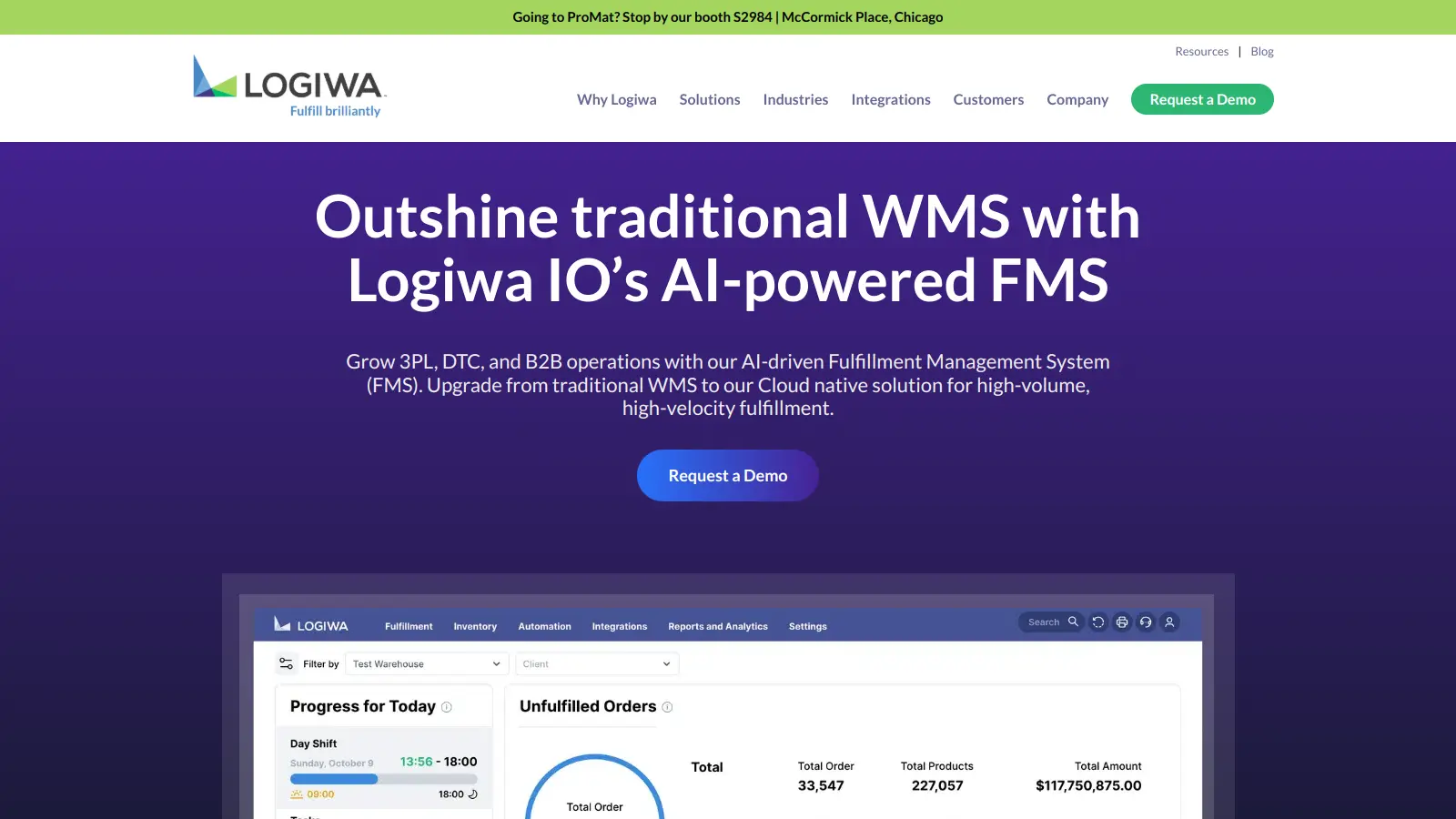
Logiwa is designed specifically for direct-to-consumer fulfillment at scale, with a focus on pick rate optimization, automated slotting, and ecommerce channel integrations. For 3PLs serving ecommerce brands, it handles multi-client inventory, per-client order rules, and customer-facing portals. It's a stronger fit for high-SKU, high-order-volume environments than for mixed B2B/B2C fulfillment operations.
Pros
✓Optimised for high-velocity DTC pick-and-pack workflows
✓Strong ecommerce platform integrations out of the box
✓Modern UI with a clear client portal
Cons
✗Less suited for 3PLs with heavy B2B or retail compliance requirements
✗Pricing requires a sales conversation; no self-serve trial
Configurable WMS with a scripting layer for custom fulfillment logic.
Paid
Best for · Small to mid-sized 3PLs with custom workflow needsPricing · From $995/mo
Infoplus lets warehouse operators write custom scripts to automate fulfillment rules, which gives it an edge for 3PLs with unusual client requirements that don't fit standard WMS workflows. It includes multi-client billing, order routing, and a client portal, and its API access is available on all paid plans. It's used by small to mid-sized 3PLs that need flexibility without the cost of full enterprise implementation.
Pros
✓Scripting layer handles non-standard fulfillment rules per client
✓Full API access included on all plans
✓Transparent pricing starting point publicly available
Cons
✗Scripting capability requires technical staff to get full value
✗Reporting tools are less polished than enterprise competitors
Cloud WMS that helped define the mid-market 3PL software category.
Custom
Best for · Smaller 3PLs moving off spreadsheets or legacy softwarePricing · Pricing on request
Before its acquisition and rebrand under Extensiv, 3PL Central was one of the most widely adopted cloud WMS tools for small and mid-sized fulfillment centers. The platform's DNA is in fast client onboarding, straightforward billing configuration, and a large library of shopping cart integrations. It now sits within the Extensiv ecosystem, which adds order management and network fulfillment capabilities for operators who need to scale.
Pros
✓Large base of 3PL-specific implementation partners
✓Broad shopping cart and marketplace integrations
✓Client portal is straightforward for non-technical end clients
Cons
✗Now part of a larger Extensiv platform, so standalone pricing is unclear
✗Heavier operations may need to upgrade to full Extensiv WMS suite
Mid-market WMS with built-in 3PL billing and logistics management.
Custom
Best for · Mid-market 3PLs with mixed warehousing and distribution servicesPricing · Pricing on request
Cadence from Cadre Technologies is a mid-market WMS with purpose-built 3PL billing, client portals, and transportation management integration. It targets fulfillment centers managing a mix of warehousing, distribution, and value-added services across multiple client accounts. Cadre has a long track record in the 3PL space and is often cited for strong customer support and US-based implementation teams.
ERP-native WMS for 3PLs already running on the NetSuite platform.
Custom
Best for · 3PLs already on the NetSuite ERP platformPricing · Pricing on request
NetSuite WMS is not a standalone 3PL tool; it's a module within the NetSuite ERP that adds warehouse execution capabilities. For 3PLs already using NetSuite for financials and client billing, adding the WMS module avoids a separate integration layer and keeps all data in one system. The tradeoff is that multi-tenant 3PL configuration is more complex to set up than with purpose-built 3PL WMS platforms, and it's most practical when clients are also NetSuite users or when the 3PL manages its own client billing through NetSuite.
Pros
✓Native integration with NetSuite financials eliminates reconciliation
✓Single platform for ERP, billing, and warehouse execution
✓Strong audit trail and compliance reporting across modules
Cons
✗Multi-client 3PL configuration requires significant implementation work
✗Not practical unless the broader NetSuite ERP is already in use
Your billing model is probably different for every client. Some are billed per pick, some per pallet stored, some on a flat monthly fee. The WMS needs to capture all chargeable activities automatically and generate accurate invoices per client without manual reconciliation. Ask vendors specifically how they handle mixed billing models within a single account.
Client onboarding speed
Every week you spend onboarding a new client is a week you're not billing at full rate. Look for systems that let you configure a new client's inventory rules, labeling requirements, and portal access in days rather than weeks. Template-based setup and self-service portal configuration are good signals here.
Integration with your clients' systems
Your clients will expect direct integration with their Shopify store, Amazon Seller Central, ERP, or EDI feeds. A WMS with a shallow integration library puts the burden on you to build connectors every time you win new business. Count the pre-built integrations and check whether EDI is included or costs extra.
Scalability without re-implementation
A system that works well at 10 clients can fall apart at 50 if it requires custom development to add new workflows. Prioritise platforms where adding automation rules, new warehouse locations, or additional users is a configuration task, not a project. Ask for reference customers who've scaled significantly on the same instance.
Customer portal quality
Your clients will judge your operation partly on what they can see themselves. A weak or slow portal generates support tickets and erodes trust. Demo the client-facing view specifically, not just the operator interface, and check whether clients can pull their own reports without calling you.
frequently asked questions
A standard WMS is designed for a single company managing its own inventory. A 3PL WMS adds multi-tenant architecture, which keeps each client's inventory, billing rules, and reporting fully separated within the same system. It also includes client-facing portals and per-client configuration options that a standard WMS doesn't have.
Purpose-built 3PL WMS platforms generally start between $500 and $2,000 per month for smaller operations, with enterprise platforms and highly configurable systems running significantly higher, often requiring custom quotes. Most vendors in this category don't publish pricing publicly because contracts are scoped to warehouse size, client count, and integration requirements.
Open-source options exist, but they typically require significant developer time to configure for multi-client billing and portal access, which erases the cost advantage quickly. For most 3PLs beyond the very early stage, a commercial platform with dedicated support and built-in 3PL features is more cost-effective than self-hosted alternatives.
Buying based on the operator interface without demoing the client portal or billing module. These are the areas where most 3PL-specific complexity lives, and a weak implementation there generates daily operational friction. Always ask the vendor to walk through a full client invoice generation and a client portal session during evaluation.
Most dedicated 3PL WMS platforms include EDI support and pre-built connectors for major ecommerce platforms like Shopify, WooCommerce, and Amazon. The depth varies: some include EDI in the base price, others charge per trading partner. Always confirm whether the integrations you need are pre-built or require custom development before signing.
tools for humans
toolsforhumans editorial team
Reader ratings and community feedback shape every score. Since 2022, ToolsForHumans has helped 600,000+ people find software that holds up after launch. The picks here come from that.