Best SOC 2 Compliance Software: Top Picks for Tech Teams (2026)
8 tools reviewedlast reviewed 20 march 2026
Editorial note:this was originally published in september of 2024
SOC 2 compliance has become a sales prerequisite for most B2B SaaS companies, yet earning it manually costs engineering teams weeks of screenshot-collecting, policy-writing, and auditor back-and-forth. The right software cuts that work down to hours by automating evidence collection, monitoring controls continuously, and keeping your documentation current as your infrastructure changes.
This list covers the tools that actually deliver on that promise: platforms built for startups and mid-market tech companies that need to get compliant fast without hiring a dedicated GRC team. I evaluated each one on automation depth, integration breadth, audit firm relationships, and total cost of ownership at different company sizes.
Whether you're prepping for your first Type I audit or maintaining continuous compliance across multiple frameworks, there's a clear right choice depending on your team size, budget, and how much hand-holding you want from the platform.
We collect first-hand reviews from people who use these tools every day — what works, what doesn't, whether it's worth paying for. We research pricing, features, and comparisons so that feedback has real context behind it. For this guide, tools were selected based on automation capabilities, real-time evidence collection, and proven audit outcomes. Read our full research methodology.
help us improve this guide
tell us what you're looking for, what you're using now, and what caught your eye — takes 30 seconds.
What is SOC 2 compliance software?
SOC 2 compliance software automates the process of preparing for, achieving, and maintaining a SOC 2 audit. SOC 2 is an auditing standard developed by the AICPA that evaluates how a service company handles customer data across five Trust Services Criteria: security, availability, processing integrity, confidentiality, and privacy.
Without dedicated software, compliance teams collect evidence manually, track control failures in spreadsheets, and scramble to pull documentation together when auditors arrive. Compliance platforms replace that process by integrating directly with your cloud infrastructure, identity providers, HR systems, and security tools to collect evidence automatically and alert you when controls drift out of compliance.
The typical buyers are engineering leaders, security managers, and founders at SaaS companies responding to customer security questionnaires or enterprise procurement requirements. Most companies target either a SOC 2 Type I report (a point-in-time assessment) or a Type II report (which covers a monitoring period, usually six to twelve months).
A flexible, risk-based approach to SOC 2 for teams that want more control over the process.
GRC-experienced teams wanting a customisable control framework
CustomPricing on request
our top pick
1
Vanta
The widest integration library in SOC 2 automation, built for fast-growing startups.
Custom
Best for · Startups and mid-market SaaS teams closing enterprise dealsPricing · Pricing on request
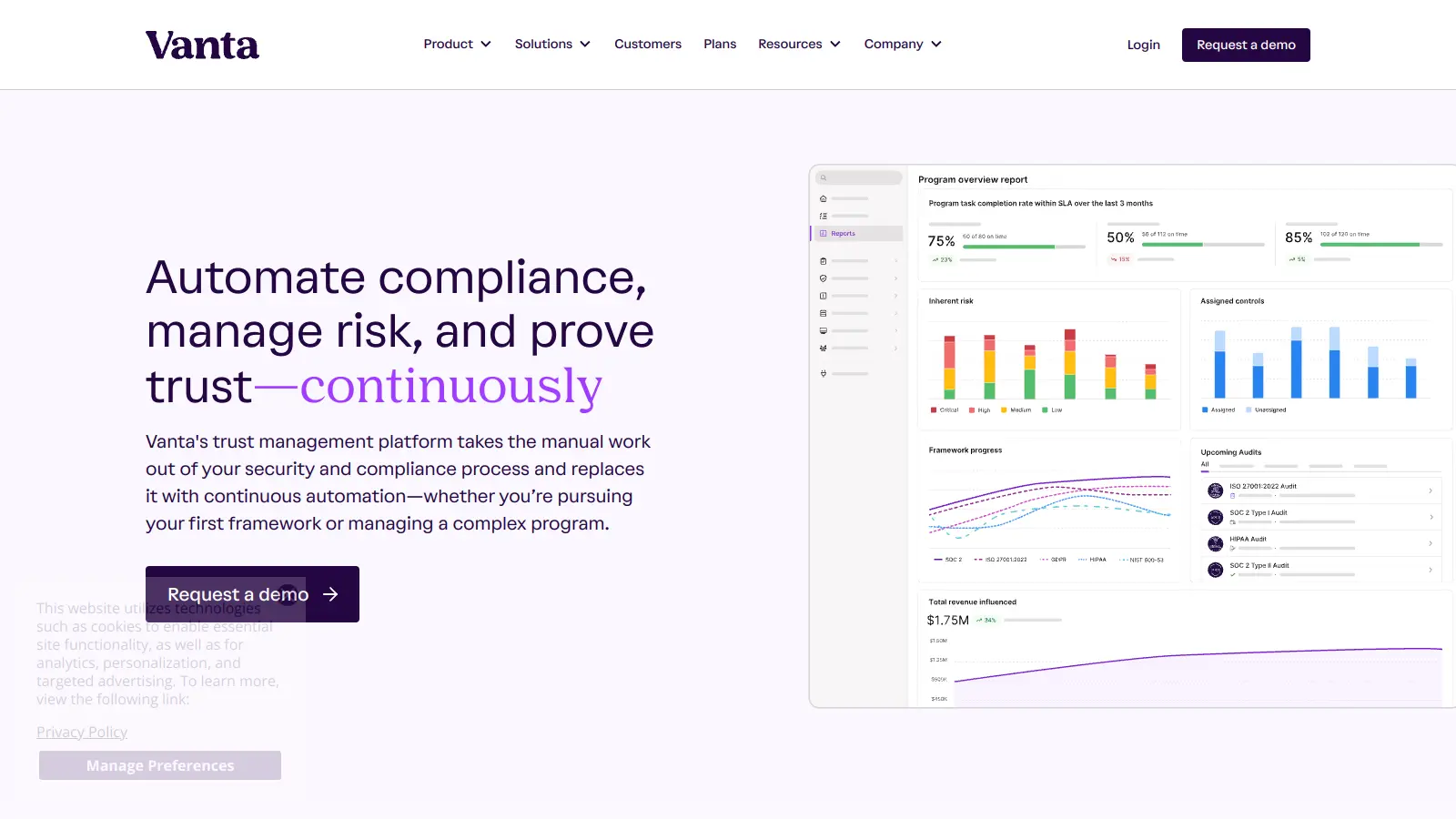
Vanta connects to over 375 integrations and runs automated control checks every hour, alerting your team immediately when something drifts. It has a built-in Trust Center that answers prospect security questions automatically, which is useful for closing enterprise deals. Vanta supports over 35 frameworks including SOC 2, ISO 27001, HIPAA, and PCI DSS, with cross-mapped controls so evidence collected for one framework populates others.
Pros
✓375+ integrations, broadest in category
✓Hourly control checks catch drift fast
✓Built-in Trust Center speeds up security reviews
Cons
✗Pricing is opaque; quotes often surprise smaller teams
✗AI features and add-ons priced separately from base plan
Continuous compliance monitoring with 24/7 automated evidence collection.
Custom
Best for · Mid-market tech companies with in-house security leadsPricing · Pricing on request
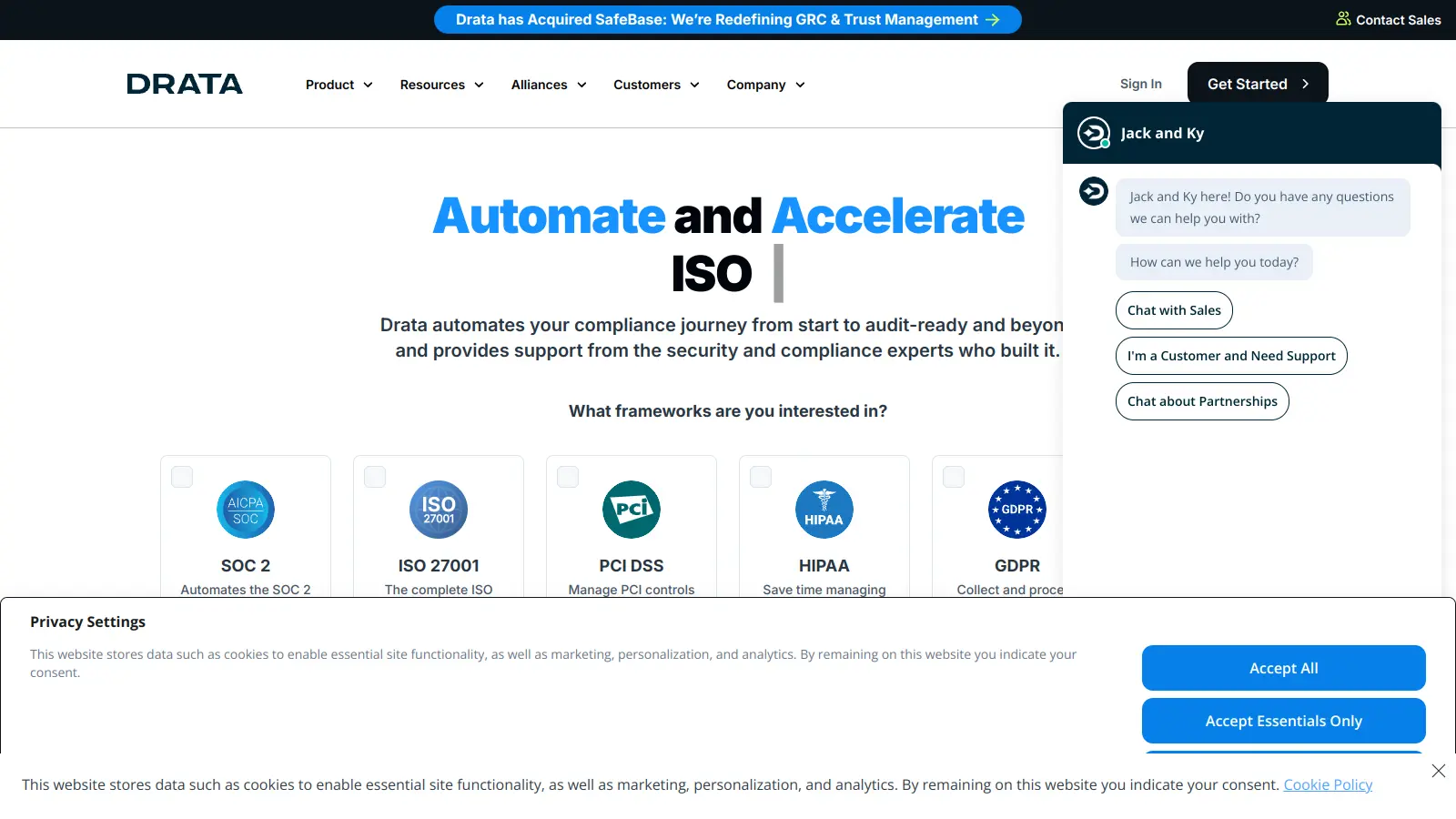
Drata automates evidence collection across your cloud and SaaS stack and monitors controls around the clock. Its audit hub lets CPA firms work directly inside the platform, reducing back-and-forth during fieldwork. It supports over 20 frameworks and has a clean UI that non-security staff can navigate without training.
Pros
✓Auditor-native workflow reduces fieldwork time
✓200+ pre-built integrations
✓Policy templates and training modules included
Cons
✗No public pricing; contract lengths tend to be multi-year
✗Customisation of control frameworks requires paid add-ons
Compliance automation with a dedicated GRC advisor included in every plan.
Custom
Best for · Startups without an in-house compliance or security teamPricing · Pricing on request
Scytale pairs its automation platform with a named compliance manager who guides your team through gap assessments, policy creation, and auditor communications. This makes it a practical choice for companies with no existing GRC function. It covers SOC 2, ISO 27001, HIPAA, GDPR, and several other frameworks from a single dashboard.
Pros
✓Dedicated compliance manager included in plans
✓Multi-framework support with shared controls
✓Hands-on audit prep guidance reduces surprises
Cons
✗Smaller integration library than Vanta or Drata
✗Advisory-heavy model may feel unnecessary for experienced GRC teams
SOC 2 automation sized for early-stage startups with transparent entry pricing.
Paid
Best for · Early-stage startups on a tight compliance budgetPricing · From $7,500/yr
Sprinto targets seed-to-Series B companies that need to get SOC 2 done quickly without enterprise-scale budgets. It automates evidence collection across AWS, GCP, and Azure and includes pre-mapped control sets for common startup stacks. The platform also covers ISO 27001, GDPR, HIPAA, and SOC 1, and it has relationships with a network of auditors that can reduce audit timelines.
Pros
✓Lower entry price than Vanta or Drata
✓Auditor network built into the platform
✓Fast setup for common startup cloud stacks
Cons
✗Fewer integrations than market leaders
✗Less suited to complex or regulated enterprise environments
Compliance software that bundles auditor services directly into the platform.
Custom
Best for · Companies that want software and auditor in one contractPricing · Pricing on request
Thoropass is unusual in that it employs in-house auditors, so you can complete your SOC 2 audit without hiring a separate CPA firm. This single-vendor model removes the coordination overhead between your compliance platform and your auditor. It's particularly efficient for Type II audits where continuous evidence collection and auditor access to the same system eliminates most fieldwork delays.
Pros
✓In-house auditors, no need to source a separate CPA firm
✓Single platform for evidence and audit fieldwork
✓Reduces total audit timeline significantly
Cons
✗Auditor and software bundled, so switching auditors means switching platforms
✗Higher overall cost than software-only alternatives
Compliance automation with strong pentesting and vendor risk management built in.
Custom
Best for · Growing companies consolidating compliance and vendor riskPricing · Pricing on request
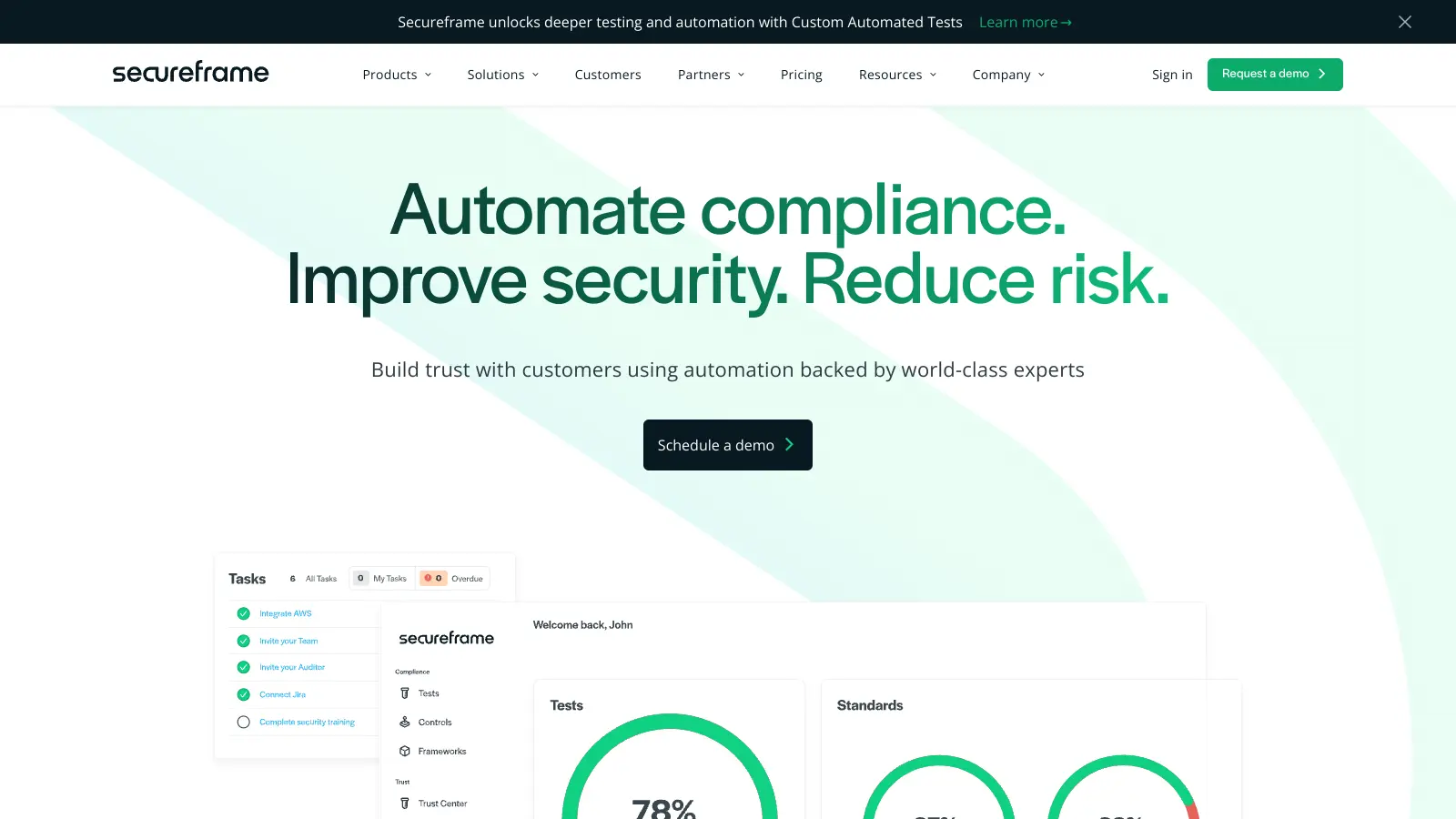
Secureframe covers SOC 2 automation alongside a wider GRC suite that includes vendor risk management, employee security training, and pentest integrations. It connects to over 200 tools and includes an AI assistant (Comply AI) that can remediate failing controls and generate policy drafts. The platform is a reasonable fit for companies that want to consolidate compliance, vendor risk, and training into a single subscription.
Pros
✓Vendor risk management included natively
✓Comply AI generates policy drafts and fixes controls
✓Employee security training built into the platform
Cons
✗Interface can feel cluttered when managing multiple frameworks
SOC 2 automation backed by OneTrust's broader privacy and GRC infrastructure.
Custom
Best for · Companies already using OneTrust for privacy or GRCPricing · Pricing on request
Tugboat Logic was acquired by OneTrust and is now positioned as OneTrust's certification automation product. It automates evidence collection and control monitoring for SOC 2 and ISO 27001, and it benefits from OneTrust's extensive connector library for privacy and GRC workflows. It suits companies already using OneTrust for privacy management who want to extend into security compliance without adding another vendor.
Pros
✓Deep integration with OneTrust privacy and risk modules
✓Strong for companies with existing OneTrust contracts
✓Covers SOC 2, ISO 27001, and privacy frameworks together
Cons
✗Less compelling as a standalone SOC 2 tool vs. Vanta or Drata
✗OneTrust platform complexity can slow down implementation
A flexible, risk-based approach to SOC 2 for teams that want more control over the process.
Custom
Best for · GRC-experienced teams wanting a customisable control frameworkPricing · Pricing on request
Strike Graph takes a risk-first methodology: you identify the risks relevant to your business, and the platform maps controls to those risks rather than applying a fixed control library. This gives compliance leads more flexibility to tailor the program to their environment. It's a better fit for companies with experienced GRC staff who want to build a defensible, customised compliance program rather than following a prescriptive checklist.
Pros
✓Risk-based control mapping gives teams more flexibility
✓Supports multiple frameworks from a single risk registry
✓Less opinionated than template-heavy competitors
Cons
✗Requires more compliance knowledge to use effectively
A platform is only as useful as its integrations. Check whether it natively connects to your cloud provider (AWS, GCP, Azure), identity provider (Okta, Google Workspace), MDM solution, and code repositories. Missing integrations mean manual evidence collection, which defeats the point.
Continuous monitoring vs. point-in-time checks
Some tools run checks daily or weekly; the best run them hourly. If a control breaks in January and your audit is in March, you want to know immediately, not at the next scheduled scan. Confirm how frequently the platform tests each control and how it alerts you to failures.
Audit firm relationships and in-platform auditing
Several platforms have partnerships with accredited CPA firms and let auditors work directly inside the platform, which speeds up fieldwork significantly. If you don't already have an auditor, this can save weeks of coordination and sometimes reduces audit fees.
Multi-framework support
Most companies that complete SOC 2 go on to pursue ISO 27001, HIPAA, or GDPR. Platforms that map controls across frameworks let you reuse evidence you've already collected rather than starting from scratch for each certification.
Support model and compliance expertise
Some platforms are pure software; others bundle in dedicated compliance managers or GRC advisors. If your team has no prior compliance experience, the guided approach is worth the extra cost. If you have an in-house GRC lead, you may not need it.
frequently asked questions
Most platforms advertise a Type I in four to eight weeks for companies that are already running basic security controls. Type II requires a monitoring period of at least six months, though you can be audit-ready on day one of that period if your controls are clean. Manual prep typically takes three to six months longer.
Entry-level plans start around $7,500 to $10,000 per year for platforms like Sprinto and Scytale. Mid-market tools like Drata and Vanta typically run $15,000 to $25,000 annually for a team of 50 to 100 employees. Enterprise-focused platforms like Thoropass or Secureframe are often custom-quoted and can exceed $40,000 per year. Most vendors don't publish pricing publicly, so you'll need to request a quote.
Yes. Compliance software prepares you for an audit and stores evidence, but the actual SOC 2 report must be issued by an accredited CPA firm. Some platforms have preferred auditor partnerships that streamline the process, but the audit itself is a separate cost, typically $15,000 to $40,000 for a Type II.
Type I is a snapshot: an auditor confirms your controls are designed correctly as of a specific date. Type II covers a period (usually six to twelve months) and confirms your controls actually operated effectively throughout that time. Enterprise buyers almost always require Type II.
Most modern compliance platforms support multiple frameworks simultaneously and map overlapping controls so you collect evidence once. Vanta, Drata, and Scytale all support this. Running both at the same time is common and saves significant effort compared to doing them sequentially.
tools for humans
toolsforhumans editorial team
Reader ratings and community feedback shape every score. Since 2022, ToolsForHumans has helped 600,000+ people find software that holds up after launch. The picks here come from that.