Best AI Contract Management Software for Legal Teams (2026)
8 tools reviewedlast reviewed 20 march 2026
Editorial note:this was originally published in july of 2023
Some links on this page are affiliate links. If you sign up via our link we may earn a commission, at no extra cost to you. This doesn't affect which tools we recommend or how we rank them.
AI contract management software handles the parts of contract work that eat time without adding judgment: extracting key dates, flagging risky clauses, tracking renewal deadlines, and keeping every agreement searchable. This page is for legal teams, operations leads, and procurement managers who want to know which tools actually work and what they cost.
The list below covers eight tools, from enterprise contract lifecycle management (CLM) platforms to lighter-weight tools built for smaller teams. Each was selected based on AI feature depth, pricing transparency, integration options, and fit across different team sizes.
If you're reviewing dozens of contracts a week or managing thousands in a repository, there's a meaningful difference between tools here. The picks below reflect that range.
We collect first-hand reviews from people who use these tools every day — what works, what doesn't, whether it's worth paying for. We research pricing, features, and comparisons so that feedback has real context behind it. For this guide, tools were selected based on automation capabilities, compliance features, and integration depth with existing business systems. Read our full research methodology.
help us improve this guide
tell us what you're looking for, what you're using now, and what caught your eye — takes 30 seconds.
What Is AI Contract Management Software?
AI contract management software uses natural language processing (NLP) and machine learning to automate the tasks involved in creating, reviewing, storing, and monitoring contracts. That includes extracting data like parties, dates, and payment terms; flagging non-standard clauses; scoring risk; and alerting teams to upcoming renewals or obligations.
The category spans two main use cases: contract lifecycle management (CLM), which covers the full process from drafting to signature to renewal, and contract analytics or review tools, which focus on analysing existing or incoming contracts for risk and compliance. Some platforms do both; others specialise in one.
Legal teams, procurement departments, and operations leads are the primary users. Companies dealing with high contract volumes, complex supplier networks, or strict compliance requirements tend to get the clearest return from these tools.
Agentic CLM with AI authoring, search, and legal chat built in.
Legal teams trialling agentic AI for contract work
CustomPricing on request
our top pick
1
Ironclad
Enterprise CLM platform built for high-volume legal teams.
Custom
Best for · Enterprise legal and operations teamsPricing · Pricing on request
Ironclad is a full contract lifecycle management platform covering drafting, negotiation, approval workflows, e-signature, and post-execution analytics. It's named a Leader in both the 2025 Gartner Magic Quadrant and Forrester Wave for CLM, which reflects genuine enterprise adoption rather than marketing positioning. AI runs through the workflow layer to automate routing, flag deviations from standard clauses, and surface contract data for reporting.
Pros
✓Gartner and Forrester Leader recognition for CLM
✓Native Salesforce and Coupa integrations
✓AI automation across the full contract workflow
Cons
✗No public pricing; enterprise cost is a significant commitment
✗Implementation complexity is high for smaller teams
AI-powered CLM built for large enterprise procurement and legal.
Custom
Best for · Large enterprises with complex procurement workflowsPricing · Pricing on request
Icertis is one of the most established names in enterprise CLM, covering authoring, negotiation, execution, and obligation tracking across procurement, sales, and legal functions. It integrates with major ERP and CRM systems and uses AI to extract contract provisions, monitor compliance, and score risk. The platform is configurable for complex governance requirements across multinational organisations.
Pros
✓Deep ERP integrations (SAP, Microsoft Dynamics)
✓Strong obligation and compliance tracking
✓Configurable for multi-entity, multinational use
Cons
✗Implementation is lengthy and requires dedicated resources
✗Not suitable for teams without IT support or a CLM administrator
Contract repository with practical AI extraction and categorisation.
Paid
Best for · Small to mid-sized legal teams needing a searchable repositoryPricing · From $399/mo
ContractSafe is a contract management tool focused on storage, search, and AI-assisted data extraction rather than full CLM workflow automation. Its AI assistant automatically extracts key data from uploaded contracts, and a newer AI categorisation feature sorts contracts by type on upload. It's designed to be simple to set up and maintain without a dedicated legal ops team.
Digital contract platform for sales, HR, and procurement teams.
Freemium
Best for · Sales and HR teams managing high contract volumesPricing · From $15/user/mo
Oneflow covers contract creation, real-time collaboration, e-signature, and post-sign management in a single platform. It's built for cross-functional use, making it accessible to sales and HR teams alongside legal. Contracts are stored as live data rather than static PDFs, which enables editing and tracking after send. AI features include contract generation and analysis from a built-in assistant.
Pros
✓Live contracts editable post-send, not locked PDFs
✓Accessible for non-legal teams without training
✓Free plan available for basic use
Cons
✗AI analysis features are less deep than dedicated review tools
AI-first contract review and negotiation platform for legal teams.
Custom
Best for · In-house legal teams doing high-volume contract negotiationPricing · Pricing on request
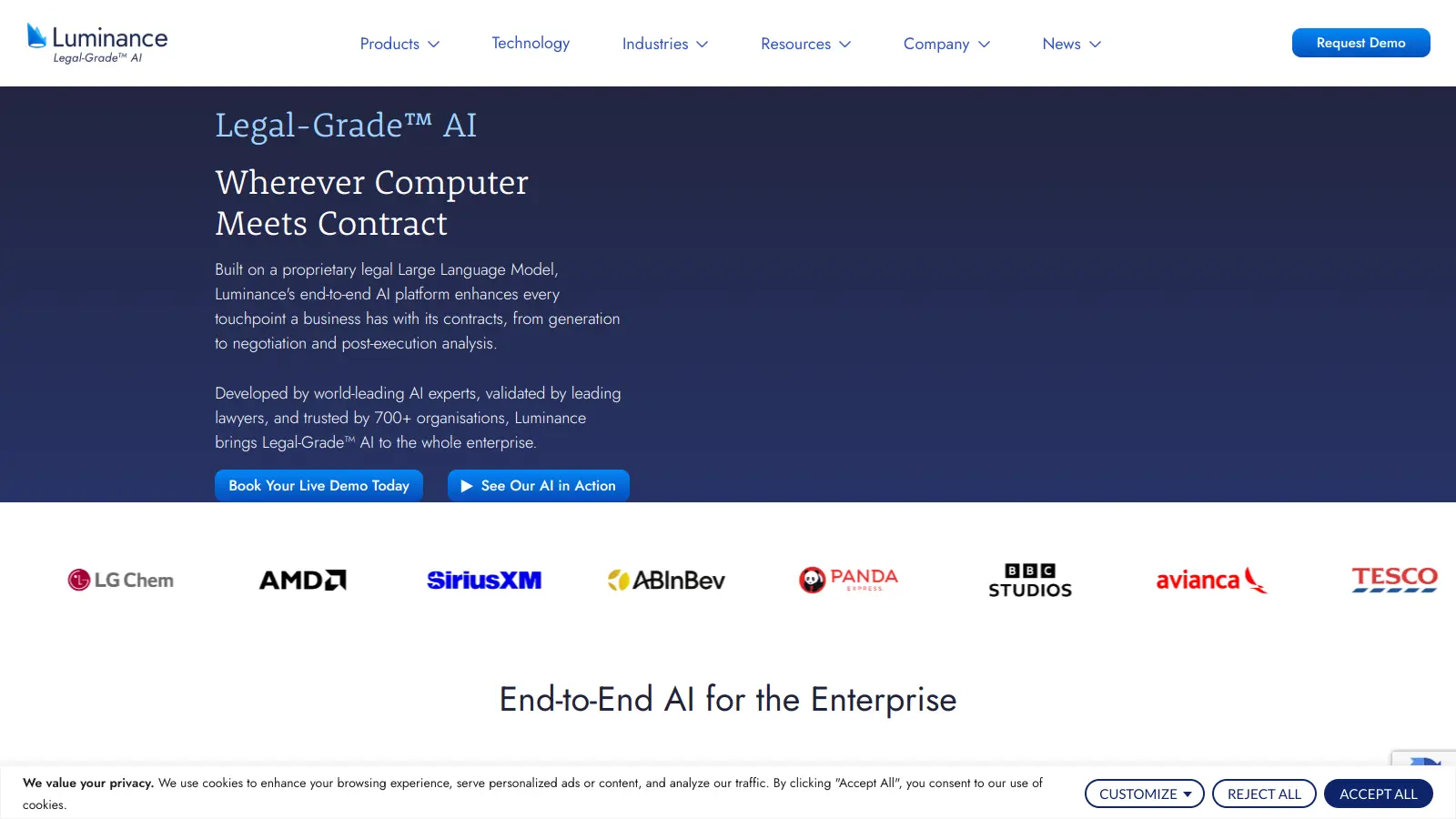
Luminance uses AI trained specifically on legal language to review contracts during negotiation, flagging risk areas and deviations from playbook positions. It works inside Microsoft Word via a plugin, which reduces friction for lawyers who draft in Word already. The platform handles both the review and the negotiation redlining process, with AI suggesting changes based on preferred positions.
Pros
✓Legal-specific AI trained on large contract datasets
✓Word plugin keeps lawyers in their existing environment
✓Automated redlining against playbook positions
Cons
✗No transparent pricing; aimed at mid to large teams
✗Repository and post-execution features are less mature than full CLMs
Mid-market CLM with machine learning for contract extraction and analytics.
Custom
Best for · Mid-market legal and procurement teamsPricing · Pricing on request
IntelAgree is a CLM platform targeting mid-market companies that need more than a basic repository but don't want the complexity of enterprise tools. Its machine learning engine extracts and analyses contract language, and the platform covers the full lifecycle from creation through signature and renewal tracking. It's recognised on Gartner peer review platforms for contract analytics.
Pros
✓ML-based extraction across custom contract types
✓Full lifecycle coverage without enterprise-level complexity
✓Accessible analytics without a dedicated data team
Cons
✗Smaller integration ecosystem than Ironclad or Icertis
✗Pricing requires a sales call with no self-serve option
AI contract review that returns marked-up contracts in minutes.
Paid
Best for · Teams reviewing high volumes of standard commercial contractsPricing · From $165/mo
Superlegal (the consumer brand for the AI system behind Lawgeex) provides automated contract review for standard commercial agreements. Users upload a contract and receive a risk-flagged, marked-up version based on predefined playbook positions. The platform is designed to handle routine contracts like NDAs, SaaS agreements, and vendor terms without requiring manual legal review for every document.
Pros
✓Fast turnaround on standard agreement types
✓Playbook-based review reduces manual legal time
✓Proven AI accuracy benchmarked against trained lawyers
Cons
✗Less effective on highly bespoke or complex agreements
✗No full CLM workflow; review only, no lifecycle management
Agentic CLM with AI authoring, search, and legal chat built in.
Custom
Best for · Legal teams trialling agentic AI for contract workPricing · Pricing on request
Leah CLM is a newer entrant positioning itself as an agentic contract platform, meaning the AI takes a more active role in executing tasks rather than just surfacing information. It includes AI-powered contract authoring, automated redlining, workflow management, a legal chatbot, and a searchable contract repository. The platform targets legal teams that want AI handling more of the execution, not just the analysis.
Pros
✓Agentic AI handles tasks across the full lifecycle
✓Built-in legal chatbot for contract queries
✓Integrated dashboards with real-time contract data
Cons
✗Newer platform with a shorter track record than established CLMs
A full CLM platform handles drafting, negotiation, e-signature, storage, and analytics in one system. A focused review or analytics tool plugs into your existing workflow and adds AI on top. If you already have DocuSign or another e-signature tool and just need smarter analysis, a standalone reviewer may be enough.
AI depth and accuracy
Check whether the AI is trained on legal language specifically, or whether it's a general-purpose model applied to contracts. Tools trained on large volumes of legal documents tend to catch clause-level risks more reliably. Ask vendors for accuracy benchmarks or trial output on your actual contract types before committing.
Integration with your existing stack
The most useful contract tools connect directly to your CRM (Salesforce, HubSpot), ERP, or procurement system so contracts don't live in a silo. Confirm native integrations versus API-only connections, and check whether your e-signature provider is supported.
Repository and search capability
Even strong AI features are less useful if you can't find the contracts you need. Look for full-text search, metadata tagging, and folder structures that match how your team actually organises agreements. Some tools include OCR for scanned legacy contracts; others don't.
Team size and pricing model
Enterprise CLM platforms are often priced on request and built for large legal teams. Several solid tools offer transparent per-seat or tiered pricing that works for smaller teams. Be clear on your contract volume and number of users before requesting a demo, since pricing often scales on both dimensions.
frequently asked questions
A CLM (contract lifecycle management) platform covers the entire contract process: drafting, negotiation, approval workflows, e-signature, storage, and post-execution monitoring. A contract review tool focuses specifically on analysing contracts for risk, deviations from standard language, and missing clauses. Some platforms include both; others specialise. If you need end-to-end workflow management, go with a CLM. If you just need smarter analysis layered onto existing processes, a standalone review tool may be sufficient.
Pricing varies widely. Lighter tools aimed at small teams start around $12 to $50 per user per month on transparent pricing pages. Mid-market CLM platforms typically run $500 to $2,000 per month depending on user count and contract volume. Enterprise platforms like Icertis and Ironclad are almost always priced on request, and contracts often run into five or six figures annually. Always ask for a per-seat breakdown and check whether features like AI review or advanced analytics are included or sold as add-ons.
No. AI tools reduce the time spent on routine clause-spotting, data extraction, and risk flagging, but they don't replace legal judgment on complex negotiations or high-stakes agreements. Think of them as a first-pass filter that surfaces issues for a human to act on. The value is speed and consistency, not full automation of legal decision-making.
Confirm whether the tool supports OCR for scanned PDFs, since many legacy contracts aren't machine-readable. Check data residency and security certifications (SOC 2, ISO 27001) before uploading sensitive agreements. Also verify whether the tool can ingest contracts in bulk and how it handles metadata from documents that weren't created in the platform.
Several do. Tools like Ironclad and Oneflow are specifically designed for cross-functional use, letting sales teams generate and send contracts from within a CRM without legal involvement for standard agreements. Procurement-focused platforms like Icertis are built around supplier contracts and sourcing workflows. If you're buying for a non-legal team, prioritise tools with simple interfaces and pre-built templates over those built primarily for legal power users.
tools for humans
toolsforhumans editorial team
Reader ratings and community feedback shape every score. Since 2022, ToolsForHumans has helped 600,000+ people find software that holds up after launch. The picks here come from that.