Best AI Tools for SEO: Ranked for Practitioners (2026)
8 tools reviewedlast reviewed 20 march 2026
Editorial note:this was originally published in july of 2023
AI SEO tools range from genuinely useful research platforms to repackaged keyword stuffers with a chatbot bolted on. This list cuts through that. It covers tools that help with the parts of SEO that actually move the needle: keyword research, topical depth, content planning, technical audits, and tracking visibility in AI search results.
Each tool was selected based on data accuracy, pricing transparency, integration with tools like Google Search Console and GA4, and whether it fits into a real workflow rather than creating more busywork. The list covers solo operators, in-house content teams, and agencies.
Pricing spans from free tiers to agency-level plans. A couple of picks here are less talked about but worth knowing, especially if you're trying to do more with a smaller budget.
We collect first-hand reviews from people who use these tools every day — what works, what doesn't, whether it's worth paying for. We research pricing, features, and comparisons so that feedback has real context behind it. For this page, tools were selected based on demonstrable SEO impact, integration capabilities, and real-world performance data rather than feature count. Read our full research methodology.
help us improve this guide
tell us what you're looking for, what you're using now, and what caught your eye — takes 30 seconds.
What are AI SEO tools?
AI SEO tools use machine learning and large language models to speed up tasks that used to require hours of manual work: finding keyword opportunities, auditing site structure, analysing competitor content, and building content briefs. The AI layer doesn't replace SEO strategy, but it cuts down the time spent on data gathering and pattern recognition.
Most tools in this category fall into one of a few buckets: all-in-one platforms like Semrush that handle research and tracking, content optimisation tools like Clearscope that focus on on-page depth, and newer tools that track how your brand appears in AI-generated answers from ChatGPT or Perplexity.
The people who get the most from these tools are content strategists, SEO managers, and freelance writers who need to produce well-researched, intent-matched content at scale, without sacrificing accuracy for speed.
Clusters thousands of keywords by intent and content type in minutes.
SEO strategists building content architectures for large sites
FreemiumFrom $58/mo
our top pick
1
Semrush
The all-in-one SEO platform with the deepest competitive data.
Freemium
Best for · In-house SEO teams and agencies managing multiple clientsPricing · From $139.95/mo
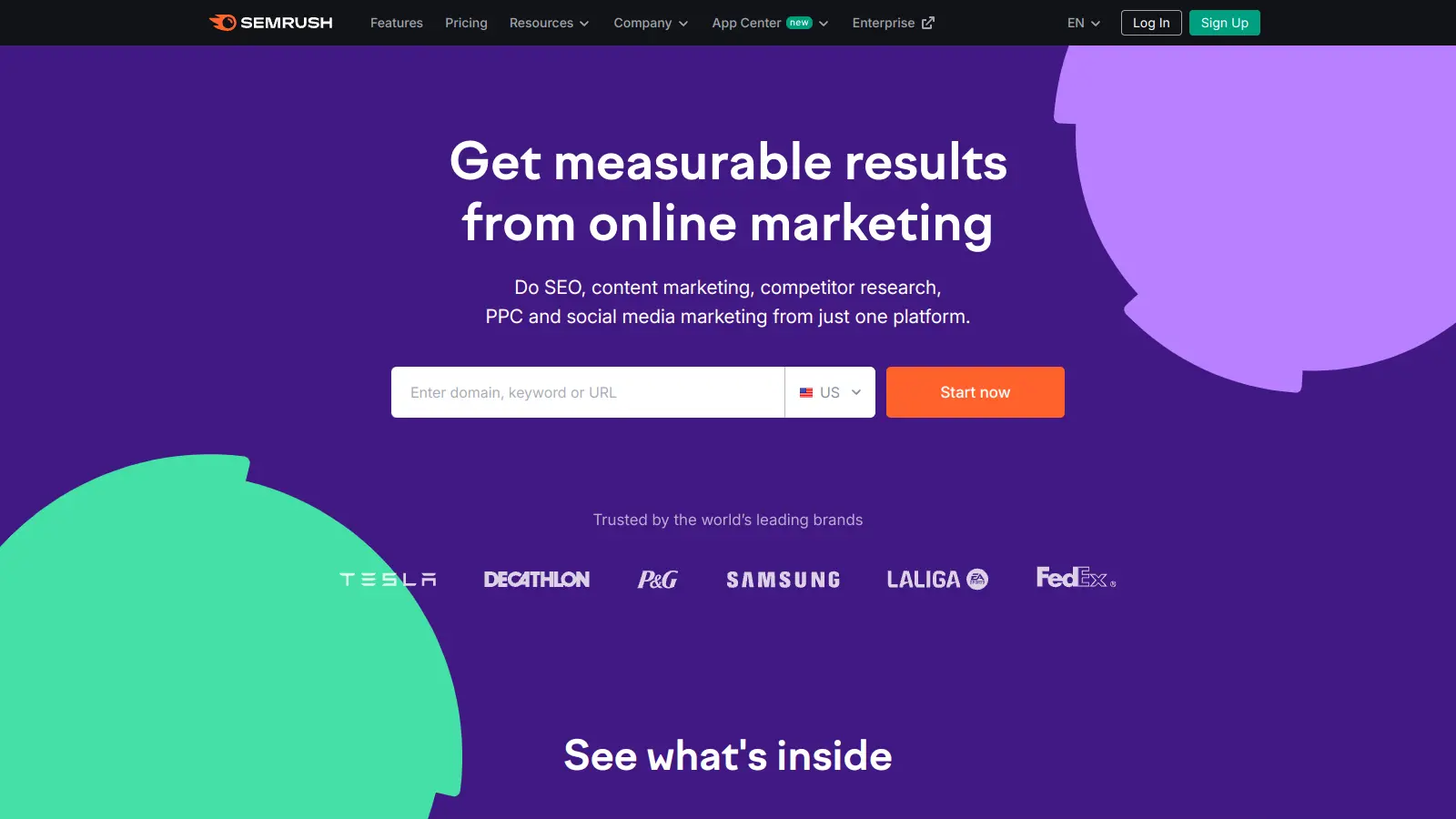
Semrush covers keyword research, site audits, backlink analysis, rank tracking, and content optimisation in one platform. Its AI features include writing assistance, keyword clustering, and an SEO Writing Assistant that scores content against top-ranking pages. It's the most comprehensive option on this list, which also makes it the most expensive for small teams.
Pros
✓Largest keyword database of any tool on this list
✓Backlink data rivals Ahrefs at similar price points
✓AI Writing Assistant integrates directly with content workflow
Cons
✗Single-seat Pro plan is expensive for solo users
✗Feature overload makes onboarding slow for new users
Content optimisation tool that scores articles against live SERPs.
Paid
Best for · Content writers and SEO editors optimising individual articlesPricing · From $99/mo
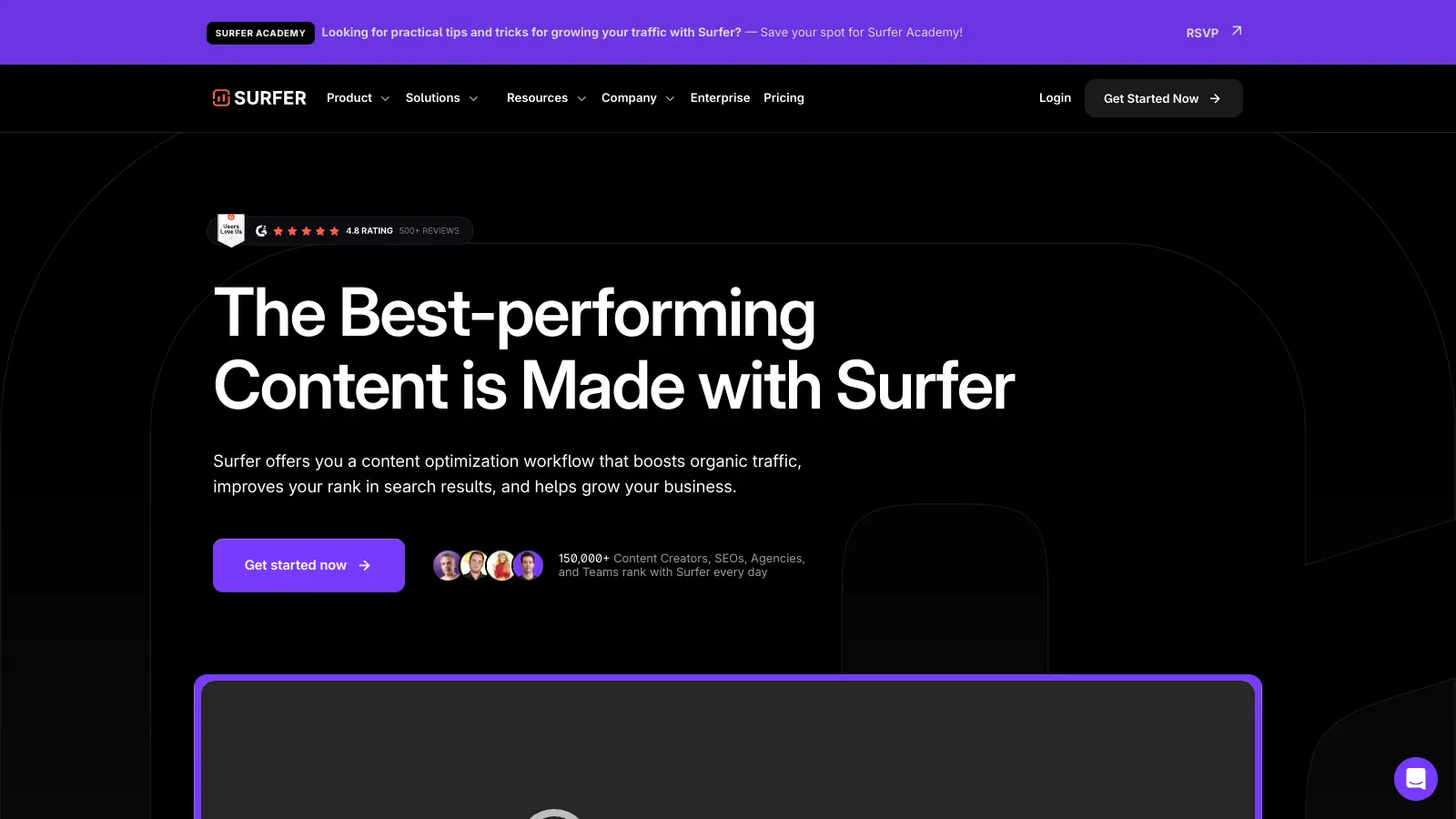
Surfer analyses the top-ranking pages for a target keyword and gives you a real-time content score as you write, flagging missing topics, keyword density, and structural gaps. It integrates with Google Docs and WordPress, which is why it's become a standard tool for content writers and SEO editors. The AI Outline Builder and Topical Map features are the most practically useful additions in recent updates.
Pros
✓Google Docs integration works reliably in practice
✓Topical Map feature surfaces content gap clusters quickly
✓Content score correlates well with on-page depth
Cons
✗No backlink or rank tracking, so you still need a second tool
✗Article limits on lower plans restrict output for busy teams
Precision content grading tool favoured by enterprise content teams.
Paid
Best for · Enterprise content teams and agencies producing high-volume SEO contentPricing · From $199/mo
Clearscope generates content reports that show which terms and concepts appear in top-ranking content for a keyword, then grades your draft in real time. It's more accurate at semantic keyword recommendations than most competitors, which is why it appears on a lot of enterprise and agency content teams' tool lists. The interface is clean and the Google Docs add-on is well built.
Pros
✓Semantic keyword accuracy is consistently high
✓Google Docs add-on is well-built and stable
✓Unlimited user seats on all plans
Cons
✗Starting price is steep for small teams or solo writers
Best-in-class backlink data with solid keyword research built in.
Paid
Best for · SEOs focused on link building and competitive researchPricing · From $129/mo
Ahrefs is the go-to tool for backlink analysis and is widely considered to have the most accurate crawl-based data in the industry. Its keyword research, site explorer, and content gap tools are all strong. The AI features are more limited than Semrush, but the underlying data quality is high enough that many SEOs use Ahrefs for research and pair it with a separate content optimisation tool.
Pros
✓Backlink index is the most accurate available
✓Site Audit crawls up to 5,000 pages on entry plan
✓Content Gap tool identifies keyword opportunities fast
Cons
✗AI content features are thinner than Semrush or Surfer
✗No free trial, only a $7 seven-day starter option
Affordable all-in-one SEO platform with strong AI content tools.
Freemium
Best for · Small agencies and in-house teams needing all-in-one coverage on a budgetPricing · From $99/mo
Search Atlas combines keyword research, site auditing, rank tracking, and AI content writing in one platform at a price point well below Semrush or Ahrefs. Its OTTO SEO feature automates a range of on-page tasks including schema markup and internal linking suggestions. It's a strong option for small agencies or in-house teams that need broad SEO coverage without the enterprise price tag.
Pros
✓Broader feature set per dollar than most competitors
✓OTTO automates schema and internal linking tasks
✓Rank tracking covers both standard and AI search results
Cons
✗Data accuracy for smaller markets lags behind Semrush and Ahrefs
✗UI feels dense and takes time to navigate efficiently
Fast content brief generation with solid SERP analysis built in.
Paid
Best for · Content managers briefing freelance writers at scalePricing · From $45/mo
Frase pulls together SERP data for a keyword, summarises what top-ranking articles cover, and generates structured content briefs in minutes. It also includes an AI writer for drafting sections directly from the brief. It's particularly useful for content managers who need to produce briefs at scale for freelance writers. The entry plan is priced accessibly, which makes it a common first tool for smaller operations.
Pros
✓Brief generation is fast and covers SERP structure clearly
✓AI writer drafts directly from the brief outline
✓Lower entry price than Clearscope or Surfer
Cons
✗AI-generated copy needs significant editing before publishing
Tracks your brand's visibility in ChatGPT, Perplexity, and AI Overviews.
Freemium
Best for · Brands tracking visibility in AI-generated search answersPricing · From $19/mo
Otterly monitors how your brand, products, and competitors are mentioned in AI-generated search results across platforms like ChatGPT, Perplexity, Bing Copilot, and Google AI Overviews. It runs automated prompts on a schedule and reports back on visibility, sentiment, and share of voice versus competitors. It doesn't replace a standard SEO platform, but for teams actively trying to understand their presence in AI search, it covers ground that Semrush and Ahrefs currently don't.
Pros
✓Covers ChatGPT, Perplexity, and AI Overviews in one dashboard
✓Automated prompt scheduling runs monitoring without manual checks
✓Affordable entry point for a genuinely new data category
Cons
✗Category is new, so benchmarks and best practices are still forming
✗No integration with standard SEO data sources like GSC or Ahrefs
Clusters thousands of keywords by intent and content type in minutes.
Freemium
Best for · SEO strategists building content architectures for large sitesPricing · From $58/mo
Keyword Insights takes a raw list of keywords and groups them by search intent and SERP similarity, so you can see which terms should share a page and which need separate content. It also generates content briefs and suggests site architecture based on the clusters. The clustering accuracy is high, and the tool handles large keyword sets that would take days to sort manually. It's not well known outside specialist SEO circles, but it solves a specific, time-consuming problem very well.
Pros
✓Keyword clustering accuracy is among the best available
✓Handles bulk lists of 50,000+ keywords without breaking
✓Content brief generation integrates directly with clusters
Cons
✗No rank tracking or backlink data, it's a research-only tool
✗Interface is functional but not particularly polished
Third-party keyword volume estimates are always approximations. Before committing to any tool, cross-check its traffic and volume data against your own GSC data. Tools that are consistently off by more than 15-20% will skew your prioritisation decisions.
Whether it handles your primary use case
Content optimisation tools and keyword research platforms solve different problems. A tool like Clearscope is built for writers optimising a single article; Semrush is built for strategists mapping out an entire site's opportunity. Paying for the wrong type wastes both money and time.
Integration with your existing stack
Check whether the tool connects natively to Google Search Console, GA4, or your CMS. Manual data exports that you then paste into spreadsheets add friction and become the reason tools go unused after the first month.
Pricing structure and seat limits
Some tools charge per user seat, others by number of projects or keywords tracked per month. A solo operator on a tight budget needs a different pricing model than a five-person agency team running thirty client projects. Read the pricing page carefully before starting a trial.
AI Overview and LLM visibility tracking
If your audience is using ChatGPT, Perplexity, or Google's AI Overviews to find answers, standard rank tracking won't tell you the full picture. A small number of tools now track brand mentions and citations in these AI-generated results. For most teams, this is becoming relevant faster than expected.
frequently asked questions
Standard SEO tools collect and display data: rankings, backlinks, crawl errors. AI SEO tools add a layer that interprets that data, generates content briefs, suggests keyword clusters, or writes draft copy. The distinction is blurring as most major platforms now include both. The question worth asking is whether the AI features in a given tool actually save time or just add noise.
Entry-level plans for focused tools like Surfer SEO or Clearscope start around $29-$49 per month. All-in-one platforms like Semrush or Ahrefs run from $99-$140 per month for a single user. Agency-level plans with multiple seats and higher limits can exceed $400 per month. Free tiers exist but are generally limited to a handful of queries per day, which is fine for occasional use but not a full workflow.
Some free tools, like Google Search Console combined with free tiers in tools such as Ubersuggest, are genuinely useful for early-stage sites or solo bloggers. The main limitations are query caps, reduced data history, and no team collaboration features. If you're running multiple projects or need reliable volume data, a paid plan pays for itself quickly.
A small number of tools now specifically track which URLs appear in AI Overviews and how often they rotate. Semrush has published research showing that AIO URL placements are highly volatile, with 96% of AI Overviews swapping out domains over a 31-day period. Tools like Semrush and newer platforms like Profound or Otterly are building features to monitor this, but the space is still early and no tool has a reliable playbook for consistently appearing in AIOs.
Paying for an all-in-one platform when you only need one specific function. If your main bottleneck is writing well-optimised articles, a focused content tool like Clearscope costs a fraction of a full Semrush subscription and does that specific job better. Match the tool to the actual constraint in your workflow, not to the longest feature list.
tools for humans
toolsforhumans editorial team
Reader ratings and community feedback shape every score. Since 2022, ToolsForHumans has helped 600,000+ people find software that holds up after launch. The picks here come from that.