Best Brand Protection Software: Top Picks for Security Teams (2026)
8 tools reviewedlast reviewed 20 march 2026
Editorial note:this was originally published in august of 2024
Brand protection software is for security, legal, and trust teams dealing with phishing domains, counterfeit listings, social media impersonation, and credential theft that exploits your company's identity. The threat is concrete: Zscaler found over 10,000 malicious lookalike domains targeting 500 major brands, and phishing attacks cost an average of $4.8 million per incident.
This list covers 8 platforms selected for threat coverage breadth, takedown speed, dark web monitoring depth, and transparency around pricing. The tools here range from phishing-focused domain monitoring to full counterfeit enforcement across global marketplaces.
One thing to know upfront: no single platform covers every threat type equally well. A tool built for phishing takedowns and one built for counterfeit enforcement are solving different problems. The right pick depends on where your primary exposure sits.
We collect first-hand reviews from people who use these tools every day — what works, what doesn't, whether it's worth paying for. We research pricing, features, and comparisons so that feedback has real context behind it. For this guide, brand protection tools were selected based on detection accuracy, real-time monitoring capabilities, and multi-channel enforcement features. Read our full research methodology.
help us improve this guide
tell us what you're looking for, what you're using now, and what caught your eye — takes 30 seconds.
What is brand protection software?
Brand protection software monitors the internet for threats that exploit your company's identity, products, or trademarks. That includes phishing domains registered to look like yours, counterfeit product listings on marketplaces, impersonation accounts on social media, and leaked credentials harvested via fake login pages. The goal is to detect these threats early and remove them before they cause financial or reputational damage.
Teams across security, legal, fraud, marketing, and brand functions use these tools. Security teams prioritize phishing domain detection and credential leak monitoring. Legal and brand teams focus on trademark enforcement, counterfeit goods, and unauthorized logo use. Most platforms serve both, though each has a clear strength in one area.
Detection alone is not the full picture. The fastest platforms have direct relationships with registrars and hosting providers that let them take down malicious sites in hours rather than weeks. Platforms without those relationships often hand you a report and leave enforcement to you.
End-to-end brand identity protection with built-in UDRP and DMCA enforcement support.
Legal and brand teams needing integrated enforcement workflow support
CustomPricing on request
our top pick
1
BrandShield
Enterprise brand protection with ML detection backed by human analyst review.
Custom
Best for · Enterprises needing broad threat coverage with low false positive ratesPricing · Pricing on request
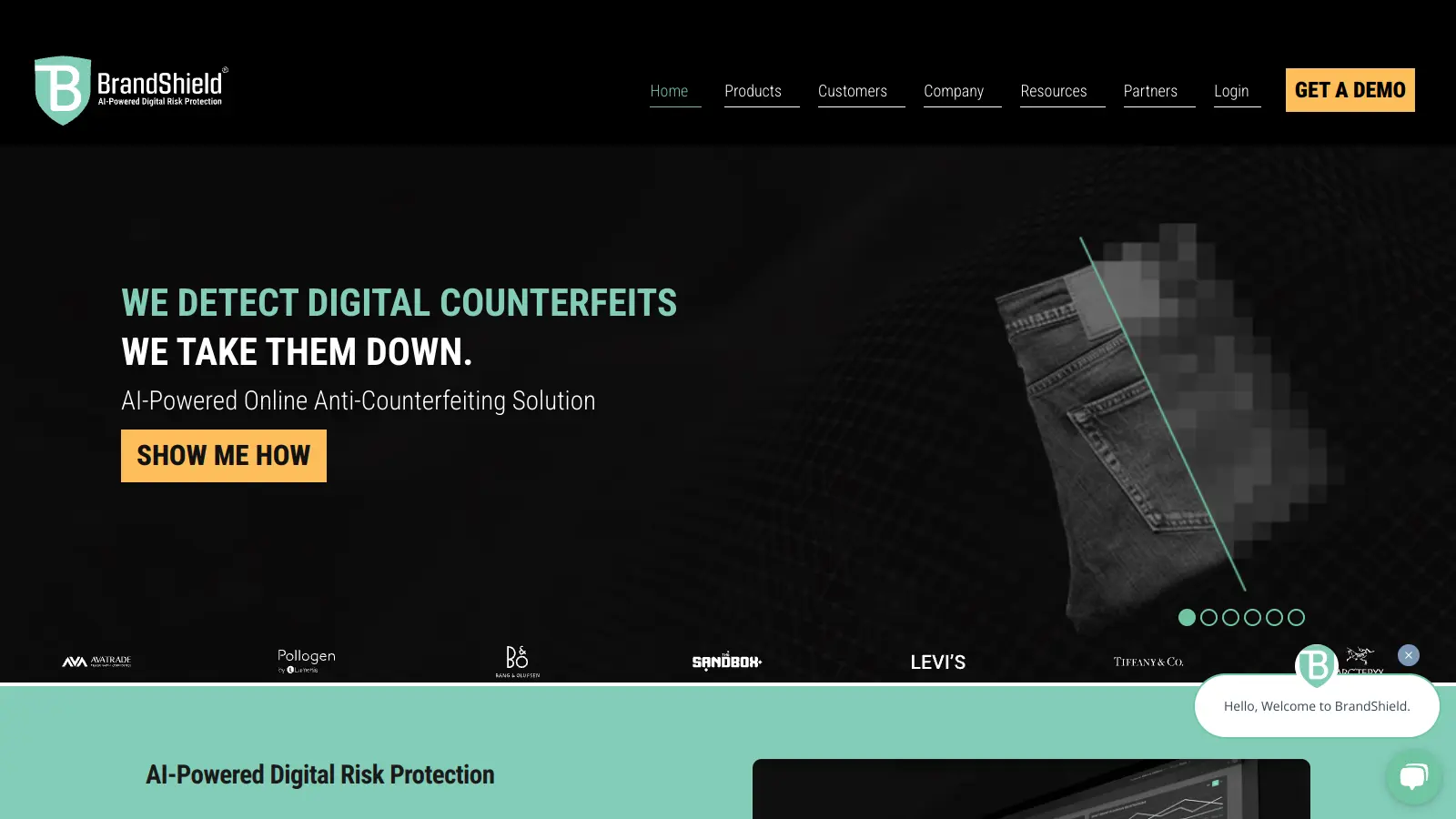
BrandShield combines automated scanning with human analyst verification to cut false positives, a real operational advantage for teams that can't afford to chase noise. Coverage spans phishing domains, counterfeit marketplace listings, and social media impersonation across a wide range of platforms. Takedown capabilities are built in, with established registrar relationships that support faster removal.
High-volume counterfeit enforcement across global e-commerce marketplaces.
Custom
Best for · Brands with large-scale counterfeit product abuse on marketplacesPricing · Pricing on request
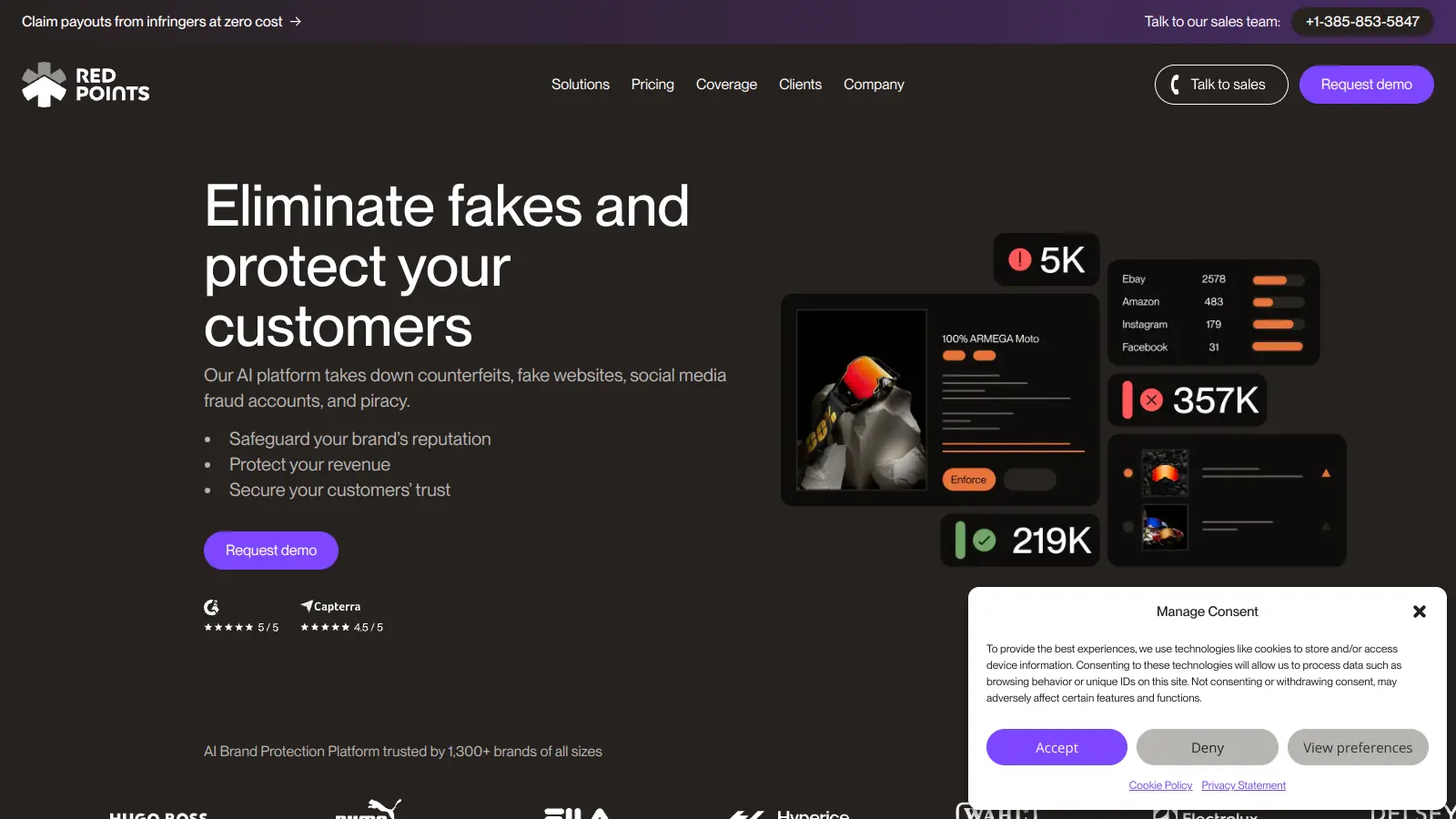
Red Points is built for brands with serious counterfeit product problems at scale. Its automated detection uses machine vision to identify infringing listings across Amazon, Alibaba, and other major marketplaces, and the platform's unlimited takedown model means enforcement costs don't spike with volume. It's less suited to phishing domain monitoring or dark web coverage.
Pros
✓Unlimited takedowns included, no per-action fees
✓Machine vision detection scales across high listing volumes
✓Strong presence on Amazon, Alibaba, and similar platforms
Cons
✗Limited depth for phishing domain and dark web threats
✗Best value only for brands with genuinely high counterfeit volumes
Social media threat monitoring across 180+ platforms with executive protection.
Custom
Best for · Organizations with high social media exposure and executive impersonation riskPricing · Pricing on request
ZeroFox is the clearest specialist in social media impersonation monitoring, covering over 180 platforms for fake accounts, credential harvesting attempts, and brand impersonation. It includes executive protection services, which makes it relevant for organizations where C-suite impersonation is a documented risk. Domain and dark web coverage exists but is secondary to its social media depth.
Pros
✓Monitors 180+ social platforms for impersonation
✓Executive protection services built into the platform
✓Integrated takedown capabilities for social media content
Cons
✗Social media specialization means weaker counterfeit enforcement
✗Pricing structure is opaque for mid-market buyers
Phishing site takedowns with industry-leading speed through direct registrar ties.
Custom
Best for · Security teams prioritizing fast phishing domain takedownsPricing · Pricing on request
Netcraft built its reputation specifically on fast phishing domain takedowns. Direct relationships with hosting providers and registrars allow them to remove malicious sites faster than most competitors, which matters because phishing infrastructure harvests credentials from the moment it goes live. The platform is strongest for organizations whose primary brand threat is phishing and lookalike domain abuse.
Pros
✓Among the fastest takedown times in the market
✓Deep relationships with hosting providers and registrars
✓Long track record in phishing detection and disruption
Cons
✗Less comprehensive for counterfeit product or social media threats
Dark web credential monitoring and phishing domain detection via API.
Custom
Best for · Security teams and MSSPs monitoring for credential leaks and phishing infrastructurePricing · Pricing on request
Breachsense focuses on the security side of brand protection: detecting lookalike domains through attack surface monitoring and tracking stolen credentials as they appear on dark web criminal marketplaces and ransomware leak sites. It's built for integration, with a well-documented API used by SOC and SIEM teams. It's not a full counterfeit enforcement platform, but it fills a specific gap that broader platforms often miss: knowing when a phishing attack has already succeeded and credentials are circulating.
Pros
✓Continuous dark web monitoring across criminal marketplaces
✓Clean API for SOC and SIEM integration
✓Detects lookalike domains before they're weaponized
Cons
✗No counterfeit product enforcement capabilities
✗Takedown execution is not built in; detection only
Threat intelligence platform with brand monitoring across open, social, and dark web sources.
Custom
Best for · Security teams already using Recorded Future for broader threat intelligencePricing · Pricing on request
Recorded Future aggregates data from open web sources, social media, forums, and dark web locations to surface brand abuse, impersonation, and fraudulent domain use. It sits inside a broader threat intelligence platform, which means brand protection capabilities are part of a larger security intelligence workflow rather than a standalone product. Security and risk teams already using Recorded Future for threat intelligence get brand monitoring as an extension of existing tooling.
Pros
✓Integrates brand monitoring with broader threat intelligence data
✓Covers open, social, and dark web sources in one platform
✓Detailed reporting suited to security and risk team workflows
Cons
✗Brand protection is a module within a large platform, not its core focus
Threat intelligence platform monitoring surface, deep, and dark web for brand exposure.
Custom
Best for · Security teams wanting combined brand and dark web threat intelligencePricing · Pricing on request
Cyble Vision monitors across surface web, deep web, and dark web for threats including data breaches, leaked credentials, exposed sensitive information, and threat actor activities targeting your organization. Its dashboard-driven interface and customizable alerting make it accessible to security teams managing ongoing monitoring workloads. Brand protection coverage includes phishing site detection and brand mention monitoring alongside the broader threat intelligence data.
Pros
✓Monitors surface, deep, and dark web from one platform
✓Customizable alerting reduces alert fatigue
✓Real-time breach and credential leak detection
Cons
✗Brand protection is one feature within a broad threat intel platform
✗Less specialized for counterfeit enforcement or takedown execution
End-to-end brand identity protection with built-in UDRP and DMCA enforcement support.
Custom
Best for · Legal and brand teams needing integrated enforcement workflow supportPricing · Pricing on request
RiskProfiler covers domain duplication, counterfeit mobile apps, phishing sites, unauthorized logo usage, and executive impersonation across social platforms and the dark web. What distinguishes it is built-in support for UDRP and DMCA enforcement processes alongside rapid takedown execution, rather than leaving legal enforcement to your team. It works with global hosting providers to speed up removal and includes monitoring for fake product listings and coordinated abuse campaigns.
Pros
✓UDRP and DMCA enforcement support built into the platform
✓Covers domains, apps, social media, and dark web in one view
✓Works directly with hosting providers to accelerate takedowns
Cons
✗Newer platform with less documented track record than established competitors
✗No published pricing or self-serve tier available
Phishing domain takedown, counterfeit enforcement, and social media impersonation require different infrastructure and expertise. Identify which threat causes the most damage to your organization and prioritize platforms that specialize there before evaluating secondary coverage.
Ask specifically about takedown speed and success rates
Average takedown time varies from hours to weeks depending on a vendor's registrar relationships. Ask vendors for documented average takedown times and success rates across specific registrars and hosting providers, not just general claims.
Check whether detection extends to the dark web
Many platforms detect threats on the surface web but miss credential leaks and data sold on dark web forums and criminal marketplaces. If credential theft is a concern, confirm that the platform monitors dark web sources continuously, not just on request.
Understand the pricing model for takedowns
Some platforms charge per takedown, which creates unpredictable costs if you face high volumes of infringement. Others offer unlimited takedowns as part of a flat subscription. This distinction matters significantly for brands dealing with large-scale counterfeit abuse.
High detection coverage is only useful if the alerts are accurate. Platforms that combine automated scanning with human analyst review tend to produce fewer false positives, which reduces the time your team spends triaging noise rather than acting on real threats.
frequently asked questions
Most enterprise-grade platforms don't publish pricing and quote based on the number of brands, markets monitored, and takedown volume. Mid-market tools tend to start between $500 and $2,000 per month. Expect significant variation depending on whether takedowns are included in the subscription or billed separately.
Free tools like Google Alerts can catch some brand mentions, but they don't monitor for lookalike domains, dark web leaks, or counterfeit listings. If your brand has any meaningful market presence, the gap between free monitoring and a dedicated platform is large enough to matter when a threat appears.
Domain monitoring is one component of brand protection, focused specifically on detecting lookalike or typosquatted domains. Full brand protection platforms also cover counterfeit product enforcement, social media impersonation, executive protection, and dark web data leaks. Some vendors use the terms interchangeably, so check the feature list carefully.
Some platforms automate takedown submissions to registrars, hosting providers, and marketplaces with which they have established relationships. Others generate takedown-ready reports that your legal team submits manually. Fully automated enforcement is faster but depends on the vendor's network of cooperative partners, and not all registrars cooperate at the same speed.
Choosing a platform based on detection breadth without verifying takedown effectiveness. A tool that finds 10,000 infringing domains but takes three weeks to remove them is less useful than one that finds fewer threats and resolves them in 24 hours. Always ask for case studies or documented takedown timelines before signing a contract.
tools for humans
toolsforhumans editorial team
Reader ratings and community feedback shape every score. Since 2022, ToolsForHumans has helped 600,000+ people find software that holds up after launch. The picks here come from that.