Best AI Lead Generation Tools: Ranked for B2B Teams (2026)
7 tools reviewedlast reviewed 20 march 2026
Editorial note:this was originally published in july of 2023
Some links on this page are affiliate links. If you sign up via our link we may earn a commission, at no extra cost to you. This doesn't affect which tools we recommend or how we rank them.
This page is for B2B sales and marketing teams that want to move faster from prospect list to booked meeting. The tools here cover the main jobs in that process: finding verified contact data, automating outreach sequences, scoring inbound leads, and enriching CRM records.
Each pick was evaluated on data accuracy, pricing transparency, ease of setup, and how well it fits real sales workflows rather than just feature lists. The list includes established platforms and a couple of narrower tools worth knowing about depending on your stack.
We collect first-hand reviews from people who use these tools every day — what works, what doesn't, whether it's worth paying for. We research pricing, features, and comparisons so that feedback has real context behind it. For this guide, tools were selected based on lead qualification accuracy, integration capabilities, and real-time data enrichment features. Read our full research methodology.
help us improve this guide
tell us what you're looking for, what you're using now, and what caught your eye — takes 30 seconds.
What are AI lead generation tools?
AI lead generation tools are software platforms that help sales and marketing teams identify, qualify, and contact potential customers with less manual work. They use machine learning and large datasets to find contact information, predict which prospects are likely to convert, and automate early-stage outreach like email sequences or LinkedIn messages.
The category covers several distinct jobs: prospecting and contact data lookup, intent signal monitoring, lead scoring, outreach automation, and CRM enrichment. Many platforms combine two or three of these, while others specialize in one. Businesses typically use them when manual prospecting can't keep up with pipeline targets, or when CRM data is too stale to trust.
The primary users are SDRs, account executives, demand generation marketers, and RevOps teams at B2B companies. Small agencies and solo founders also use lighter-weight tools in this category to replace manual research time.
Multichannel outreach sequences with personalized image and video steps.
Sales teams prioritising personalised multichannel outreach
PaidFrom $39/user/mo
our top pick
1
Apollo.io
A large B2B contact database with built-in outreach sequencing.
Freemium
Best for · SMB and mid-market B2B sales teamsPricing · Free plan available. Paid from $49/user/mo
Apollo gives you access to over 275 million contacts with filters for job title, company size, industry, revenue, and technology stack. You can build prospect lists and launch email and LinkedIn sequences from the same interface. The AI features include lead scoring, suggested sequences, and job change alerts that flag when contacts move to new companies.
Pros
✓Free plan includes 10,000 email credits/mo
✓Sequencing and contact data in one tool
✓Strong filtering for ICP-based list building
Cons
✗Data accuracy drops for mid-market European contacts
✗Sequence builder is less capable than dedicated tools like Outreach
Real-time contact data search with Chrome extension prospecting.
Freemium
Best for · SDRs focused on outbound phone and email prospectingPricing · Free up to 50 credits. Paid plans via custom quote
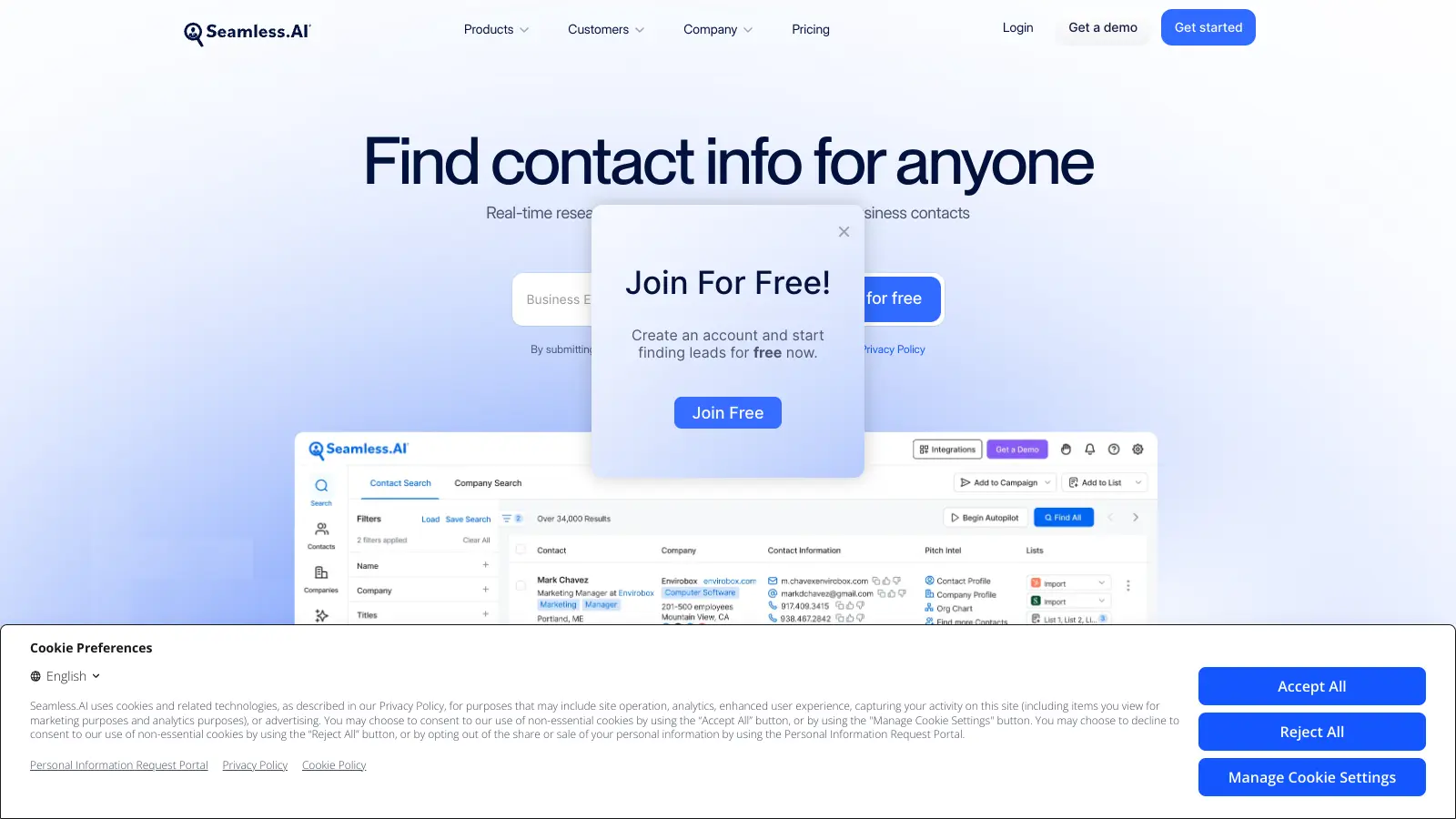
Seamless.AI crawls the web in real time to find and verify contact data rather than serving records from a static database. The Chrome extension lets SDRs pull phone numbers and emails directly from LinkedIn profiles or company websites. It also has a basic pitch intelligence feature that generates talking points based on a prospect's role and company.
Pros
✓Real-time verification reduces bounce rates
✓Chrome extension works directly on LinkedIn
✓Includes mobile phone numbers more often than many rivals
Cons
✗Paid pricing requires a sales call to get a quote
A data enrichment workflow builder that pulls from 75+ sources.
Freemium
Best for · Ops-savvy teams doing high-personalization outboundPricing · Free plan available. Paid from $149/mo
Clay is a spreadsheet-style tool that lets you build enrichment and research workflows by combining data from over 75 providers, including LinkedIn, Apollo, Clearbit, and Hunter. You can automate lead research that would otherwise take hours of manual work: pulling company funding data, tech stack, headcount growth, and contact info in one step. Its AI feature, Claygent, can visit websites and extract custom information using natural language instructions.
Pros
✓Combines 75+ data sources in one workflow
✓Claygent can extract custom data from any website
✓Reduces cost by only calling enrichment APIs when needed
Cons
✗Requires time to learn the workflow logic before seeing value
✗Credit costs add up fast if enrichment workflows aren't carefully scoped
Account-level intent data and predictive scoring for enterprise GTM teams.
Custom
Best for · Enterprise revenue teams with defined ICPPricing · Pricing on request
6sense uses AI to identify which accounts are actively researching solutions like yours, even when they haven't filled out a form. It pulls intent signals from across the web, combines them with firmographic data, and predicts where an account is in its buying journey. The platform connects to Salesforce and HubSpot to surface these scores directly in the CRM and trigger automated plays.
Pros
✓Identifies anonymous buying intent at account level
✓Strong Salesforce and HubSpot native integration
✓Reduces wasted outreach to accounts not in-market
Cons
✗Pricing is enterprise-level with annual contracts required
✗Takes significant setup and ICP definition to generate accurate scores
Cold email infrastructure with built-in lead database and warmup.
Paid
Best for · Small teams running high-volume cold email campaignsPricing · From $37/mo for sending. Lead database from $47/mo
Instantly is primarily a cold email sending platform with features for inbox rotation, email warmup, and deliverability monitoring. It added a B2B lead database in 2024 with around 160 million verified contacts. The combination means you can find prospects and send to them without connecting a separate tool, which simplifies the stack for small teams doing high-volume outbound.
Pros
✓Email warmup and rotation built in from day one
✓Lead database and sending tool in one subscription
✓Simpler setup than stitching Apollo and a sending tool together
Cons
✗Lead database is newer and has less depth than Apollo or Seamless
Website visitor identification and Klaviyo enrichment for e-commerce brands.
Custom
Best for · E-commerce brands running Klaviyo email programsPricing · Pricing on request. ROI guarantee offered.
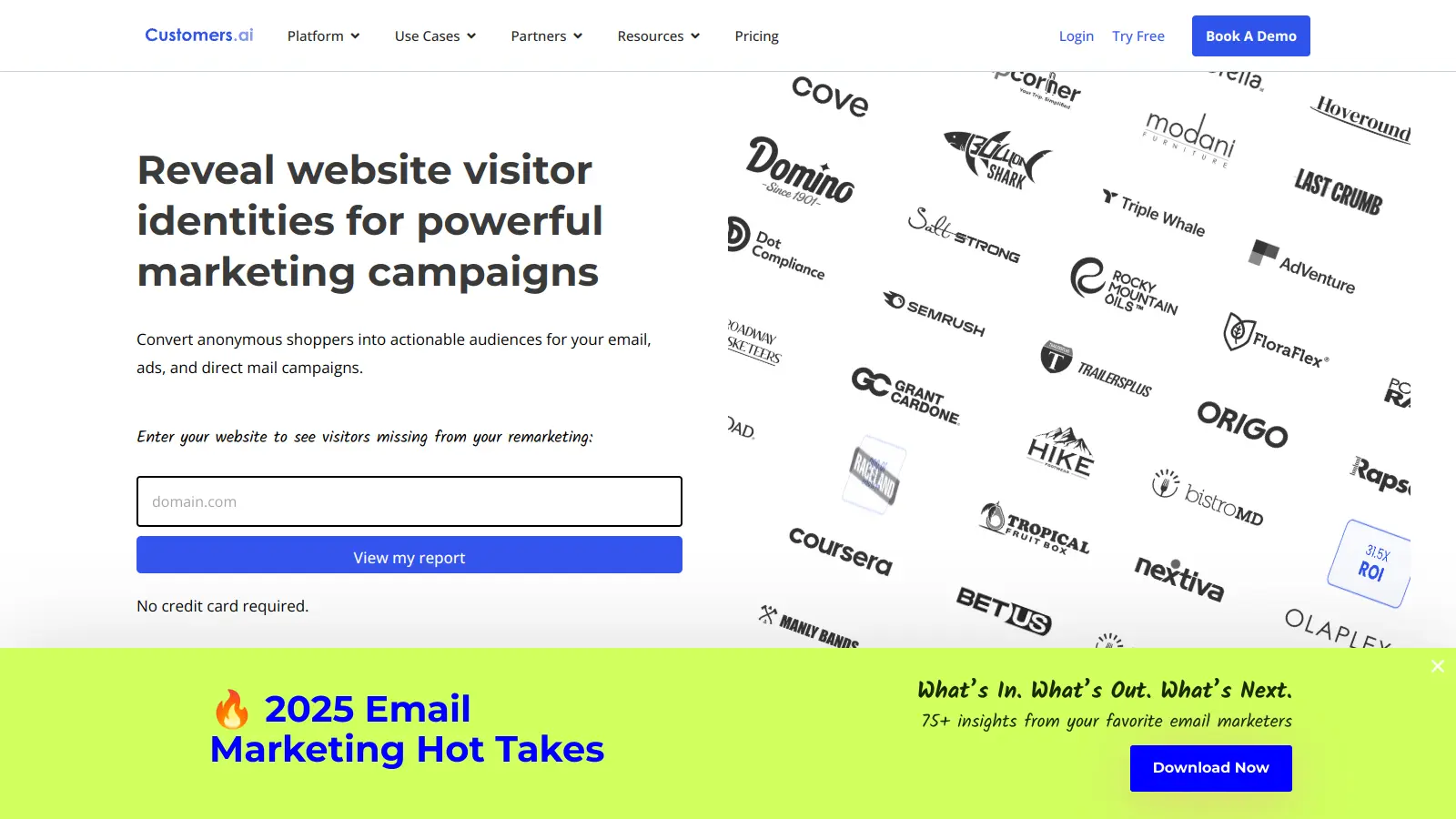
Customers.ai identifies anonymous website visitors and builds audience segments based on predicted purchase intent, then feeds those segments into Klaviyo email flows. Its X-Ray pixel captures more behavioral signals than Klaviyo's native tracking, and its AI agent Alfred predicts likelihood to buy based on daily-updated models. It's more relevant to e-commerce retention teams than traditional B2B outbound teams.
Pros
✓Identifies anonymous visitors Klaviyo misses
✓Daily intent scoring updates without manual input
✓Claims guaranteed 5x ROI or no payment
Cons
✗Built specifically for e-commerce, not B2B sales teams
✗Pricing requires a sales conversation with no public tiers
Multichannel outreach sequences with personalized image and video steps.
Paid
Best for · Sales teams prioritising personalised multichannel outreachPricing · From $39/user/mo
Lemlist runs email, LinkedIn, and cold call steps inside a single sequence. Its standout feature is dynamic personalization: you can insert a prospect's name, company logo, or screenshot of their website into email images automatically. It also has a lead database of around 450 million contacts and an AI sequence builder that generates full multichannel cadences from a prompt.
Pros
✓Dynamic image personalisation is genuinely differentiating
✓Email, LinkedIn, and call steps in one sequence
✓AI sequence builder drafts full cadences quickly
Cons
✗Contact database quality is inconsistent for non-English markets
✗Per-seat pricing gets expensive for teams larger than five people
A tool with 300 million contacts is only useful if it covers the industries, geographies, and job titles you actually sell to. Ask vendors for a sample of records in your target segment before committing, and check whether they verify emails in real time or rely on static databases that go stale.
Outreach automation vs. data-only
Some tools are purely data providers: you export contacts and run outreach in your existing email or CRM tool. Others include built-in sequencing, calling, and LinkedIn steps. If you already have a sales engagement platform like Outreach or Salesloft, you may not need a second one bundled in.
CRM and workflow integrations
Check whether the tool connects natively to your CRM (Salesforce, HubSpot, Pipedrive are the most common) or requires a Zapier workaround. Native two-way sync matters most if you want lead scores and enrichment data to update automatically rather than on a manual export schedule.
Pricing model and credit limits
Most contact data tools charge per credit or per seat with a monthly credit allowance. Understand what counts as a credit (is it one email lookup, one full contact record, or one export?) and whether unused credits roll over. Tools that charge per seat can get expensive fast for larger SDR teams.
Compliance and data sourcing
GDPR and CCPA compliance is a real concern, particularly for European market prospecting. Ask specifically how the vendor sources contact data, how often records are refreshed, and whether they honor opt-out requests. This matters both legally and for deliverability: outdated or scraped email lists hurt your sending reputation.
frequently asked questions
Entry-level plans with limited credits start around $49 to $99 per month for individual users. Mid-market team plans typically run $300 to $1,000 per month depending on seat count and credit volume. Enterprise tools with intent data and predictive scoring often require custom quotes and annual contracts starting in the low five figures.
Most free plans give you 50 to 100 credits, which is enough to verify whether the contact data quality is good for your target segment. It's usually not enough to run a full campaign. Use free plans specifically to spot-check record accuracy before upgrading, rather than as a long-term workflow.
Separate tools give you more flexibility but require more integration work. All-in-one platforms like Apollo.io are a sensible choice for smaller teams that don't already have a sales engagement platform. If you're already running Outreach or Salesloft, a data-only tool like Seamless.AI or Clay may be a better fit to avoid paying twice for sequencing features.
Importing too many contacts too fast without validating email quality first. Large, unverified lists damage your sending domain reputation, which can take months to recover. Start with a tightly filtered segment, validate emails before sending, and warm up sending volumes gradually.
Most use a combination of firmographic fit (company size, industry, job title) and behavioral signals (website visits, content downloads, email opens). Intent data tools also layer in third-party signals like review site activity or topic research spikes. The quality of the output depends entirely on how well you've defined your ideal customer profile in the tool's setup.
tools for humans
toolsforhumans editorial team
Reader ratings and community feedback shape every score. Since 2022, ToolsForHumans has helped 600,000+ people find software that holds up after launch. The picks here come from that.