Best Survey Analysis Software: Top Picks for Researchers (2026)
7 tools reviewedlast reviewed 20 march 2026
Editorial note:this was originally published in september of 2024
Survey analysis software does the heavy lifting between raw responses and decisions you can act on. This page is for researchers, UX teams, and market analysts who need to go beyond pivot tables and actually understand what their data is saying.
The tools here cover a wide range: AI-powered qualitative analysis, statistical platforms for advanced modelling, and all-in-one solutions that handle collection and analysis together. Pricing ranges from free tiers to enterprise contracts, and the right choice depends heavily on whether you're working with structured quantitative data, open-ended responses, or both.
Each tool was selected based on analysis depth, realistic pricing, integration options, and fit for teams at different sizes and technical levels.
We collect first-hand reviews from people who use these tools every day — what works, what doesn't, whether it's worth paying for. We research pricing, features, and comparisons so that feedback has real context behind it. For this guide, tools were selected based on automation capabilities, real-time collaboration features, and statistical analysis depth. Read our full research methodology.
help us improve this guide
tell us what you're looking for, what you're using now, and what caught your eye — takes 30 seconds.
What is survey analysis software?
Survey analysis software processes responses from questionnaires and converts them into structured findings. It handles tasks like cross-tabulation, statistical significance testing, sentiment analysis on open-text responses, and visual reporting, so researchers spend less time cleaning data and more time drawing conclusions.
These tools are used by market researchers, UX designers, product teams, HR departments, and academic institutions. Some focus purely on analysis and import data from other collection tools. Others combine survey building, distribution, and analysis into one platform.
The category has expanded significantly with AI features that can auto-code open-ended responses, detect themes across thousands of answers, and surface correlations that would take hours to find manually.
Enterprise survey and research analytics platform for professional researchers.
Research agencies and enterprise CX teams
CustomPricing on request
our top pick
1
Qualtrics XM
Enterprise survey platform with deep statistical analysis built in.
Custom
Best for · Enterprise research teams and large organisationsPricing · Pricing on request
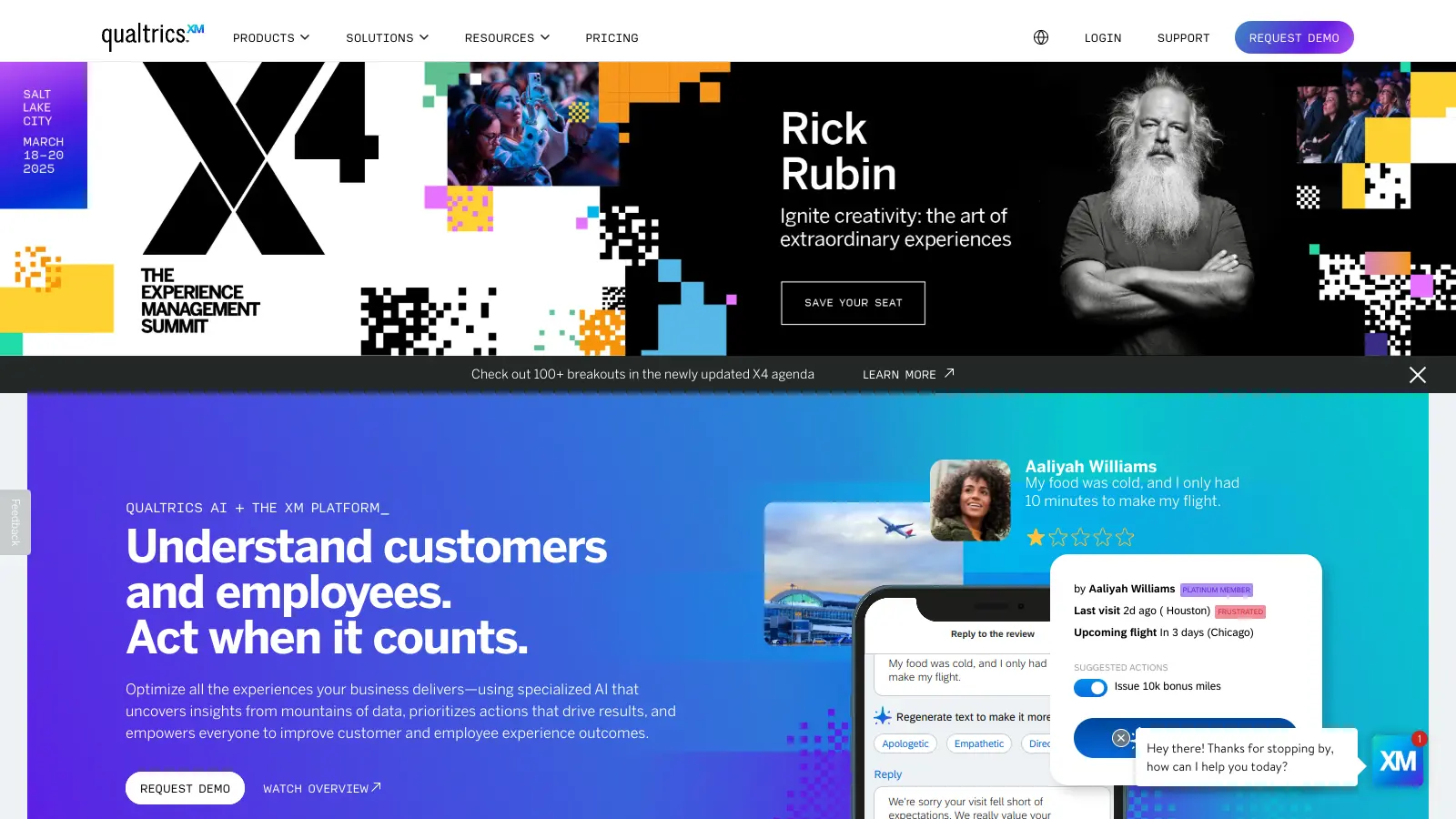
Qualtrics combines survey creation, distribution, and analysis in one platform used by large research teams and enterprise companies. Its Stats iQ feature handles regression, correlation, and significance testing without requiring statistical expertise, and Text iQ auto-codes open-ended responses at scale. It's overkill for small teams but hard to match for organisations running continuous research programmes.
Pros
✓Stats iQ handles regression without manual setup
✓Text iQ auto-codes thousands of open responses
✓Integrates with Salesforce, Marketo, and ServiceNow
Cons
✗Pricing is opaque and contracts run expensive
✗Feature depth creates a steep learning curve for new users
AI research repository that analyses surveys alongside other qualitative data.
Custom
Best for · UX researchers and product teams running mixed-method researchPricing · Pricing on request
Marvin is a user research platform with a dedicated survey analysis module. It imports NPS surveys and other response data, then uses AI to identify themes, find correlations between responses, and protect participant anonymity. It's particularly useful for teams that run both surveys and interviews, since it keeps all research in one searchable repository rather than scattered across files.
Pros
✓Correlates NPS scores with open-text responses automatically
✓Centralises surveys, interviews, and other research in one place
✓Anonymises participant data while preserving insights
Cons
✗Pricing requires a sales conversation, no self-serve plan listed
✗Heavier focus on qualitative UX research than quantitative survey stats
The statistical standard for academic and professional survey researchers.
Paid
Best for · Academic researchers and statisticians needing advanced analysisPricing · From $99/year (academic)
SPSS has been the go-to tool for survey statisticians for decades. It handles everything from basic frequencies to advanced multivariate analysis, factor analysis, and conjoint studies. The interface is dated compared to newer platforms, but the analytical depth is unmatched in its price range. Academic licences start around $99/year, making it accessible for students and researchers.
Pros
✓Widest statistical procedure library in the category
✓Syntax-based workflow is reproducible and auditable
✓Academic pricing makes it affordable for research institutions
Cons
✗Interface has not meaningfully updated in years
✗No built-in survey creation or distribution tools
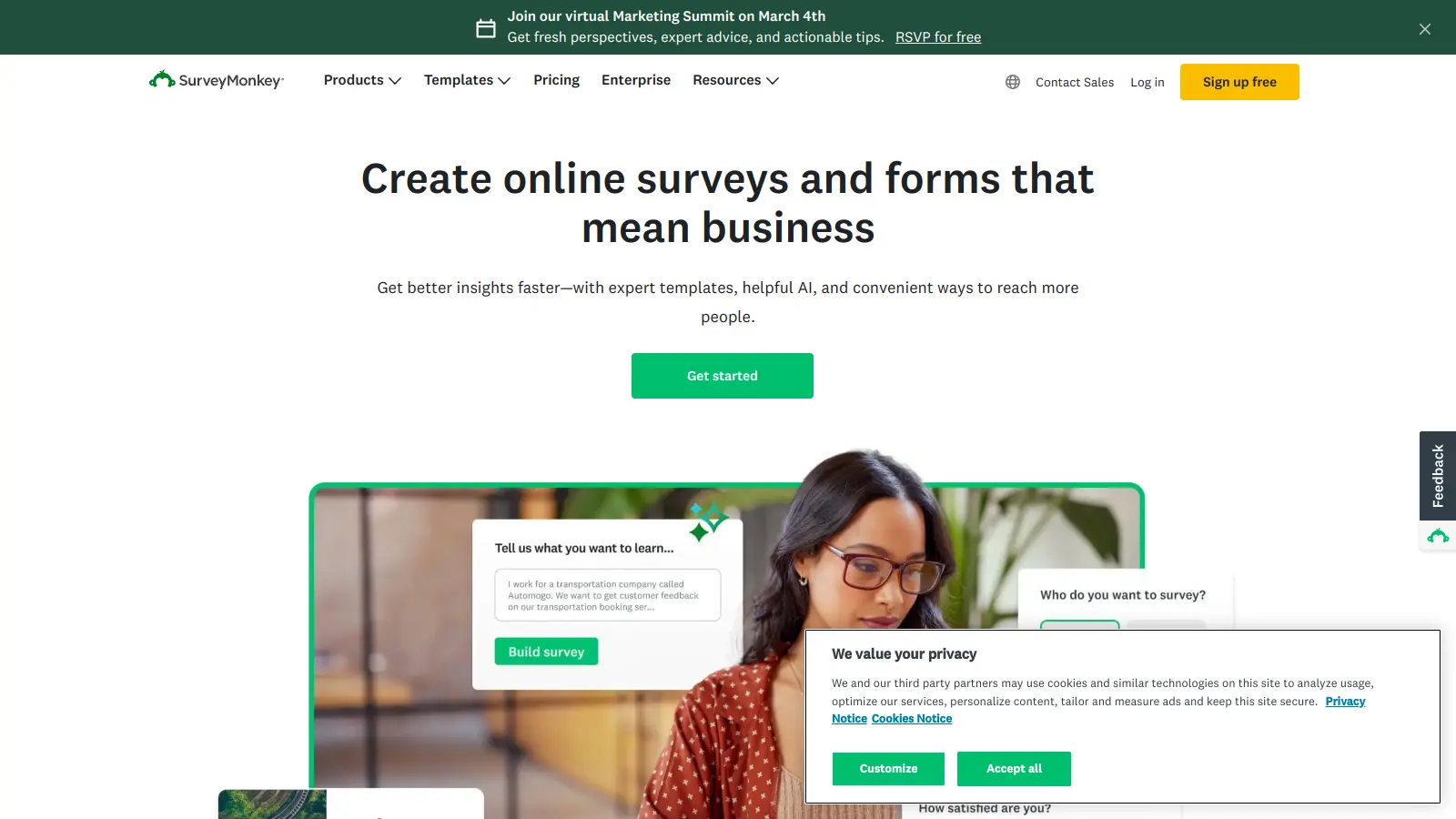
Accessible analysis built into the world's most-used survey tool.
Freemium
Best for · Teams already collecting surveys through SurveyMonkeyPricing · Free plan available; paid from $25/mo
SurveyMonkey's built-in Analyze features cover filtering, cross-tabulation, and sentiment tagging on responses collected through the platform. It's not a standalone analysis tool, but for teams already using SurveyMonkey for collection, the analysis layer is immediately available without exporting data. The free plan covers basic summaries; significance testing and custom reports need a paid plan.
Pros
✓No data export needed, analysis runs on collected responses directly
✓Filter and cross-tab builder requires no technical setup
✓Benchmark data available for common question types
Cons
✗Analysis is limited to data collected in SurveyMonkey itself
✗Advanced statistical tests not available even on higher-tier plans
Automated survey analysis and reporting for market researchers.
Paid
Best for · Market research teams producing client-facing reportsPricing · From $119/mo
Displayr is built specifically for market research teams who run large quantitative studies. It automates cross-tabulation, significance testing, and chart creation, and can generate full PowerPoint or PDF reports from templates. The platform connects directly to data from Qualtrics, SurveyMonkey, and other tools, and uses R under the hood for statistical computation without requiring users to write code.
Pros
✓Automated cross-tab and significance testing saves hours per project
✓Generates branded PowerPoint reports directly from the platform
✓R-powered stats without requiring users to write R code
Cons
✗Pricing is high for smaller teams or infrequent research projects
✗Learning the template and automation system takes meaningful setup time
Conversational survey tool with built-in response analytics.
Freemium
Best for · Small teams running lightweight surveys who need quick response summariesPricing · Free plan available; paid from $25/mo
Typeform's analytics panel gives completion rates, drop-off points, response distributions, and averages across question types. It's useful for diagnosing survey performance and reviewing response trends without exporting data. For deeper analysis, Typeform connects to Google Sheets and Zapier. The analysis features are not as deep as dedicated tools, but the combination of high completion rates and immediate reporting is practical for smaller teams.
Pros
✓Drop-off and completion analytics visible without extra setup
✓Native Zapier and Google Sheets connections for further analysis
✓High response rates from conversational survey format
Cons
✗No statistical testing or cross-tabulation in the native analytics
✗Open-text analysis requires export to a separate tool
Enterprise survey and research analytics platform for professional researchers.
Custom
Best for · Research agencies and enterprise CX teamsPricing · Pricing on request
Forsta covers the full research lifecycle from survey design to analysis to reporting, with particular strength in customer experience and market research programmes. It supports complex survey logic, multilingual studies, and advanced analytics including text analytics and predictive modelling. The platform targets research agencies and large in-house research functions rather than small teams.
Pros
✓Handles multilingual and multi-market research programmes natively
✓Text analytics and predictive modelling included at enterprise tier
✓Strong reporting and dashboard customisation for client delivery
Cons
✗No publicly listed pricing, requires sales engagement to evaluate cost
✗Complexity is too high for teams running simple or infrequent studies
Quantitative data with Likert scales and multiple choice works well in most tools. If you have a lot of open-ended text responses, you need a platform with text analytics or AI coding, not just cross-tabs.
Statistical depth required
Basic frequency counts and significance testing are standard. If you need regression modelling, conjoint analysis, or MaxDiff, only a handful of platforms support those natively. SPSS and Qualtrics Stats iQ handle advanced stats; most others don't.
Where your data lives
Check whether the tool imports directly from your survey platform (SurveyMonkey, Typeform, etc.) or whether you'll be uploading CSV files manually. Native integrations save time on every project cycle.
Team size and technical skill
Some platforms assume statistical knowledge and present raw output. Others are designed for non-researchers and auto-generate plain-English summaries. Match the tool to the people who'll actually use it daily, not just the one expert on your team.
Reporting and sharing requirements
If stakeholders need polished dashboards or live shareable reports, look for tools with customisable templates and export options. Some platforms produce presentation-ready outputs; others output data tables you'll still need to format yourself.
frequently asked questions
Survey software handles design and data collection. Survey analysis software processes the responses after collection. Many modern platforms combine both, but dedicated analysis tools like SPSS or Marvin are built specifically to go deeper on the insights side, not the distribution side.
Free tiers exist for basic tools like Google Forms with Sheets analysis or limited plans from SurveyMonkey. Mid-range platforms run from roughly $25 to $150 per month. Enterprise platforms like Qualtrics and Forsta are priced on request and typically cost thousands per year. Statistical tools like SPSS are sold by subscription, starting around $99/year for academic licences.
Yes, but only in certain tools. Platforms like Marvin and Qualtrics use AI to auto-code themes in open-text responses. Basic tools require manual coding or export to a separate text analysis tool. If open-ended responses are central to your research, prioritise platforms with built-in NLP or AI tagging features.
It depends on the tool. Platforms like SurveyMonkey Analyze and Marvin are designed for non-statisticians and present results in plain language. SPSS and R-based tools assume familiarity with statistical concepts. Most enterprise platforms sit somewhere in between, with guided analysis options alongside raw statistical output.
Choosing based on survey-building features and ignoring the analysis side. Many teams pick a tool they like for creating surveys but find the analysis options too limited once responses come in. Evaluate the output quality and reporting capabilities first, then work backwards to collection.
tools for humans
toolsforhumans editorial team
Reader ratings and community feedback shape every score. Since 2022, ToolsForHumans has helped 600,000+ people find software that holds up after launch. The picks here come from that.