Best Amazon PPC Software: Top Picks for Sellers (2026)
7 tools reviewedlast reviewed 20 march 2026
Editorial note:this was originally published in september of 2024
Some links on this page are affiliate links. If you sign up via our link we may earn a commission, at no extra cost to you. This doesn't affect which tools we recommend or how we rank them.
Managing Amazon PPC by hand stops working fast. Once you're running dozens of campaigns across Sponsored Products, Sponsored Brands, and Sponsored Display, the volume of bid adjustments, negative keyword harvesting, and search term analysis quickly exceeds what any spreadsheet can handle.
This page covers 7 Amazon PPC tools worth considering in 2026, from full-stack automation platforms for high-spend brands to leaner tools for sellers who want more control. Each pick is assessed on automation quality, pricing transparency, supported ad types, and how quickly a new user can get results.
Pricing models vary significantly across this category: some tools charge a flat monthly fee, others take a percentage of ad spend. That distinction matters a lot as your budget grows, so pricing structure is called out clearly for each tool.
We collect first-hand reviews from people who use these tools every day — what works, what doesn't, whether it's worth paying for. We research pricing, features, and comparisons so that feedback has real context behind it. For this guide, tools were selected based on automation capabilities, real-time bid management, and keyword research depth specific to Amazon advertising. Read our full research methodology.
help us improve this guide
tell us what you're looking for, what you're using now, and what caught your eye — takes 30 seconds.
What is Amazon PPC software?
Amazon PPC software connects to Amazon's Advertising API to manage Sponsored Products, Sponsored Brands, and Sponsored Display campaigns on your behalf. It automates bid adjustments, identifies high-converting search terms, and flags wasted spend on non-performing keywords, tasks that would otherwise require daily manual checks inside Seller Central.
Sellers use these tools to handle the volume and speed that manual campaign management can't match. A mid-size seller running 200 campaigns might have tens of thousands of active keywords; adjusting bids on each one daily by hand is impractical. PPC software applies rules or machine learning to do this continuously, often every few hours.
The category splits roughly into two types: rule-based tools, where you define the logic (e.g. 'if ACoS exceeds 30%, reduce bid by 15%'), and AI-driven tools that adjust bids based on predictive models. Most modern platforms offer some combination of both.
AI-powered PPC optimisation with a free tier for lower-spend sellers.
Early-stage sellers wanting AI automation before committing to a paid plan
FreemiumFree up to $10k ad spend/mo; paid plans from $99/mo
our top pick
1
Perpetua
AI bid optimisation built for serious Amazon advertisers.
Paid
Best for · Mid-to-large sellers with $10k+ monthly ad spendPricing · From $250/mo
Perpetua uses goal-based campaign management: you set a target ACoS or growth objective, and its algorithm adjusts bids across Sponsored Products, Sponsored Brands, and Sponsored Display continuously. It also supports Amazon DSP and Walmart Advertising, making it one of the more complete platforms for brands running multi-channel campaigns. The interface is clean but assumes you already understand campaign structure.
Pros
✓Covers SP, SB, SD, and Amazon DSP in one platform
✓Goal-based setup reduces manual configuration
✓Strong dayparting and scheduling controls
Cons
✗Expensive for sellers under $5k monthly ad spend
✗Limited transparency into how the AI makes specific bid changes
PPC automation inside the most widely used Amazon seller suite.
Paid
Best for · Sellers already on Helium 10 wanting PPC in one subscriptionPricing · From $99/mo (Diamond plan required for full Adtomic access)
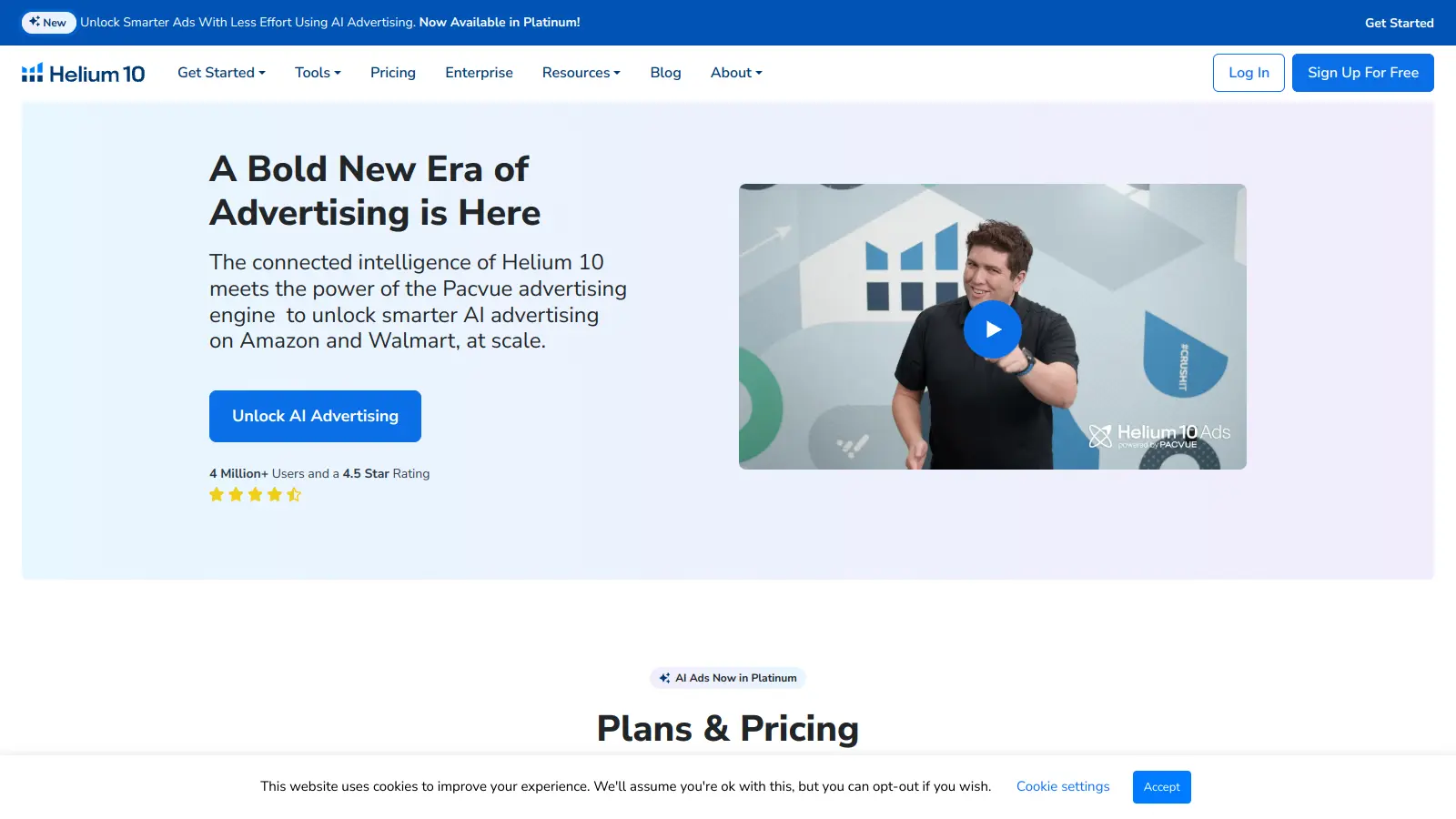
Adtomic is Helium 10's PPC management module, available as part of its broader seller toolkit that also includes keyword research, listing optimisation, and inventory tools. The automation uses a combination of rule-based logic and AI suggestions, and it covers Sponsored Products, Sponsored Brands, and Sponsored Display. Its main practical advantage is that sellers already using Helium 10 for research get PPC management without paying for a separate tool.
Pros
✓Keyword research and PPC data in a single platform
✓Rule-based automation with clear logic you can audit
✓Large user community and documentation
Cons
✗Full Adtomic features require higher-tier plan at $279/mo
✗AI recommendations less sophisticated than standalone PPC tools
Flat-fee Amazon PPC automation for cost-conscious FBA sellers.
Paid
Best for · Small to mid-size FBA sellers watching software costsPricing · From $97/mo (14-day free trial available)
SellerMetrics is a straightforward PPC automation tool with automated bidding, search term harvesting, dayparting, and a one-click campaign launcher for Sponsored Products. It supports all Amazon ad types and runs bid optimisation continuously against user-defined ACoS goals. Its pricing is flat-fee and tiered by ad spend, which makes it predictably affordable compared to percentage-of-spend competitors. A 14-day trial is available on all plans.
Pros
✓Flat-fee pricing won't scale with your ad spend
✓Dayparting and keyword ranking tools included
✓14-day trial on all plans, no credit card required
Cons
✗Smaller user base means fewer third-party tutorials and community help
✗Reporting depth is lighter than enterprise-tier competitors
Granular rule-based PPC automation for detail-oriented sellers.
Paid
Best for · Experienced sellers who want rule transparency over AI automationPricing · From $78/mo
Scale Insights is a rule-based Amazon PPC tool popular with sellers who want to build precise, auditable automation logic rather than hand control to an opaque AI. It supports Sponsored Products automation with detailed bid rules, search term harvesting, and bulk operations. Pricing is based on the number of ASINs rather than ad spend, which benefits sellers with high spend but a focused catalogue.
Pros
✓ASIN-based pricing is predictable and doesn't scale with ad spend
✓Highly configurable automation rules with full audit trail
✓Active support community and regular feature updates
Cons
✗Steeper learning curve than goal-based AI tools
✗Sponsored Brands and Sponsored Display automation less mature than SP
Enterprise-grade retail media management across Amazon and beyond.
Custom
Best for · Enterprise brands and agencies managing $100k+ monthly ad spendPricing · Pricing on request
Pacvue is built for brands and agencies managing large advertising budgets across Amazon, Walmart, Instacart, and other retail media networks. It includes automated bidding, share of voice tracking, dayparting, and competitive intelligence at a depth that smaller tools don't match. The platform is priced for enterprise buyers and typically requires a demo before pricing is disclosed. It's overkill for individual sellers but appropriate for large brands or agencies managing multiple accounts.
Pros
✓Covers Amazon, Walmart, Instacart, and other retail media in one platform
✓Share of voice and competitive intelligence built in
✓Robust agency and multi-account management features
Cons
✗Pricing is not publicly disclosed and typically involves long contracts
✗Far more complexity than most individual sellers need
AI-driven Amazon PPC optimisation that charges a percentage of ad spend.
Paid
Best for · Growth-stage brands running Amazon and off-Amazon ads togetherPricing · Percentage of ad spend (typically 2-3%)
Quartile applies machine learning to Amazon PPC bid management across all major ad types, with the algorithm updating bids based on real-time auction signals. It also supports Google, Meta, and Walmart advertising, which makes it a fit for brands running cross-channel campaigns. Pricing is percentage-based, so costs grow directly with ad budget, something to factor in carefully as spend scales.
Pros
✓Cross-channel support including Google and Meta ads
✓Fully managed AI automation with hands-off operation
✓Proven track record with mid-market and DTC brands
Cons
✗Percentage-based pricing becomes expensive at higher ad budgets
✗Less control for sellers who want to understand or override bid logic
AI-powered PPC optimisation with a free tier for lower-spend sellers.
Freemium
Best for · Early-stage sellers wanting AI automation before committing to a paid planPricing · Free up to $10k ad spend/mo; paid plans from $99/mo
Teikametrics offers a freemium model: its basic AI bid optimisation is free for accounts spending under $10k/month on ads, which is a rare entry point in this category. The paid Flywheel AI tier adds more aggressive optimisation, keyword harvesting, and performance forecasting. It covers Sponsored Products and Sponsored Brands across Amazon and Walmart. The free tier is genuinely useful, not just a stripped-down demo.
Pros
✓Free tier covers real AI optimisation, not just basic reporting
✓Covers both Amazon and Walmart Advertising
✓Clear upgrade path as ad spend grows
Cons
✗Free tier limits access to advanced keyword harvesting features
✗Paid percentage-of-spend tier can get costly for high-volume accounts
Pricing model: flat fee vs. percentage of ad spend
Percentage-of-spend pricing sounds low at first but compounds quickly. A tool charging 3% of ad spend costs $300/month at $10k spend and $1,500/month at $50k. Flat-fee tiers are usually better for scaling sellers. Check whether the tier is based on ad spend, revenue, or number of ASINs.
Automation depth and bid logic transparency
Some platforms treat their bidding algorithms as a black box; others let you build explicit rules you can audit. If you want to understand why a bid changed, look for tools with rule-based automation or detailed change logs. If you're comfortable handing over control, AI-driven automation can outperform manual rules at scale.
Supported ad types and marketplaces
Not all tools support every ad type equally. Confirm that Sponsored Brands Video and Sponsored Display are fully supported if you use them, not just Sponsored Products. Also check which Amazon marketplaces are covered if you sell outside the US.
Search term harvesting and negative keyword management
The ability to automatically move converting search terms into exact-match campaigns, and to push irrelevant terms to negative lists, is one of the highest-leverage features in PPC software. Check how frequently the tool runs these operations and whether it does so automatically or requires manual approval.
Reporting and analytics quality
Most sellers need more than ACoS by campaign. Look for tools that surface data at the keyword and search term level, show TACoS (total advertising cost of sale) alongside ACoS, and let you export raw data for external analysis. Weak reporting forces you back into Seller Central for half your decision-making.
frequently asked questions
Rule-based automation executes logic you define, such as reducing a bid when ACoS exceeds a threshold. AI-driven automation uses predictive models to adjust bids based on patterns the algorithm learns from your campaign history. Rule-based tools give you more transparency and control; AI tools can manage complexity at a scale that rules alone can't handle, but you have less visibility into why specific decisions were made.
Expect to pay anywhere from $50/month for entry-level tools aimed at new sellers to several hundred dollars per month for full-featured platforms at higher ad spend tiers. Tools that charge a percentage of ad spend typically range from 2% to 5%. At $20k monthly ad spend, a 3% fee equals $600/month, which is often more expensive than a comparable flat-fee plan.
Yes, to some degree. Software handles the high-frequency, data-intensive tasks like bid adjustments and negative keyword harvesting, but strategic decisions, campaign structure, and budget allocation still benefit from human oversight. Most experienced sellers check in weekly to review performance and adjust strategy even when automation is handling the day-to-day work.
Most major platforms support multiple Amazon marketplaces, but the depth of support varies. Some tools support all 14 Amazon advertising marketplaces; others are US-centric. If you sell in Europe or Japan, confirm marketplace coverage before committing to a plan, since some tools charge per marketplace.
Results vary widely depending on your starting point and how well your campaigns are structured. Sellers with disorganised manual campaigns often see significant ACoS reductions in the first 60 to 90 days as automation cuts wasted spend. Sellers who are already managing campaigns carefully may see smaller efficiency gains but benefit more from time savings at scale.
tools for humans
toolsforhumans editorial team
Reader ratings and community feedback shape every score. Since 2022, ToolsForHumans has helped 600,000+ people find software that holds up after launch. The picks here come from that.