No Code Development Platform+2 more

GitHub Copilot
best deal
Try Copilot with a 30-day free trial including GitHub Enterprise, Copilot, and Advanced Security
redeem now
GitHub Copilot
best deal
Try Copilot with a 30-day free trial including GitHub Enterprise, Copilot, and Advanced Security
redeem nowWe start with direct ratings from our readers, then look at what real users are saying in practitioner forums and community spaces. We pair that with search demand data and profession-level persona analysis.
Editorial note: this was originally published in june of 2024
quick take
based on real user feedback, community sentiment, pricing value, and fit for target audience. see our full methodology
used GitHub Copilot? we'd love to know your thoughts
reader ratings shape our score
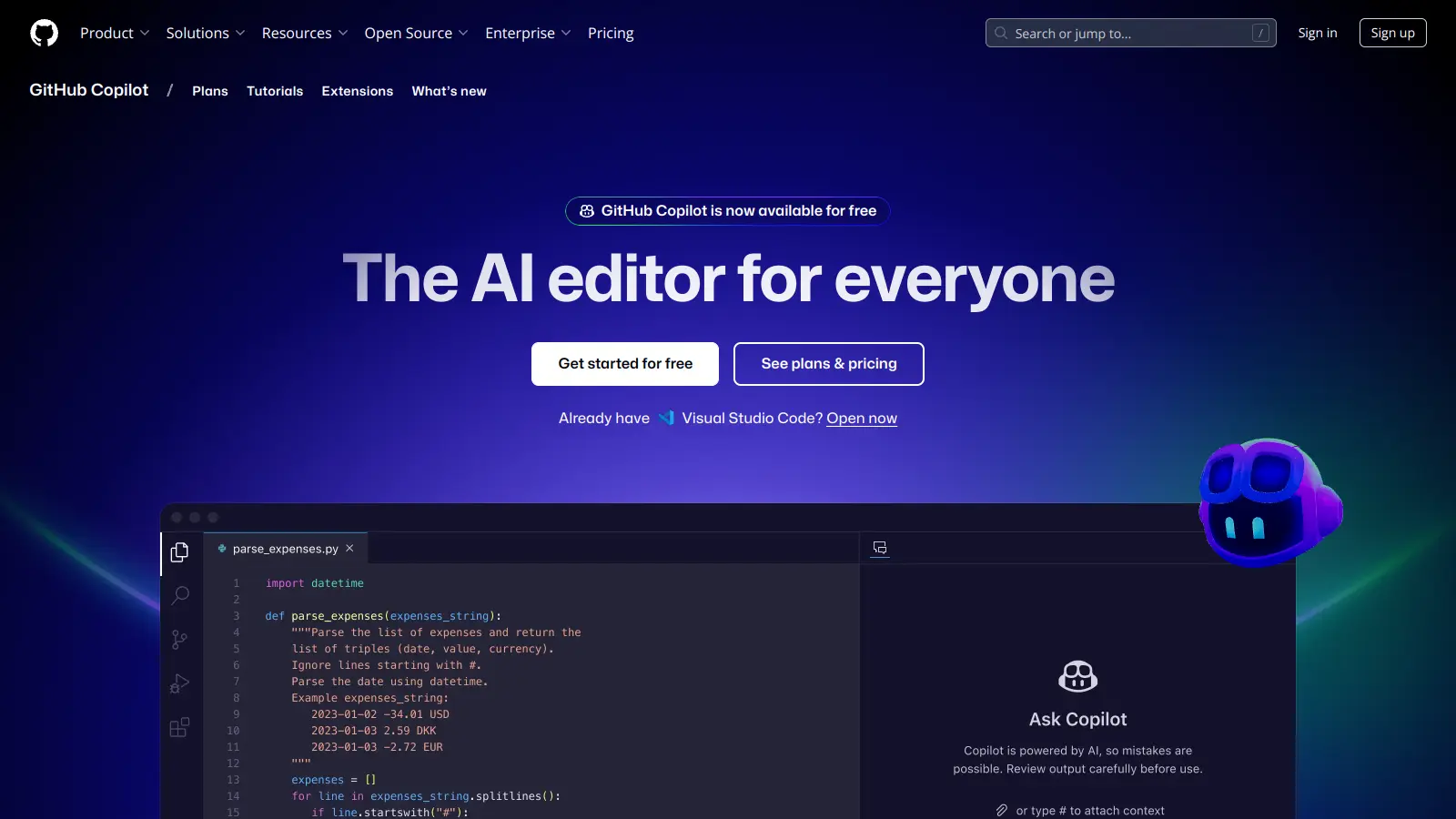
GitHub Copilot puts AI-generated code suggestions directly inside your editor as you type, trained on a vast corpus of public code and tightly integrated with VS Code, JetBrains IDEs, and Neovim. Professional developers and freelancers who work in mainstream languages like Python, TypeScript, and Java get the most out of it, particularly on repetitive work like writing tests, scaffolding boilerplate, and generating documentation. It's faster at that specific category of work than any competing tool right now, but suggestion quality drops for niche languages and domain-specific code, and the review burden doesn't disappear: you still need to read what it gives you.
The free tier covers 2,000 inline suggestions and 50 chat interactions per month, enough to assess whether it fits your workflow before spending anything. The Pro plan at $10/month or $100/year unlocks unlimited completions and is the tier most individual developers should start with. Pro+ at $39/month adds higher-end model access and more premium requests, but it's hard to justify unless you're already hitting limits on Pro. Verified students get Pro free. If you're writing code most working days in a well-supported language, try the free tier for a week and you'll know pretty quickly whether it's worth subscribing.
monthly search interest
90.5k/mo now
GitHub Copilot spiked sharply in early 2023 during the height of AI coding tool hype, then settled into a range roughly a third below that peak, where it has held fairly steadily since mid-2024. That kind of pattern usually means the novelty chasers have moved on and what's left is a real, stable user base. You're evaluating a product that has found its audience rather than one still riding a launch wave.
Whether Copilot is worth it depends almost entirely on what kind of coding you do and how often you do it. Pick your role below to see the honest breakdown.
overall sentiment
select your role to see what people like you are saying
Professional Developer
positiveIf you're in VS Code all day on mainstream languages, the $10/month Pro plan pays back quickly. Boilerplate, test generation, and documentation all get meaningfully faster. The catch: you can't accept suggestions uncritically, bugs and security gaps do slip through, and for domain-specific or niche-language work the quality ceiling arrives sooner than you'd like.
strengths
concerns
Junior Developer
positiveCopilot is genuinely useful for seeing what idiomatic code looks like in a new framework, and the free Pro plan for verified students removes any cost barrier. The real risk is using it to skip the thinking rather than check your thinking. Use it after you've attempted a problem yourself and it accelerates learning rather than replacing it.
strengths
concerns
Freelancer/Independent Developer
mixedIf you're billing consistently, the $10/month Pro plan is easy to justify through faster project turnaround and less time spent on documentation. During slow periods, that fixed cost bites. Quality also varies enough across languages that if your specialisation is outside the mainstream, you'll notice the drop. Worth trying on the free tier before committing to a subscription.
strengths
concerns
Team Lead/Engineering Manager
mixedFor teams, the value case is mostly about standardising AI tooling rather than individual productivity gains. The Business and Enterprise tiers add policy controls and usage visibility that matter at scale. The individual Pro plans don't give you that visibility. If you're evaluating team-wide rollout, the per-seat pricing at the Business tier needs to be weighed against actual adoption, not assumed usage.
strengths
concerns
“The responses were pretty harsh but it did open my eyes to some of the code I had on there.”
Reddit r/GithubCopilot
Community discussion around GitHub Copilot in late 2025 has shifted noticeably toward its code review capabilities, which weren't a headline feature at launch. A piece on Medium argues that Copilot's code review is better than what most development teams produce in practice, not because it's smarter, but because it's consistently available and paying attention, two things human reviewers frequently aren't. A thread in r/GithubCopilot reflects a similar experience: one developer described asking Copilot to review a prototype and finding the responses surprisingly harsh but genuinely useful, opening their eyes to problems in their own code. On the flip side, a thread asking whether Copilot is still worth it in 2025 reflects growing unease, particularly around the Pro+ tier at $39/month, with several developers questioning whether the quality uplift over the $10 Pro plan is meaningful enough to justify the cost gap. The recurring criticism isn't that Copilot doesn't work, it's that suggestion quality is uneven across languages and the subscription feels steep on slow months.
The $10/month Pro plan is worth it for any developer writing code most working days. At $100/year, the time saved on boilerplate, tests, and documentation comfortably justifies the spend. The $39/month Pro+ plan is a different story: it's only worth it if you need higher premium request limits or specific model access, and most developers on the Pro plan won't hit those ceilings in normal use. The free tier, with 2,000 inline suggestions and 50 chat interactions per month, is genuinely useful for occasional use or for testing before committing.
Professional developers working in popular languages who want to cut time on repetitive code and generate tests faster. Junior developers benefit from seeing best-practice patterns in real-time, and there's a free Pro plan for verified students. Freelancers with a steady client flow get clear ROI from faster project turnaround. Team leads evaluating AI tooling for their teams will find the Business and Enterprise tiers add centralised policy controls, though those aren't covered in the individual plans.
Generated code can contain bugs or security issues, so every suggestion still needs review rather than blind acceptance. Suggestion quality drops noticeably for less common languages and highly domain-specific codebases. The subscription is a fixed monthly cost even when your workload drops, which stings for freelancers in slow periods. And at the Pro+ tier, $39/month is a lot to spend when competitors offer comparable quality at lower prices.
Copilot is a plugin that lives inside your existing editor. Cursor is an editor built around AI from the ground up. If you're already comfortable in VS Code and want AI assistance without changing your workflow, Copilot is the lower-friction choice. If you want AI more deeply integrated into how you navigate, edit, and refactor code, and you're willing to switch editors, Cursor is worth trying. Cursor's free tier is more generous than Copilot's, and many developers who've tried both report Cursor's context handling feels more capable on complex multi-file tasks.
This is the real question for junior developers, and it's legitimate. Copilot is excellent at showing you what idiomatic code looks like in an unfamiliar framework, which genuinely accelerates learning. The risk is using it as a shortcut to avoid thinking through problems, which does happen. The practical advice: use it to check your direction after you've attempted something yourself, not as the first stop. The free student Pro plan means you can develop this habit at zero cost before deciding whether the paid tier is worth it once you graduate.
toolsforhumans editorial team
Reader ratings and community feedback shape every score. Since 2022, ToolsForHumans has helped 600,000+ people find software that holds up after launch. how we research →

Shopify is an e-commerce platform that enables businesses of all sizes to create, manage, and grow online stores. It offers tools for store creation, product management, payment processing, and multichannel sales, supporting both online and in-person transactions. With customizable themes, extensive app integrations, and flexible pricing plans, Shopify caters to entrepreneurs, small businesses, and global brands.
best deal
Get Shopify Basic for $29/month when billed annually (regularly $39/month)

Wix is a website builder that lets individuals and businesses create professional websites without coding. It offers drag-and-drop editing, AI-powered design tools, templates, and features for e-commerce, SEO, and marketing. Pricing ranges from free to enterprise-level, covering everything from personal portfolios to online stores.
best deal
Get 50% off Wix annual plans, with Light Plan starting at $17/month

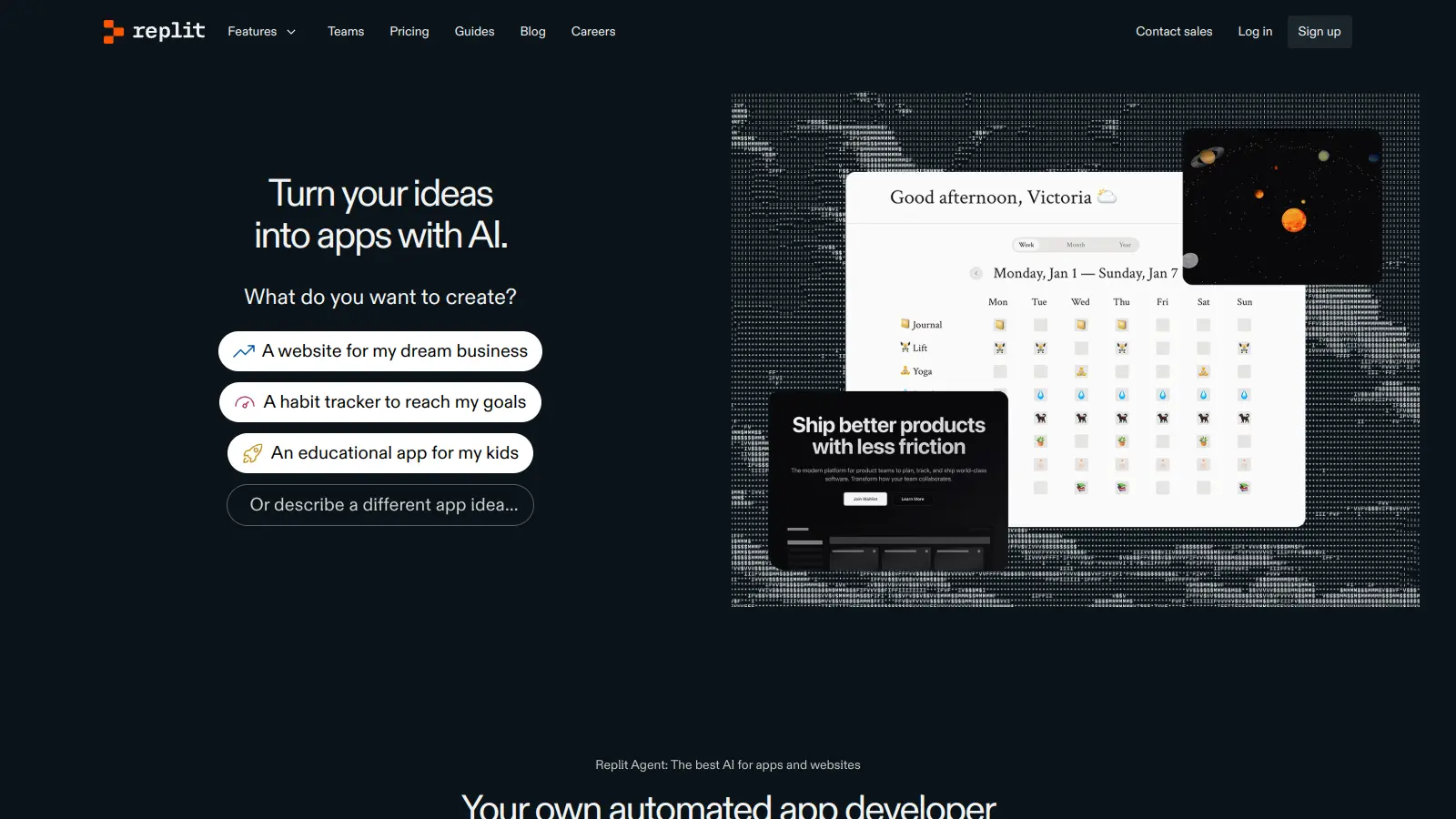
Replit is an AI-powered cloud-based integrated development environment (IDE) that supports over 50 programming languages, offering real-time collaboration, AI assistance through Replit Agent that can build complete applications from natural language prompts, and direct application deployment. It provides a platform for developers of all levels, enabling coding, project sharing, and hosting directly from a web browser with pricing tiers from free to enterprise-level plans.
best deal
Teams users automatically upgraded to Pro at no additional cost for remainder of term; yearly Teams subscribers get $100 monthly credits free until term ends

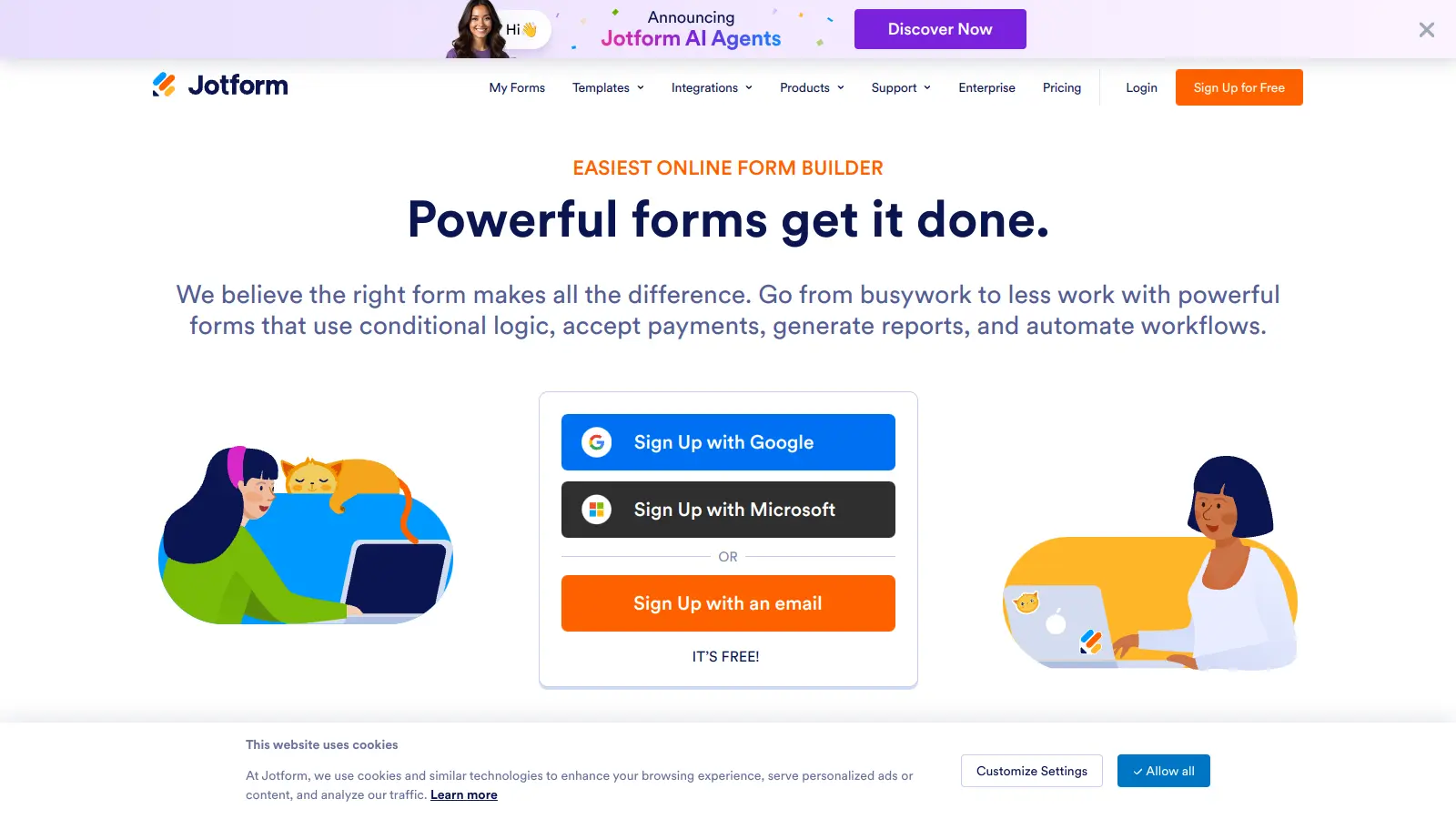
Jotform is an AI-powered form builder that enables individuals and businesses to create, customize, and manage digital forms, apps, and workflows without coding skills. It offers a drag-and-drop interface, 10,000+ templates, payment integrations, AI agents for customer support, and connects with over 1,000 apps. The platform provides conditional logic, form analytics, and robust security, making data collection and workflow automation simple across industries.
best deal
Try the Starter plan for free with 5 forms, 100 monthly submissions, and all standard features. Nonprofits and educational institutions get 50% off paid plans.

Dora is a no-code AI platform that enables users to create dynamic, 3D animated websites without coding knowledge. It offers AI-driven design assistance, seamless 3D integration, and a user-friendly interface similar to Figma. The tool allows for easy customization, responsive design, and incorporates advanced features like automated design tasks and 3D model incorporation, making web design more accessible to beginners and professionals alike.
best deal
Try Dora AI Free - Unlimited projects with AI website building, 3D animation, and responsive design.

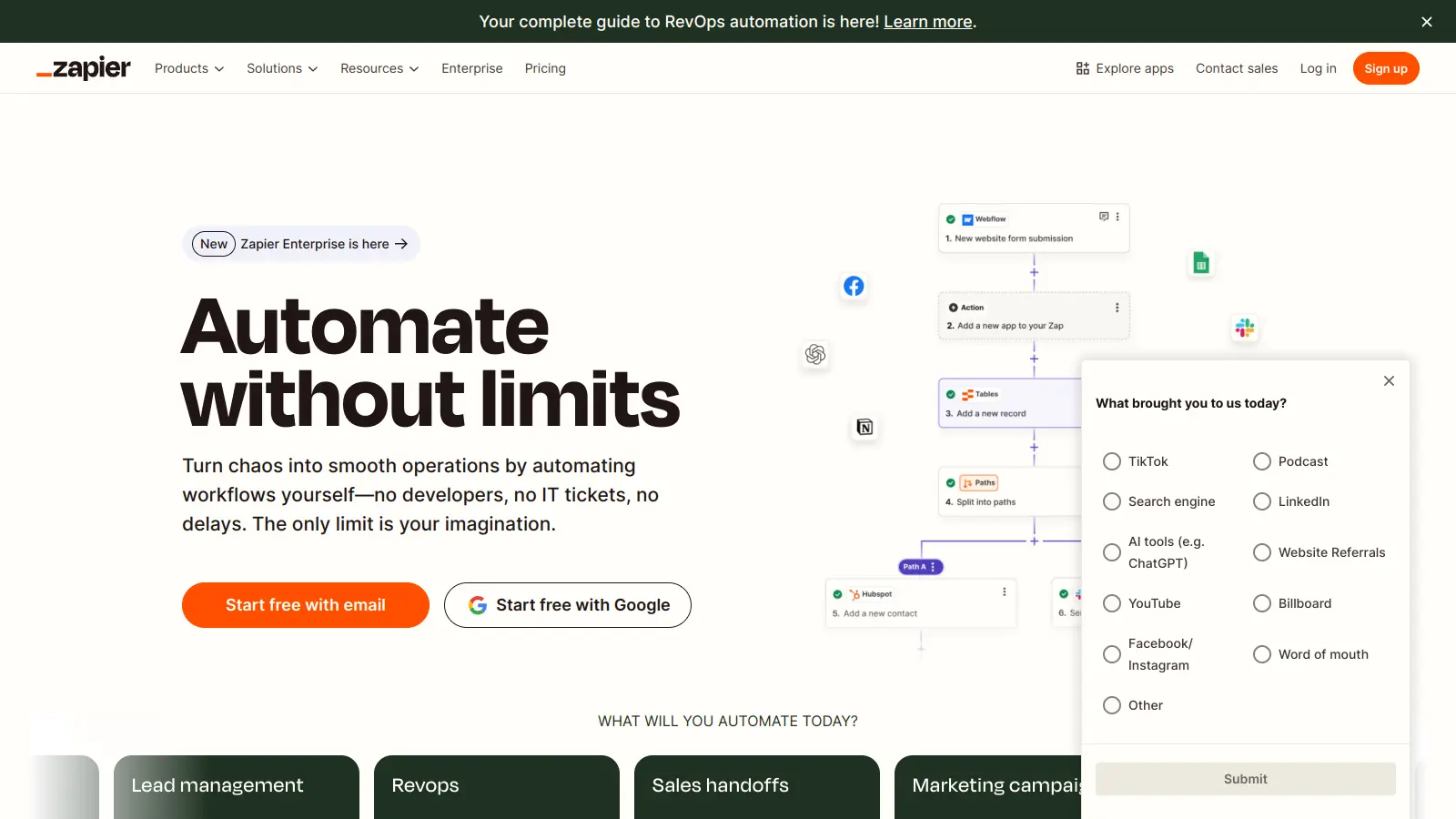
Zapier is a no-code automation platform that connects over 8,000 apps, enabling users to create automated workflows called "Zaps" without coding. It integrates different services, automating repetitive tasks through customizable triggers, multi-step processes, and real-time data transfer. Pricing ranges from free to enterprise tiers.
best deal
Start automating with unlimited Zaps and 100 monthly tasks free – no credit card needed