tools for
humans

Pendo reviews — what users really think

last reviewed 24 march 2026
how we review

We start with direct ratings from our readers, then look at what real users are saying in practitioner forums and community spaces. We pair that with search demand data and profession-level persona analysis.

full methodology →

Editorial note: this was originally published in august of 2024

quick take

  • Best for: mid-market product teams needing behavior analytics and no-code onboarding guides
  • Skip if: you're a startup with under 500 MAUs or need predictable flat pricing
  • £Best value: Free tier for early validation; Core plan only if you'll use session replays and segmentation together
½3.8/ 5 — editorial rating

based on real user feedback, community sentiment, pricing value, and fit for target audience. see our full methodology

used Pendo? we'd love to know your thoughts

reader ratings shape our score

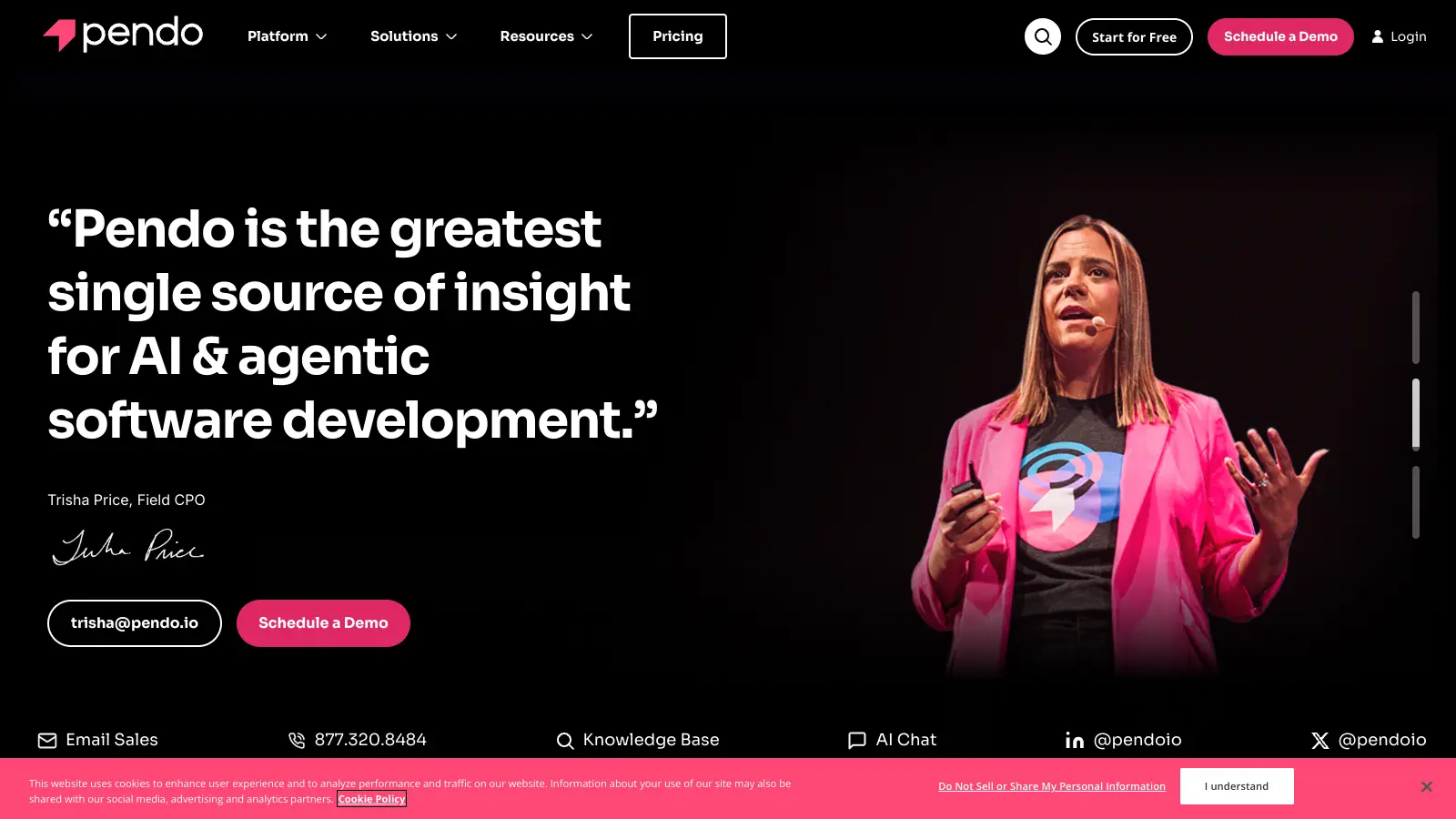
Pendo helps businesses understand how users interact with their products while providing tools to enhance the product experience. This platform combines analytics, in-app guidance, user feedback collection, and product planning in one solution.

The software tracks user behavior across web, mobile, and AI interfaces. Product teams can create customized guides and walkthroughs without coding, making it easier to onboard new users and highlight features. The platform includes AI-powered features like conversational Agent Mode, which uses Model Context Protocol for querying insights and automating tasks.

The platform includes tools for gathering feedback through surveys and polls, plus options for roadmap planning based on user data. Session replays let you watch how users navigate your product, and AI analyzes feedback to identify themes and summarize NPS data.

Pendo offers several pricing tiers, starting with a free plan for up to 500 monthly active users. Paid plans scale based on user count and feature requirements, with enterprise options available for larger organizations. Entry-level plans provide core functionality, but advanced features like session replay and journey orchestration require higher-tier subscriptions.

Common use cases include product analytics, user onboarding, feature adoption tracking, and collecting customer feedback. The platform integrates with tools like Salesforce, Slack, and Segment. Organizations building AI agents can use Pendo to monitor agent performance and validate ROI.

how popular is Pendo?

monthly search interest

12.1k/mo now

09.9k19.8k30k2023202420252026
peak interest22k/moMar 2025
searches now12k/moFeb 2026
1-month change18%vs prev month

Pendo's search volume has been remarkably stable for three years, bouncing in a narrow band between 14,800 and 22,200 per month with no sustained growth trend. The recent dip to 12,100 in late 2025 and early 2026 is the lowest point in the dataset, suggesting the product analytics category is getting more competitive and Pendo may be losing mindshare to newer entrants. It's an established tool with a stable core user base, but the declining tail means you're evaluating a maturing platform, not a growing one.

who is Pendo for?

Whether Pendo's worth it depends heavily on your role and what you're actually trying to measure. Pick your role below to see the honest breakdown.

overall sentiment

select your role to see what people like you are saying

Product Manager

positive

If you're making roadmap calls based on gut feel or sparse data, Pendo's session replays and feature adoption dashboards will change how you work. The analytics are genuinely deep. The friction is the cost: as your MAU count climbs, the pricing climbs with it, and the advanced segmentation features take real time to learn properly.

strengths

  • Session replays and heatmaps reveal actual user navigation patterns and friction points
  • Integration with existing tools reduces implementation burden
  • Analytics dashboards clearly show feature adoption rates and drop-off points
  • Reduces reliance on assumptions for product roadmap prioritization

concerns

  • Steep learning curve for advanced analytics and segmentation features
  • Pricing structure makes scaling costly as product usage grows
  • Limited customization options for unique analytics workflows

what users are saying

The jump from Free to paid feels sudden for scaling startups, and once you move to paid, costs can reach $20,000+ per year before you've unlocked the features that actually justify the price.

Across professional review platforms, Pendo sits at strong ratings with over 1,500 reviews skewing heavily toward four and five stars. The most consistent praise centres on the no-code in-app guide builder and the quality of behavior analytics, with product teams specifically calling out session replays and feature adoption tracking as genuinely useful for roadmap decisions. The Gartner Peer Insights community similarly positions Pendo positively across both the digital adoption and product analytics markets, with reviewers noting the platform earns its place in enterprise product stacks. The main complaints that surface repeatedly are pricing opacity, a steep learning curve for advanced segmentation, and performance degradation on high-traffic products. Cost is the loudest theme: users report the Base plan quickly balloons into thousands of dollars per month as monthly active user counts grow, and the jump from Free (capped at 500 MAUs) to paid feels sudden for scaling startups.

Our take: Pendo is a genuinely capable product analytics and adoption platform, but it's priced and structured for mid-market and enterprise teams, not for startups testing the waters. The free tier is useful for very early validation, and the analytics quality at the Core and Ultimate tiers is hard to argue with. But if you're at a smaller company watching your MAU count climb toward the pricing cliff, you'll want to model out costs carefully before committing. WalkMe covers similar digital adoption territory and is worth comparing at the enterprise end; for leaner teams, UserGuiding or Appcues will get you in-app guides at a fraction of the cost. Don't sign a contract until you've had a direct pricing conversation and know exactly what your bill looks like at 2x your current user volume.
features

  • Product Analytics: Track how users interact with your software through data visualization, user paths, retention metrics, and product engagement across web, mobile, and AI interfaces.
  • In-App Guides: Create no-code guides like tooltips and banners targeted to specific user segments without requiring developers. AI can help you create and localize guides using text prompts.
  • Session Replays: Watch recordings of user sessions to see exactly how people navigate your product, with the ability to segment replays by specific pages, users, or accounts to identify friction points.
  • AI-Powered Insights: Get automatic trend detection, anomaly alerts, and autonomous insights generated by Pendo AI that surface patterns in user behavior without manual analysis.
  • User Feedback: Collect user insights through in-app polls, NPS surveys, and feedback modules. AI analyzes responses to identify themes, suggest improvements, and summarize sentiment.
  • Product Roadmapping: Prioritize product initiatives by gathering user feedback, rating feature impact and effort, and sharing developments with your customer base.
  • Agent Mode: Use conversational AI with Model Context Protocol to query insights, automate workflows, and complete tasks without manual data exploration.
  • Pendo Predict: Model churn risk and expansion opportunities by integrating third-party data sources to identify accounts that need attention or are ready to grow.

pricing

  • Free Plan offers basic product analytics, in-app guides, branded NPS surveys, and roadmaps for up to 500 monthly active users with one-year data retention, SSO, and security compliance at no cost.
  • Base Plan provides custom monthly active user tracking, one core integration, product analytics, in-app guides, NPS surveys, and roadmaps with custom pricing based on usage. User reports suggest costs ranging from $7,000 to $35,000/year depending on MAU count.
  • Core Plan includes everything in Base plus session replays, with custom pricing requiring sales team consultation.
  • Pulse Plan adds white-labeled NPS and product discovery features on top of Core Plan capabilities, with custom pricing available through the sales team.
  • Ultimate Plan offers everything in Pulse plus journey orchestration, data sync, and advanced in-app guides, representing the most comprehensive tier with custom enterprise pricing.
  • Pricing considerations include annual costs typically ranging from $25,800 to $132,400 depending on scale and features, with multi-year contract discounts ranging from 5% to 20%, and additional expenses for essential integrations not included in lower-tier plans. A 30-day free trial is available for paid plans.

frequently asked questions

The Free plan is worth using if you have under 500 MAUs and need basic analytics and in-app guides to validate product decisions early. Once you move to the Base or Core plans, the custom pricing model means costs can reach $20,000+ per year depending on MAU volume, and that's a meaningful commitment. It's worth it for mid-market product teams who'll actually use session replays, segmentation, and NPS together. If you only need one or two of those features, you're almost certainly overpaying.

Product Managers at B2B SaaS companies get the clearest return, especially those managing complex products where understanding feature adoption and drop-off points directly informs roadmap decisions. Customer Success Managers at companies with high onboarding friction also get strong value from the in-app guides. Executives use it for board-level product health metrics, though they're more likely to feel the pricing pain than anyone.

First, the pricing structure is genuinely opaque. There are no public prices beyond the Free tier, and costs scale aggressively with MAU growth, which makes budgeting unpredictable. Second, the advanced analytics and segmentation features have a real learning curve. Getting full value out of funnels, paths, and custom dashboards takes time and sometimes dedicated admin. Third, performance on high-traffic products can suffer, particularly with in-app guides loading slowly or inconsistently.

Both target digital adoption at the enterprise end, but WalkMe has historically focused more on employee-facing software and change management, while Pendo is stronger for customer-facing product analytics. If you're a product team trying to understand user behavior and reduce churn in a SaaS product, Pendo's analytics depth gives it the edge. If you're an IT or HR team rolling out internal tools and need guided workflows for enterprise software, WalkMe is the more natural fit. For most product teams reading this, Pendo wins on analytics breadth.

Yes, and that's one of the clearest reasons CS teams adopt it. The in-app guide builder is genuinely no-code: you can create tooltips, walkthroughs, and banners targeted to specific user segments without filing a ticket. The caveat is that initial installation still requires a developer to add the Pendo snippet to your product. After that, day-to-day guide creation and NPS survey management is self-service.

tools for
humans

toolsforhumans editorial team

Reader ratings and community feedback shape every score. Since 2022, ToolsForHumans has helped 600,000+ people find software that holds up after launch. how we research →

other tools to check out

SurveyMonkey screenshot
online buzz165k
trend (1M)steady
3.5based on real user feedback, community sentiment, pricing value, and fit for target audience. see our full methodology

SurveyMonkey

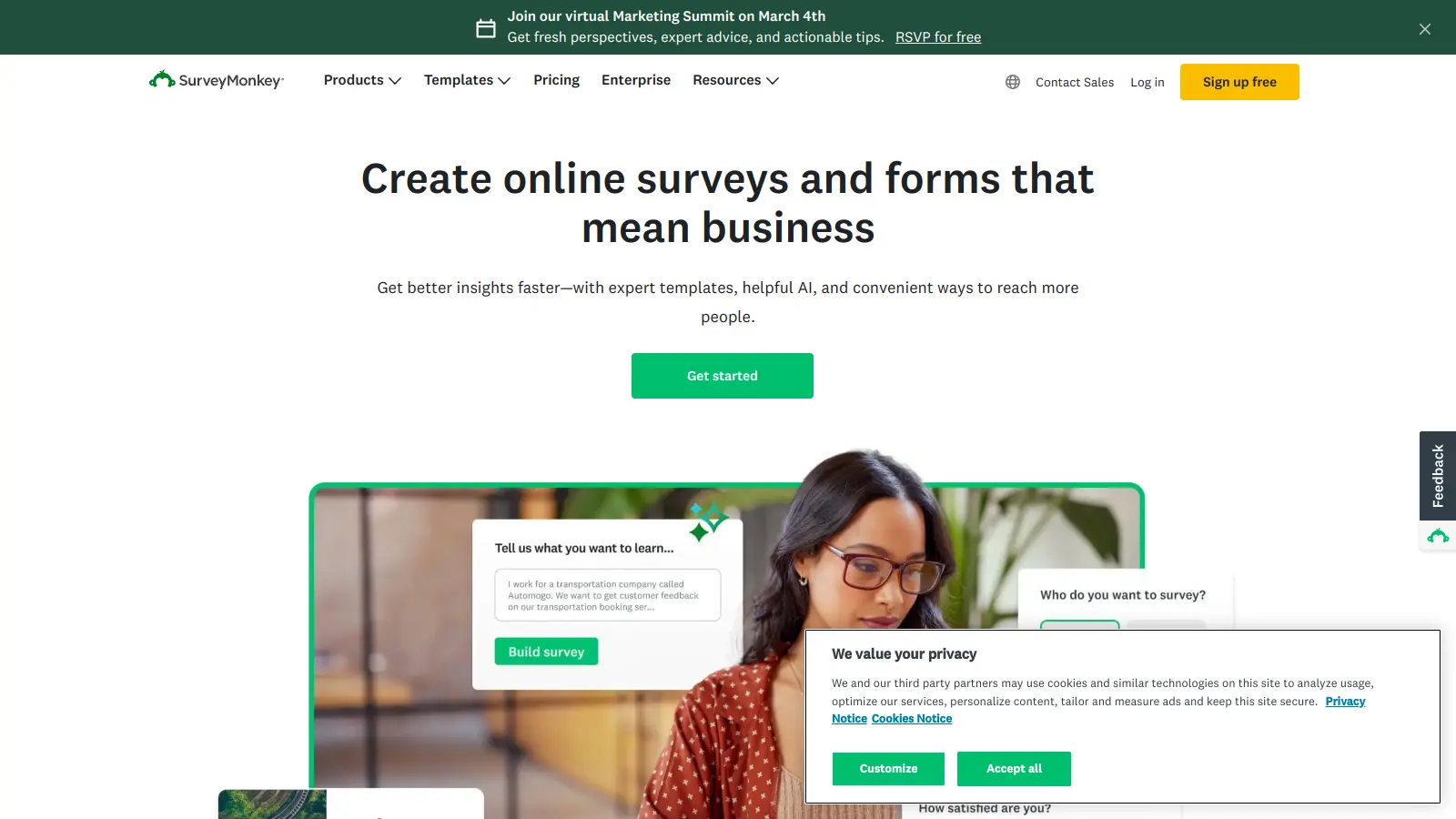
SurveyMonkey is an online survey platform that enables users to create, distribute, and analyze surveys with customizable forms and AI-powered tools. It offers multiple question types, survey templates, advanced logic, and analytics tools. Used by individuals and enterprises, SurveyMonkey provides integrations with other tools and flexible pricing plans for research and feedback collection.

best deal

Try SurveyMonkey's Basic Plan free – Create unlimited surveys with up to 10 questions each

Qualtrics screenshot
online buzz135k
trend (1M)23%
3.5based on real user feedback, community sentiment, pricing value, and fit for target audience. see our full methodology

Qualtrics

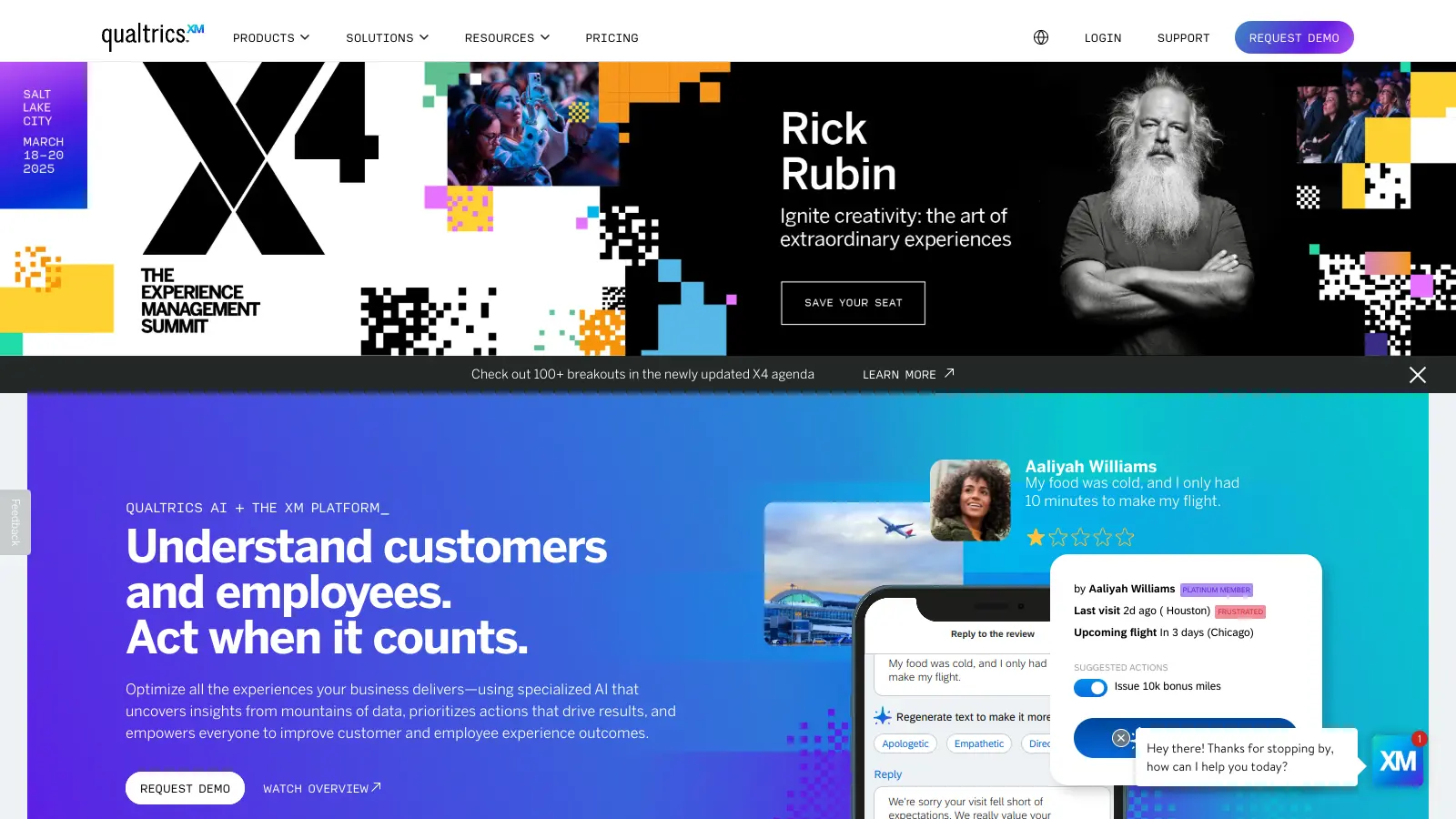
Qualtrics is an AI-powered experience management platform for creating, distributing, and analyzing surveys. It uses machine learning, natural language processing, and generative AI to collect and analyze feedback across surveys, video, calls, and chats. Features include customizable surveys, AI-driven analytics, and enterprise integrations.

best deal

Start Free Now: Get 500 survey responses with basic features on a single-user account

Typeform screenshot
online buzz61k
trend (1M)18%
3.5based on real user feedback, community sentiment, pricing value, and fit for target audience. see our full methodology

Typeform

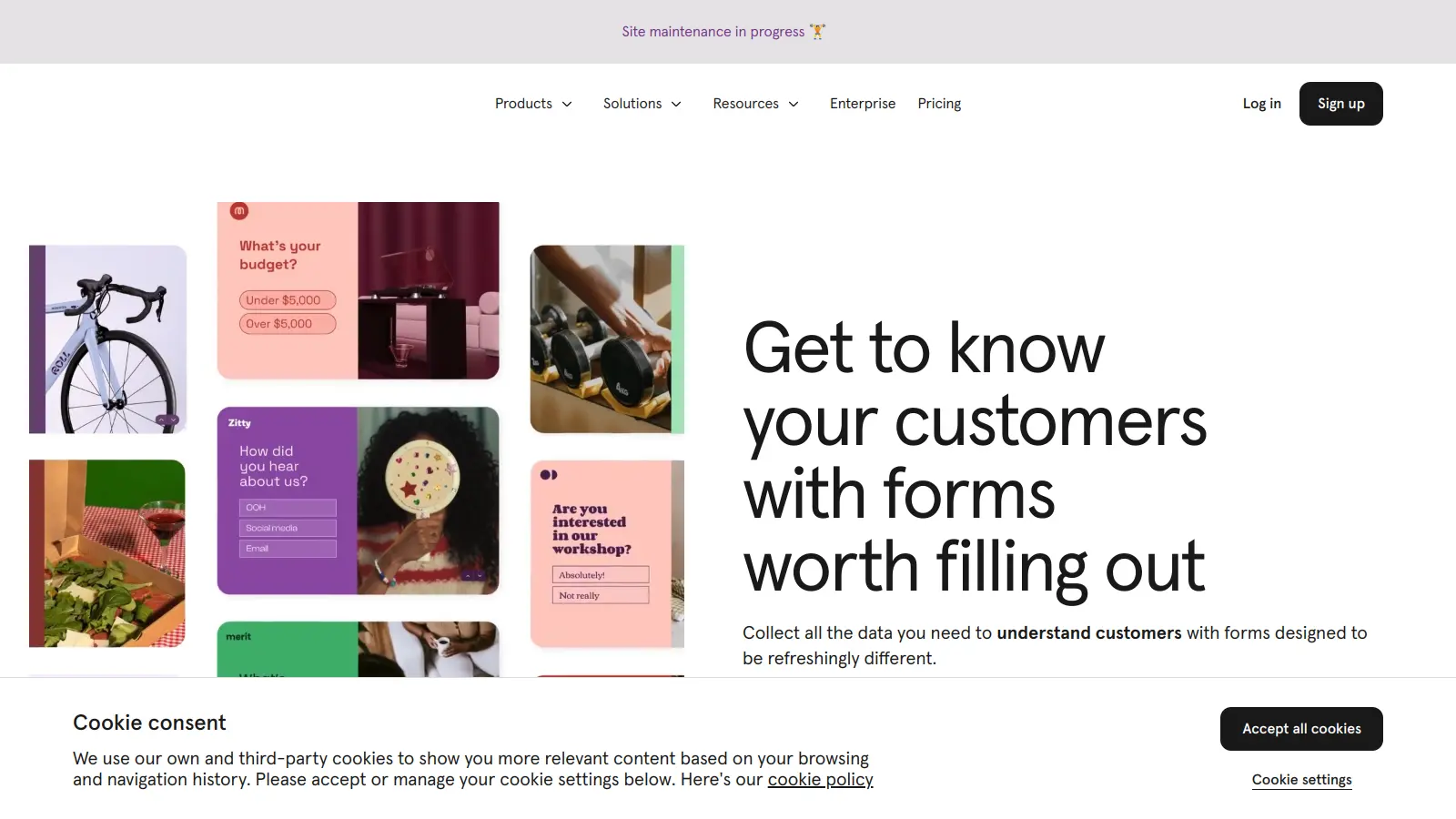
Typeform is an AI-powered form builder for creating interactive, conversational forms and surveys. It presents questions one at a time, leading to higher engagement and completion rates. With AI-generated form building, customizable templates, integrations with 500+ apps, and AI-powered insights that analyze responses, Typeform provides a solution for collecting data across industries.

best deal

Annual plans save 16% compared to monthly billing. Free plan available with 10 responses per month.

Heap screenshot
online buzz41k
trend (1M)18%
3.8based on real user feedback, community sentiment, pricing value, and fit for target audience. see our full methodology

Heap

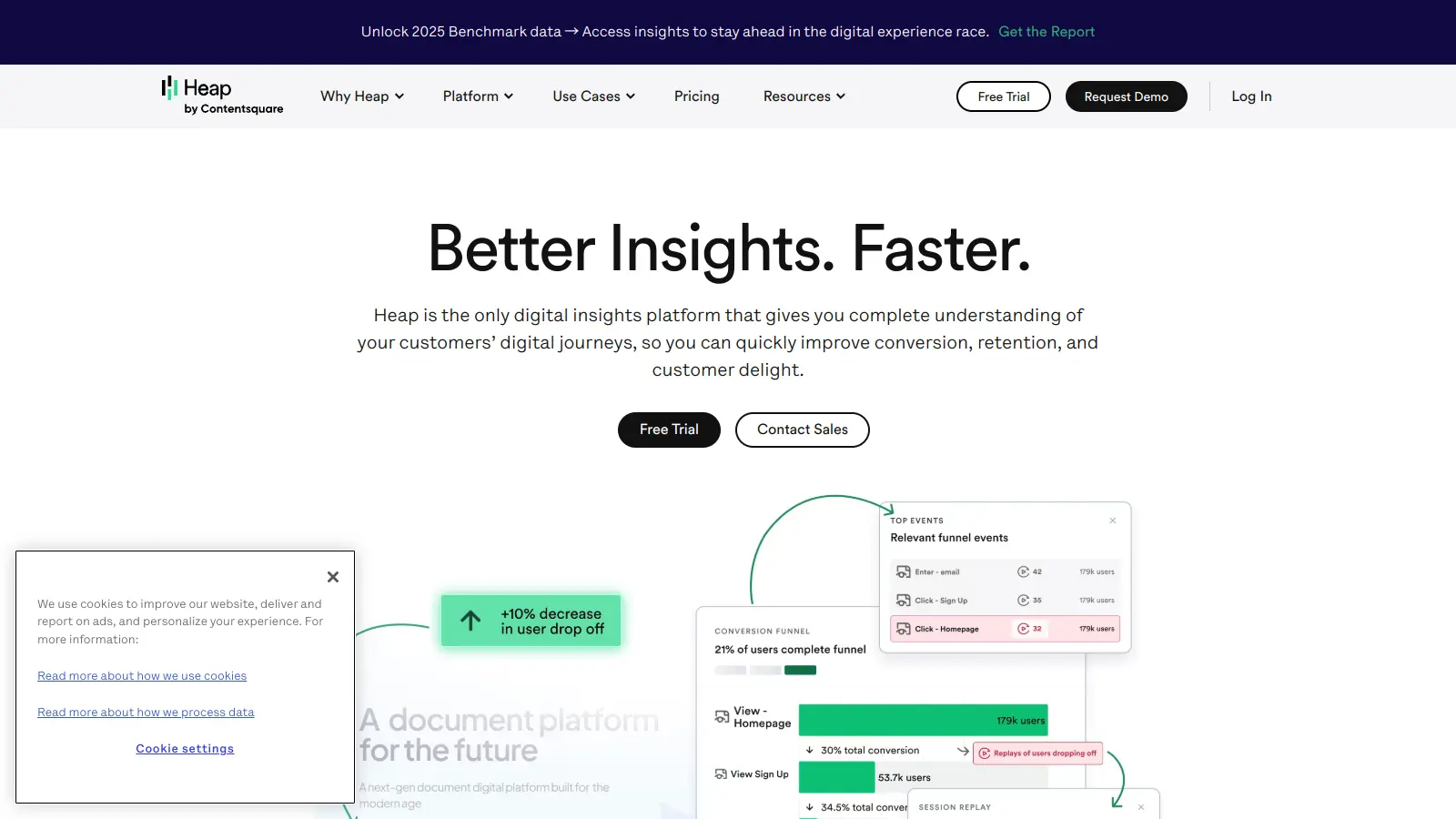
Heap is a digital insights platform that automatically captures all user interactions on websites and mobile apps to analyze user behavior, optimize funnels, and uncover insights. It uses AI-powered tools like CoPilot and Sense for natural language queries, plus data science features that detect friction points, helping product, marketing, and data teams make decisions without manual tracking setup.

best deal

Try Heap Free: Track 10,000 sessions/month with automatic capture, retroactive analysis, and 6 months data history (no credit card required)

Medallia screenshot
online buzz15k
trend (1M)steady
3.5based on real user feedback, community sentiment, pricing value, and fit for target audience. see our full methodology

Medallia

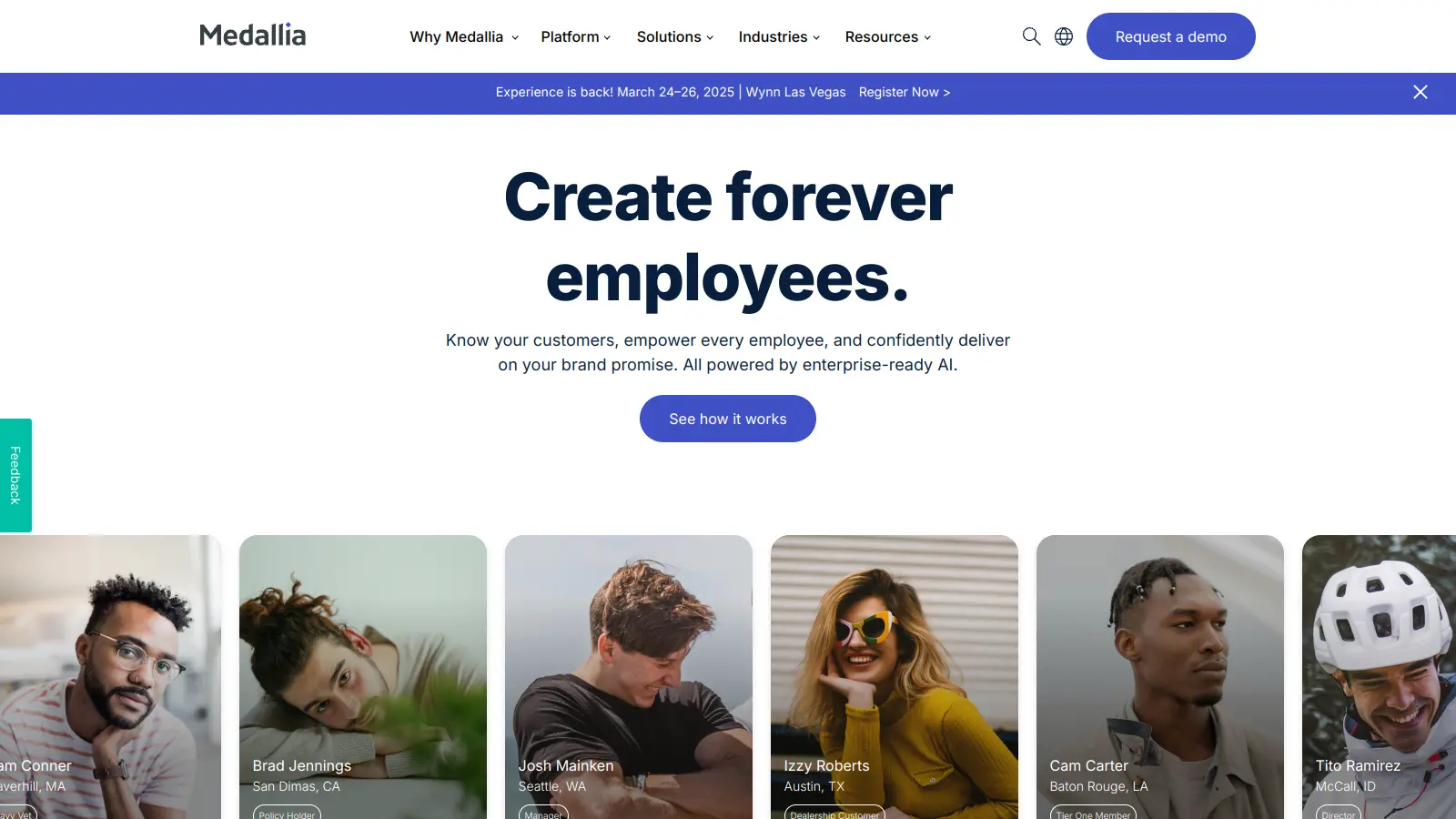
Medallia is an enterprise experience management platform that captures and analyzes customer and employee feedback across multiple channels. Using AI-driven analytics, it helps businesses improve satisfaction, loyalty, and performance by providing real-time insights and actionable recommendations.

best deal

Get your personalized enterprise quote and see Medallia in action

Mixpanel screenshot
online buzz8.1k
trend (1M)45%
3.8based on real user feedback, community sentiment, pricing value, and fit for target audience. see our full methodology

Mixpanel

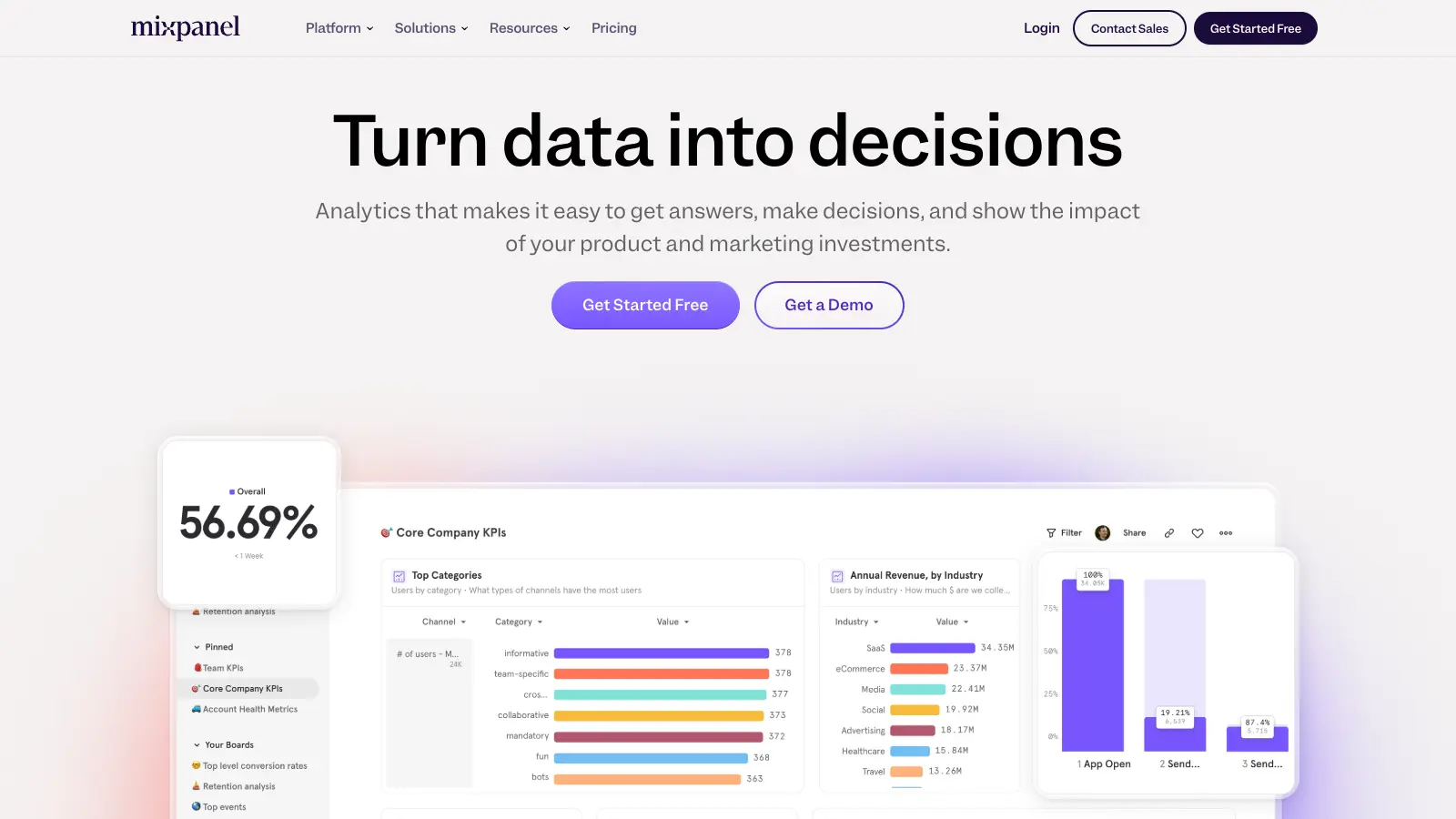
Mixpanel is a product analytics platform that helps businesses understand user interactions through event tracking, user segmentation, funnel analysis, retention analysis, A/B testing, and real-time reporting with AI-powered natural language queries. It's built for product teams who need to make data-driven decisions about user behavior, engagement, and conversion rates.

best deal

Start Free with 1M Monthly Events - Get Unlimited Reports & Custom Dashboards